
Overview
Micron Technology, the only U.S.-based producer of high-bandwidth memory, forecast first-quarter revenue above Wall Street estimates as demand for memory used in artificial intelligence infrastructure continues to exceed available supply.
The company expects fiscal first-quarter revenue of about $61.5bn, plus or minus $1.5bn, compared with the $57bn average analyst estimate compiled by LSEG. Adjusted earnings are expected at $38.15 per share, plus or minus $1, ahead of the $35.40 consensus estimate.
Micron also said customers have increased financial commitments under long-term supply agreements to $32bn from $22bn reported in June. Most of those commitments are backed by cash deposits, according to CEO Sanjay Mehrotra.
Remaining performance obligations under the agreements rose to approximately $150bn, up from about $100bn in the previous quarter. The figure represents contracted revenue Micron expects to recognize in future periods.
We expect memory and storage supply-demand conditions to be much tighter in fiscal 2027 and 2028 than they were in 2026.
Finance chief Mark Murphy said Micron expects fiscal 2027 to set another company record, with revenue increasing sequentially in each quarter.
Micron benefits from AI-driven HBM demand
Demand for high-bandwidth memory has accelerated as Nvidia, AMD and other chipmakers require larger amounts of memory for processors used in AI models and data-center workloads. HBM combines multiple layers of DRAM to provide much higher memory bandwidth than conventional designs.
Micron is one of three large suppliers competing in the global HBM market alongside South Korea’s SK Hynix and Samsung Electronics.
Micron currently has the smallest market share among the three, but demand has been strong enough to leave its available production capacity heavily committed.
Mehrotra said the company has secured agreements covering most of its fiscal 2027 HBM output. Micron also plans to increase capital spending in fiscal 2027 beyond previous plans as it adds manufacturing capacity.
The company is working with Nvidia on what Mehrotra described as the industry’s first custom HBM implementation. He also said Micron has a strong development roadmap for future HBM products.
Fourth-quarter DRAM revenue reached $39.8bn, up 343% from a year earlier and representing 73% of total company revenue. The increase illustrates how strongly memory demand has shifted toward AI infrastructure and other high-performance computing applications.
Micron reports $54.23bn quarterly revenue
Fiscal fourth-quarter revenue rose to $54.23bn from $11.32bn a year earlier, beating the $51.07bn analyst estimate. Adjusted earnings reached $33.42 per share, above expectations of $31.61.
Net income climbed to $37.7bn, or $32.87 per share, from $3.2bn, or $2.83 per share, in the same quarter last year.
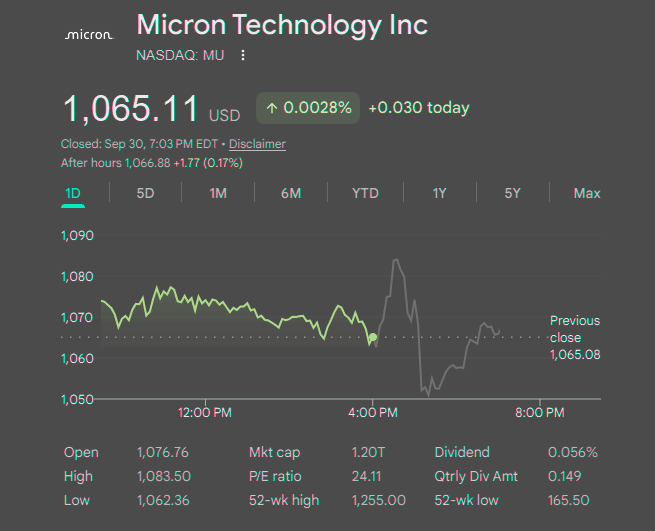
Micron shares have more than tripled during 2026 and have gained more than 500% over the past 12 months. The company’s market capitalization has moved above $1.2tn as investors price in continued growth from AI-related memory demand.
The stock initially gained more than 1% in extended trading following the results before giving back the increase and trading slightly lower.
Technology companies are spending heavily on the computing infrastructure required for generative AI. Amazon, Alphabet and other large technology groups are expected to spend more than $730bn on AI infrastructure this year, increasing demand for processors, memory and data-center equipment.
The pressure on memory supply has also contributed to higher component prices across consumer electronics. Memory costs affect products including laptops, tablets and other devices that rely on DRAM and storage components.
Micron expands U.S. manufacturing investment
Micron increased its planned U.S. investment to more than $250bn through 2035 after customer orders exceeded available manufacturing capacity.
The company is developing new production sites for advanced memory, including two large manufacturing campuses. Construction began in January on its project in Clay, New York, while a new fabrication facility in Boise, Idaho, is scheduled to begin production next year.
SK Hynix and Samsung are also expanding HBM manufacturing capacity in South Korea as the three producers respond to demand from AI chipmakers and cloud providers.
Hendi Susanto of Gabelli Funds described Micron’s quarterly performance as another strong earnings beat and forecast increase. He said he had not seen evidence suggesting the current memory cycle was moving toward a downturn in the near term.
Micron’s results and forecast provide further evidence that spending on AI infrastructure remains strong.
Micron expects tighter memory supply conditions to continue through fiscal 2027 and 2028, while long-term customer commitments and contracted revenue have increased sharply. With most of its 2027 HBM production already covered by agreements, the company is raising investment to bring additional capacity online.