Follow Beinsure
SpaceX shares extended their gains after Morgan Stanley analyst Adam Jonas repeated his Outperform rating and $300 price target, arguing investors have only a few weeks to buy before several expected business and launch milestones.
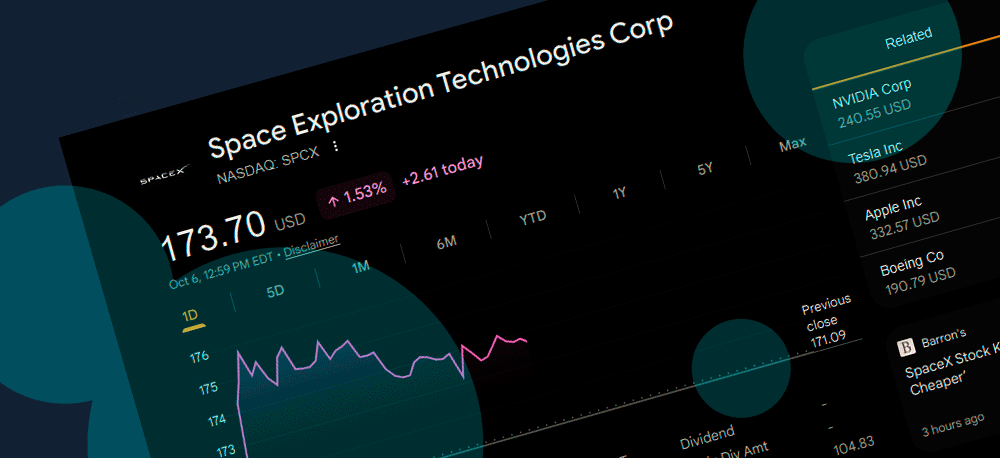
The stock rose more than 7% on Monday and added roughly 1.5% in midday trading Tuesday, putting it near its highest closing level since June. Shares traded around $174 during the session, continuing the rally sparked by Jonas’s research note, titled SPCX $159: Cheap and Getting Cheaper.
“We think that over the next few weeks, ahead of Starship Flight 15, investors can take advantage of a unique opportunity to buy shares that look unusually cheap,” Jonas wrote.
His call follows SpaceX’s Flight 14 test, when Starship reached low Earth orbit for the first time and deployed Starlink satellites. Morgan Stanley expects further Starship progress over the coming months to affect how investors value the company.
Jonas is also assigning more importance to SpaceX’s work around AI computing and chipmaking. He said future AI product releases, additional compute contracts and Starship progress could move the stock closer to Morgan Stanley’s $300 target.
Morgan Stanley is using a sum-of-the-parts valuation, assessing SpaceX’s businesses separately before combining them into an overall estimate.
Jonas argues the market is already assigning substantial value to the company’s launch and satellite connectivity operations, while giving little value to its compute, chipmaking and other AI-related activities.
That gap sits at the centre of the bank’s bullish case. Jonas said valuing SpaceX only as a telecommunications company through Starlink, or only from an AI compute perspective, makes the shares look expensive because both approaches miss other parts of the business.
We believe future AI product releases, Starship progress, and additional neocloud contracts showing continued pricing around $30-50/watt are all upside-skewed catalysts that can push the stock closer to our $300/share price target.
He also argued many investors struggle to assess SpaceX because its businesses require knowledge across aerospace engineering, satellite communications and computing economics. According to Jonas, relatively few investors are positioned to judge issues such as Starship’s heat shield, full-flow staged combustion engines and future compute pricing.
Space stocks rise alongside SpaceX
The buying also spread to other publicly traded space companies Tuesday. AST SpaceMobile shares gained about 8%, while Rocket Lab climbed roughly 5%, both outperforming SpaceX during morning trading.
The Procure Space ETF, which holds all three companies, rose around 2%. The SPDR S&P 500 ETF Trust was up about 0.6%, leaving the space group ahead of the broader market during the session.
AST SpaceMobile traded around $63.34 during the move, while Rocket Lab was near $76.31. SpaceX traded around $174.67, according to the cited market data.
Morgan Stanley’s note focused primarily on SpaceX, though stronger trading across the sector suggests investors were also buying other commercial space companies. The biggest near-term event in Jonas’s thesis is Starship Flight 15, which he sees as one of the milestones capable of changing investor expectations.
A delay to that test would weaken some of the urgency behind the call. Progress in Starship, AI products and compute contracts would support Morgan Stanley’s argument that investors aren’t yet assigning enough value to several parts of SpaceX’s business.
For Jonas, the current setup amounts to a narrow buying window. His thesis depends on investors beginning to value SpaceX as more than a launch and connectivity company, with AI computing, chipmaking and future Starship missions carrying a larger share of the valuation.