Overview
- Boeing Q2 2026 earnings: Revenue improves, but profitability remains weak
- Boeing 737 MAX production and certification remain critical
- Boeing’s $715 bn backlog supports long-term growth
- Boeing stock price targets: Analysts forecast significant upside
- Boeing stock forecast: Key price levels and Q3 earnings outlook
- Boeing stock forecast for 2027 and 2028
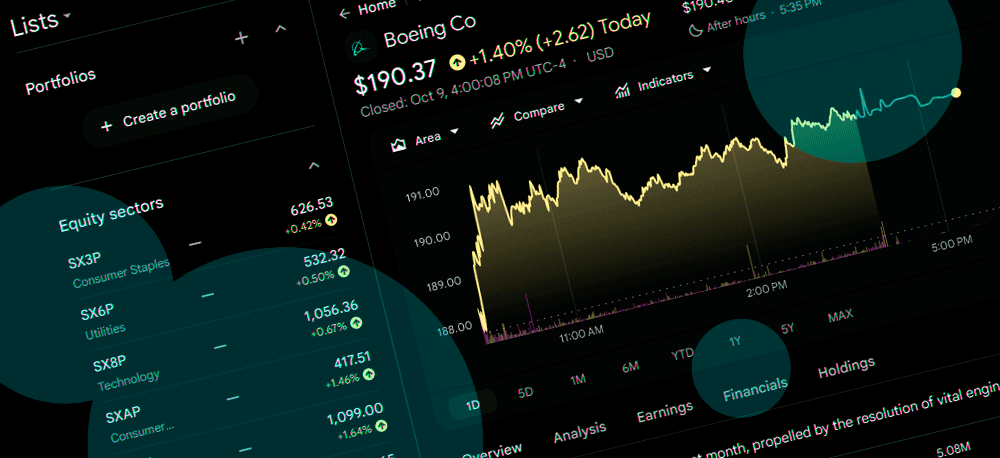
Boeing (NYSE: BA) shares ended October 9, 2026, near $190.37, remaining approximately 12.3% below their December 2025 closing price of $217.12. Despite improving commercial aircraft deliveries, positive quarterly free cash flow and major defense contract awards, investors remain concerned about production stability, certification delays and the pace of financial recovery.
- Boeing’s Q2 revenue increased 8% to $24.56 bn, while free cash flow turned positive at $631 mn. Its record $715 bn backlog supports future revenue, although manufacturing challenges and debt remain significant.
- The October 27 earnings report will test whether improving aircraft deliveries, 737 MAX production and defense contracts can support sustained profitability and stronger cash generation.
Wall Street maintains a favorable outlook. The average 12-month Boeing stock price target stands at $272.44, implying approximately 43% upside. However, achieving that valuation will depend on Boeing converting its $715 bn backlog into profitable aircraft deliveries while reducing debt and manufacturing costs.
Boeing Q2 2026 earnings: Revenue improves, but profitability remains weak
Boeing reported second-quarter revenue of $24.56 bn, an 8% year-over-year increase, supported by higher commercial aircraft deliveries and improving production performance.
GAAP operating income reached $156 mn, compared with a $176 mn operating loss a year earlier. The company reported a net loss of $428 mn, narrower than the $612 mn loss in Q2 2025. GAAP loss per share improved to $0.67 from $0.92, while the core loss per share of $0.76 missed analyst expectations.
Commercial Airplanes revenue increased 8% to $11.75 bn, although the division still recorded an operating loss of $322 mn. Boeing delivered 171 aircraft during the quarter, up 14% year over year.
Defense, Space & Security generated $7.48 bn in revenue but reported a $15 mn operating loss, partly reflecting additional charges related to the VC-25B presidential aircraft program.
Boeing Q2 2026 financial results
| Financial metric | Q2 2026 | Q2 2025 |
| Revenue | $24.56 bn | $22.75 bn |
| Operating income (loss) | $156 mn | -$176 mn |
| Net loss | -$428 mn | -$612 mn |
| GAAP EPS | -$0.67 | -$0.92 |
| Operating cash flow | $1.36 bn | $227 mn |
| Free cash flow | $631 mn | -$200 mn |
| Aircraft deliveries | 171 | 150 |
Global Services remained Boeing’s strongest earnings contributor, generating $968 mn in operating profit on revenue of $5.34 bn, with an 18.1% operating margin.
Boeing’s cash flow performance improved considerably. Operating cash flow reached $1.36 bn, while free cash flow turned positive at $631 mn. However, first-half free cash flow remained negative at $823 mn.
The company ended June with $20 bn in cash and marketable securities against $45.9 bn in debt. Management expects full-year 2026 free cash flow of approximately $1 bn to $3 bn, making sustained production growth essential to improving financial flexibility.
Boeing 737 MAX production and certification remain critical
Boeing delivered 314 commercial aircraft during the first six months of 2026, compared with 280 a year earlier. The recovery reflects higher production rates, although manufacturing bottlenecks continue to limit output.
The company is working to stabilize 737 MAX production at 47 aircraft per month before targeting 52 monthly deliveries in 2027.
Certification developments have been mixed. The FAA approved the 737 MAX 7 in August, but the larger 737 MAX 10 encountered additional scrutiny following the identification of a flight management software issue in September.
A subsequent regulatory assessment concluded that the problem did not pose an immediate safety concern, easing certification uncertainty. Nevertheless, final approval of the MAX 10 remains outstanding.
Boeing’s wide-body programs also face execution risks. The 787 Dreamliner is approaching a production rate of eight aircraft per month, with management targeting ten, while initial 777X deliveries remain scheduled for 2027.
Certification delays, engine component problems and supplier constraints could affect those timelines.
These developments directly influence Boeing’s financial outlook because delivery delays postpone customer payments, increase inventory and weaken cash conversion.
Boeing’s $715 bn backlog supports long-term growth
| Business segment | Backlog |
| Commercial Airplanes | $597 bn |
| Defense, Space & Security | $85 bn |
| Global Services | $33 bn |
| Total backlog | $715 bn |
Boeing ended Q2 with a record $715 bn backlog, including more than 6,200 commercial aircraft. Commercial Airplanes accounted for approximately $597 bn, Defense, Space & Security for $85 bn and Global Services for $33 bn.
Aircraft leasing company Avolon announced an agreement to purchase 140 Boeing 737 MAX aircraft, subject to shareholder approval.
Boeing’s defense business also secured important contracts. In September, the U.S. Navy selected the company for its next-generation F/A-XX fighter development program, valued at more than $20 bn.
An additional agreement with Lockheed Martin, worth up to $14.7 bn over seven years, covers components for the PAC-3 missile defense system.
These awards strengthen Boeing’s long-term order pipeline, but their profitability will depend on program execution and cost management. Previous fixed-price defense contracts have generated substantial losses.
Boeing stock price targets: Analysts forecast significant upside
Wall Street’s average Boeing stock price target of $272.44 represents approximately 43% appreciation from the October 9 closing level. The median target is $270, while individual forecasts range from $240 to $305.
| Investment bank | Price target | Rating |
| Barclays | $300 | Overweight |
| Bernstein | $298 | — |
| JPMorgan | $290 | Buy |
| Jefferies | $265 | Buy |
| Morgan Stanley | $250 | Equalweight |
| TD Cowen | $240 | Buy |
| Wall Street consensus | $272.44 | Buy |
Recent institutional estimates include:
- Barclays: $300, Overweight
- JPMorgan: $290, Buy
- Jefferies: $265, Buy
- Bernstein: $298
- TD Cowen: $240, Buy
- Morgan Stanley: $250, Equalweight
The forecasts largely depend on Boeing restoring production efficiency and expanding free cash flow.
Jefferies projects free cash flow of $2.2 bn in 2026, rising to $4.8 bn in 2027 and $8 bn in 2028. Those expectations would represent a substantial improvement in financial performance, although further manufacturing disruptions could delay the recovery.
Traditional P/E valuation remains less useful while Boeing reports net losses. Free cash flow, debt reduction and normalized operating margins provide more relevant measures of its potential recovery.
Boeing stock forecast: Key price levels and Q3 earnings outlook
| Indicator | Price |
| October 9, 2026 close | $190.37 |
| Near-term support | $184–$186 |
| Secondary support | $176–$180 |
| Initial resistance | $197–$200 |
| Secondary resistance | $210–$212 |
| Average analyst target | $272.44 |
| Potential upside to consensus | +43.1% |
Boeing shares experienced substantial volatility during 2026, including a 6.9% decline on September 28 following renewed 737 MAX certification concerns.
The stock currently faces initial resistance around $197-$200, followed by $210-$212. A sustained move above those levels would strengthen the technical recovery.
Near-term support lies around $184–$186. A breakdown could expose the shares to further weakness toward $176-$180.
Boeing’s next major event is its third-quarter earnings announcement on October 27, 2026.
Analysts expect approximately $24.84 bn in revenue and a loss of $0.23 per share. Investors will focus on commercial aircraft deliveries, manufacturing margins, free cash flow and updated production guidance.
A stronger-than-expected result, accompanied by progress toward higher 737 MAX production rates, could support a recovery toward the $200-$212 resistance region and eventually Wall Street’s higher valuation estimates.
Weaker cash generation, further certification delays or unexpected defense charges would increase the risk of renewed selling pressure.
Boeing free cash flow forecast
| Year | FCF forecast |
| 2026 | $2.2 bn |
| 2027 | $4.8 bn |
| 2028 | $8.0 bn |
Boeing’s record order backlog and improving cash flow provide a foundation for recovery, but the company’s share-price outlook remains closely tied to execution. The October 27 results will offer important evidence of whether higher aircraft demand is translating into sustainable profitability and debt reduction.
Boeing stock forecast for 2027 and 2028
Boeing’s medium-term stock outlook is tied to its ability to restore normalized cash generation.
The central operating assumptions include stable 737 MAX production at higher monthly rates, further 787 output increases and progress toward initial 777X deliveries in 2027.
Successful execution would also support inventory reduction and allow Boeing to direct more cash toward debt repayment.
Jefferies’ forecasts of $4.8 bn in free cash flow for 2027 and $8 bn for 2028 illustrate the potential financial recovery analysts are anticipating.
Those estimates are not Boeing’s reported results or guaranteed management targets. They depend on production rates, deliveries, margins and working-capital requirements.
- A favorable scenario would involve sustained manufacturing improvements, timely aircraft certification and fewer exceptional charges from defense programs. That combination could support a recovery toward Wall Street’s current 12-month price target range.
- A weaker scenario would involve renewed 737 MAX production disruptions, additional 777X delays, lower commercial margins or further defense contract losses.
In that case, cash flow expectations could deteriorate, limiting potential share-price appreciation despite Boeing’s large backlog.