Overview
- Tesla stock analyst price targets
- Tesla Q3 2026 deliveries beat forecasts, but annual volumes remain lower
- Tesla Q2 2026 earnings reveal pressure on margins and free cash flow
- Robotaxi, Optimus and AI investments shape Tesla’s valuation
- Wall Street’s Tesla stock price targets show divided expectations
- Can Tesla stock break above $400?
- Tesla Q3 2026 earnings forecast: What investors should watch
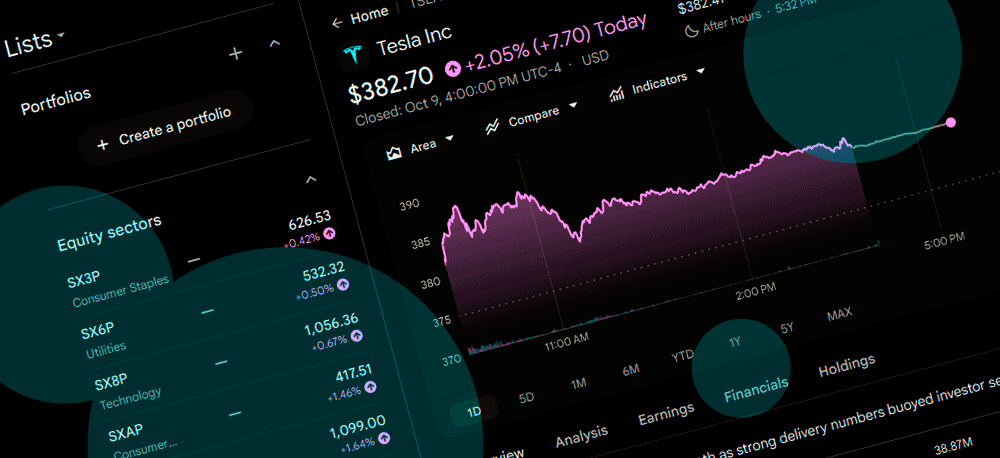
- Tesla (TSLA) shares closed at $382.70 on October 9, 2026, gaining 2.05% and moving above the closely watched $380 resistance level. The stock remains approximately 15% below its year-end 2025 price.
- Third-quarter deliveries reached 486,532 vehicles, exceeding analyst expectations of 456,896, although volumes declined 2.1% year over year. Tesla’s next earnings report is scheduled for October 21, 2026.
- Tesla’s investment plans call for capital expenditures exceeding $25 bn in 2026, increasing pressure on free cash flow as the company expands autonomous driving, AI infrastructure and humanoid robotics.
Tesla (NASDAQ: TSLA) shares advanced 2.05% to close at $382.70 on October 9, 2026, recovering above the $380 level that had repeatedly limited the stock’s rebound since late July. The shares traded as high as $388.56 during Friday’s session, after closing at $375 on October 8.
The recovery follows stronger-than-expected third-quarter vehicle deliveries, developments in Tesla’s artificial intelligence and autonomous driving programs, and renewed investor attention to its semiconductor manufacturing ambitions.
Despite the latest advance, Tesla remains approximately 15% below its closing price at the end of 2025. Investors are weighing improving vehicle demand against weaker automotive margins, rising capital requirements and the uncertain commercial returns from Robotaxi and Optimus.
The October 21 earnings announcement will provide the next major test of whether operating performance can support the company’s valuation and sustain the rebound above $380.
Tesla stock analyst price targets
| Investment firm | Rating | TSLA price target |
| Tigress Financial | Buy | $550 |
| Baird | Buy | $475 |
| UBS | Neutral | $442 |
| Truist Financial | Hold | $430 |
| Morgan Stanley | Equalweight | $415 |
| JPMorgan | Hold | $415 |
| Jefferies | Hold | $400 |
| BNP Paribas | Sell | $268 |
Tesla Q3 2026 deliveries beat forecasts, but annual volumes remain lower
Tesla delivered 486,532 electric vehicles in the third quarter, above the 456,896 units expected by analysts surveyed by Visible Alpha. The result represented a modest sequential improvement from 480,126 deliveries in Q2 but remained 2.1% below the 497,099 vehicles delivered in the third quarter of 2025.
The company produced 464,391 vehicles, including 457,387 Model 3 and Model Y units and 7,004 other models. Model 3 and Model Y accounted for 478,237 deliveries, while other vehicles contributed 8,295.
Production fell short of deliveries, indicating that Tesla drew down existing vehicle inventory during the quarter.
Energy storage deployments reached 13.7 GWh, compared with 13.5 GWh in the preceding quarter, although the latest figure was below market expectations of approximately 15.9 GWh.
Tesla Q3 2026 vehicle deliveries and production
| Metric | Q3 2026 | Comparison |
| Total vehicle deliveries | 486,532 | -2.1% YoY |
| Analyst delivery forecast | 456,896 | Actual exceeded by 6.5% |
| Q2 vehicle deliveries | 480,126 | Q3 increased 1.3% |
| Total vehicle production | 464,391 | Below deliveries |
| Model 3/Y deliveries | 478,237 | 98.3% of total |
| Other vehicle deliveries | 8,295 | 1.7% of total |
| Energy storage deployments | 13.7 GWh | 13.5 GWh in Q2 |
The vehicle delivery announcement on October 2 helped lift Tesla shares 4.7%, partially reversing the selloff that followed its second-quarter financial results in July.
More recent regional sales figures provide additional evidence of a recovery, but demand remains uneven.
On October 9, the China Passenger Car Association reported that sales of Tesla vehicles manufactured in Shanghai increased 5% year over year to 95,366 units in September, the factory’s strongest monthly result of 2026.
Exports accounted for 30,529 vehicles, rising approximately 58% annually. Domestic Chinese deliveries declined 9% to 64,837 units, indicating that overseas shipments were responsible for the improvement in the factory’s total wholesale volume.
European vehicle registrations have also recovered, helping offset weaker demand in Tesla’s two largest markets, the United States and China. Competition and the expiration of U.S. electric vehicle purchase incentives remain important constraints on underlying automotive demand.
Tesla Q2 2026 earnings reveal pressure on margins and free cash flow
Tesla’s latest reported financial results, released July 22, showed revenue growth alongside disappointing profitability.
Second-quarter revenue reached $28.24 bn, increasing approximately 26% year over year and exceeding analysts’ forecasts of $25.53 bn to $25.64 bn.
Adjusted earnings per share were $0.33, below market expectations of approximately $0.47 to $0.49. Automotive gross margin excluding regulatory credits declined to 16.3%, compared with 19.2% in the preceding quarter.
Energy storage gross margin also weakened, falling to 20.4% from 39.5% in Q1, partly because of warranty-related adjustments.
Tesla Q2 2026 financial results
| Financial metric | Q2 2026 |
| Total revenue | $28.24 bn |
| Revenue growth YoY | 26% |
| Earnings per share | $0.33 |
| Analyst EPS forecast | $0.47–$0.49 |
| Automotive gross margin | 16.3% |
| Energy storage gross margin | 20.4% |
| Operating cash flow | Approximately $4.7 bn |
| Capital expenditures | Approximately $5.8 bn |
| Free cash flow | Approximately -$1.1 bn |
| Cash and short-term investments | $43.52 bn |
| FY2026 capital expenditure guidance | Above $25 bn |
Despite stronger vehicle volumes, the combination of pricing pressure and higher operating expenditure limited the company’s ability to convert revenue growth into earnings.
Tesla generated approximately $4.7 bn in operating cash flow during Q2, but capital expenditures of $5.8 bn resulted in negative free cash flow of roughly $1.1 bn.
Management expects spending to remain elevated as Tesla builds production capacity for autonomous vehicles, humanoid robots, AI computing systems and semiconductor manufacturing.
The company projects capital expenditures exceeding $25 bn in 2026, with investment expected to increase over the following two to three years.
Tesla had $43.52 bn in cash, cash equivalents and short-term investments at the end of June, providing financial flexibility for its expansion plans. The scale of spending nevertheless increases the importance of generating sufficient operating cash flow to fund those investments.
Robotaxi, Optimus and AI investments shape Tesla’s valuation
Tesla’s investment case increasingly depends on businesses beyond conventional electric vehicle manufacturing. The company’s long-term strategy includes autonomous driving software, commercial Robotaxi services, the Cybercab and the Optimus humanoid robot.
Tesla has expanded Robotaxi operations in several Texas and Florida markets, including Austin and Miami. Its autonomous vehicle program remains in development, with differences between markets in operating conditions, supervision and deployment scale.
Progress in commercial operations could strengthen the case for assigning greater value to Tesla’s software and mobility businesses. Scaling those services profitably, however, requires further technological and operational progress.
Regulatory approval represents another important factor. On October 9, Tesla began replacing the name “Full Self-Driving” with “Tesla Assisted Driving” across its European websites.
The change followed regulatory objections that the original terminology could suggest a higher degree of autonomy than the system provides. Drivers remain responsible for supervising the technology.
Eight European Union countries currently permit the system, but an EU-wide approval vote has been delayed from October until at least December 2026.
The delay could affect Tesla’s ability to expand software adoption across Europe, where regulatory clearance remains an important condition for broader commercialization.
Tesla is also investing in semiconductor manufacturing to support its AI ambitions.
On October 7, Elon Musk clarified that Tesla and SpaceX intend to retain ownership and operational control of the planned Terafab chipmaking complex. Taiwan Semiconductor Manufacturing Company could potentially lease capacity, but Musk rejected suggestions that it would operate the project.
Terafab is intended to support the development of custom processors for autonomous vehicles, robotics and other AI applications.
The initiative represents a separate development from Tesla’s earlier Dojo supercomputer program. Musk confirmed the shutdown of Dojo and cancellation of Dojo 2 in August 2025 as the company redirected its chip strategy toward newer AI hardware architectures.
The additional semiconductor manufacturing ambitions create potential for greater control over computing capacity, but also introduce substantial execution and financing requirements.
Wall Street’s Tesla stock price targets show divided expectations
Analyst forecasts remain widely dispersed, reflecting different assumptions about Tesla’s automotive profitability and the potential value of its AI businesses.
According to a market consensus compiled by Stock Analysis from S&P Global data, Tesla’s average 12-month price target stood at $396.57 as of October 9, representing approximately 3.6% upside from its closing share price of $382.70.
The median target was $412.50, with individual estimates ranging from $128.11 to $600.StockAnalysis.com
Recent institutional forecasts illustrate the disagreement. Baird maintained a Buy recommendation with a $475 target, citing stronger vehicle delivery trends. JPMorgan retained a Hold rating and a $415 target, expressing caution about capital expenditure and automotive margins.
BNP Paribas took a more negative position, assigning a Sell rating and a $268 target amid concerns that Tesla’s investment requirements could keep free cash flow under pressure through 2028.
On October 9, Tigress Financial reiterated its Buy rating and $550 target, emphasizing the potential contribution of AI and robotics to Tesla’s future valuation.
A much more optimistic scenario published by TIKR projects a Tesla share price of $1,863 by December 31, 2030.
That mid-case valuation model originally implied a 403% return from the October 2 reference price of approximately $371. Measured against the October 9 closing price, the same target would represent roughly 387% potential appreciation.
The TIKR estimate is a scenario-based valuation rather than a Wall Street consensus forecast. Its realization would depend on business growth and profitability assumptions extending well beyond the company’s currently reported financial performance.
Can Tesla stock break above $400?
Tesla’s technical position improved following the October 9 close above $380, but the stock has not yet established a sustained breakout.
The shares experienced significant volatility during 2026. After ending 2025 near $450, Tesla declined toward $344 in early April before recovering to approximately $445 by mid-May.
The stock later fell toward $300 in late July, following the second-quarter earnings announcement and management’s discussion of sharply higher capital expenditures.
A recovery through August and September brought the shares back toward $380, although repeated advances encountered selling pressure in that area.
The latest trading session pushed Tesla above that level, with an intraday high of $388.56.
The $380-$400 range remains significant because previous trading activity may generate selling from investors seeking to recover earlier losses or realize gains from the rebound.
A sustained advance through $390 and $400 would provide stronger evidence of upward momentum, particularly if accompanied by improving financial expectations.
Conversely, a move back below $380 could indicate that Friday’s advance was temporary. The $370 area and the September trading region around $350–$355 would then become relevant reference points, followed by the July low near $300 if selling pressure intensified.
These are technical reference levels rather than independently reliable price forecasts.
Tesla’s elevated valuation adds another consideration. MarketWatch reported a trailing P/E ratio of approximately 355.6 at the October 9 close, illustrating how strongly the current share price depends on expectations of future earnings expansion. Forward earnings multiples are lower but remain sensitive to changes in analyst profit forecasts.
Interest rates could also affect the outlook. Higher vehicle financing costs tend to reduce affordability for consumers, particularly for expensive discretionary purchases. Continued competition in electric vehicles may further constrain Tesla’s pricing flexibility.
Tesla Q3 2026 earnings forecast: What investors should watch
Tesla will release its third-quarter financial results after U.S. markets close on October 21, 2026, followed by a management webcast at 5:30 p.m. Eastern Time.
Analysts expect earnings of approximately $0.45 per share, compared with $0.33 in Q2 and $0.50 in the year-earlier quarter. Revenue expectations are around $27.5 bn to $28.3 bn, depending on the estimates provider.
Vehicle deliveries have already demonstrated an improvement over market expectations, but the earnings report will determine whether that performance translated into stronger automotive profitability.
Investors will also be looking for evidence that Tesla can recover margins while financing its expanding investment program.
The company’s progress in Robotaxi deployment, Optimus manufacturing, autonomous driving software approvals and semiconductor infrastructure will remain relevant to longer-term expectations, although financial contributions from these initiatives are subject to substantial uncertainty.
Tesla’s October 9 recovery above $380 improved its near-term technical position. Whether the shares can establish a durable advance toward $400 will depend on the company’s ability to demonstrate stronger earnings and cash flow alongside progress in its capital-intensive AI strategy.