Follow Beinsure
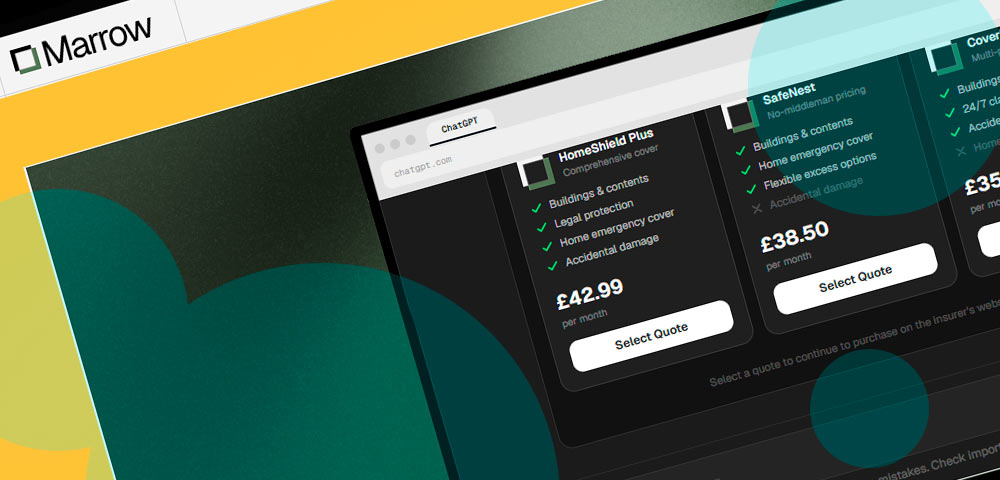
London-based insurtech startup Marrow has raised £1.49 mn in pre-seed funding to develop infrastructure connecting artificial intelligence assistants with insurers’ existing pricing, underwriting and policy administration systems.
The investment round was led by Insurtech Gateway, with participation from Seed X, Leo Capital, Portfolio Ventures and a group of angel investors.
- Marrow secured £1.49 mn in funding led by Insurtech Gateway, with Seed X, Leo Capital, Portfolio Ventures and angel investors participating.
- The company’s infrastructure enables AI assistants such as ChatGPT, Claude and Gemini to access insurance products while preserving insurer control over pricing, underwriting, disclosures and regulatory compliance.
- Marrow has been in production with Aviva since March 2026 and is developing open AMI Standards to support AI-mediated insurance distribution across multiple product lines.
The company plans to use the funding to expand its engineering and commercial teams, onboard additional insurance providers and develop its Agent-Mediated Insurance (AMI) Standards into a first full version.
Marrow is building middleware that allows AI agents to quote, purchase and service insurance products while leaving insurers in control of underwriting decisions, pricing rules and regulatory requirements.
The platform is designed for insurers and brokers seeking to distribute products through AI assistants, including ChatGPT, Claude and Gemini, without allowing unstructured model-generated responses to interact directly with their core systems.
Rather than operating as an insurer or broker, Marrow provides the technical infrastructure connecting AI-driven customer interactions with regulated insurance transactions.
AI-powered insurance shopping creates new distribution requirements
The growing use of AI assistants in insurance research and purchasing is creating a distribution challenge for insurers, which must make products accessible through third-party agents without losing control of how sales are conducted.
Research by Consumer Intelligence found that 18.7% of UK home insurance shoppers had used AI tools, compared with 14.5% who had used a broker.
Those figures indicate that AI is already part of some consumers’ insurance purchasing journeys, although they do not establish that an AI agent completed an insurance transaction.
Tim Graham, co-founder and chief executive of Marrow, sees an opportunity for insurers to reach customers through AI interfaces, provided the processes meet regulatory requirements.
We think that’s great, and that can allow a really consumer-centric interaction, whilst creating a massive opportunity for insurers. However, these are still regulated insurance sales: there’s a high bar to clear to be sure that the consumer is safe and these interactions are robust.
Tim Graham, co-founder and chief executive of Marrow
Insurers face several possible approaches to AI-mediated distribution, each with operational implications.
Restricting access by AI agents could limit their ability to reach consumers who increasingly use assistants to research products. Allowing agents to interact with existing websites, meanwhile, can leave insurers with limited visibility into the questions asked, information presented and records retained during the transaction.
Building individual integrations for each AI platform creates another problem, as development and compliance work may need to be repeated whenever a new distribution channel emerges.
Marrow’s proposition is to provide a single interface through which multiple AI agents can access insurance products under controls defined by the insurer.
How Marrow connects AI agents to insurer systems
Marrow’s platform operates as an intermediary between AI assistants and the pricing, underwriting and policy administration technology already used by insurers.
According to its technical documentation, the system maps existing insurer endpoints into a common data structure, or canonical schema, allowing different AI interfaces to communicate with insurance systems through a consistent protocol.
Each request is validated before reaching the underlying systems. The platform also enforces required disclosures, restrictions on advice and other rules governing the sales process.
Structured responses are then returned to the AI assistant, reducing the risk associated with allowing unstructured language-model output to interact directly with regulated insurance infrastructure.
The technology is designed to accommodate different generations of insurer systems.
Marrow says it can connect to modern application programming interfaces as well as older SOAP and XML endpoints, enabling insurers to test AI distribution without replacing their core platforms.
An insurer can map its existing systems to Marrow once, after which multiple AI assistants and embedded distribution channels can access the connected products through the same protocol.
The company says requests are processed without retaining end-user personal data, while interactions generate auditable records. These are company-reported capabilities, but they define the operational role Marrow intends to occupy between insurers and AI platforms.
The middleware governs which questions an agent can ask, what constitutes a valid response, which information customers must receive before a price is presented and what evidence of the transaction is retained.
Marrow does not seek to acquire customers or provide advice comparing insurance products. Its technology focuses on the conduct of transactions where the insurer does not control the external AI assistant.
For carriers, a single integration could make products available across several AI-powered distribution channels while keeping underwriting appetite, pricing and policy rules within their existing systems.
Its effectiveness will depend on Marrow’s ability to connect sufficient insurers and product categories while demonstrating that different AI models consistently operate within each provider’s requirements.
Aviva deployment provides early production experience
Marrow says its technology has been in production with UK insurer Aviva since March 2026, following procurement, information security, legal and data protection reviews.
The deployment provides evidence of the company’s ability to integrate its technology into an established insurer’s operating environment.
Marrow has subsequently signed additional carriers, brokers and managing general agents (MGAs), although the source material does not identify those organisations or quantify their number.
The company is also seeking to establish common technical standards for AI-mediated insurance transactions.
In September 2026, Marrow published the AMI Standards, an open, machine-readable specification covering how AI agents request, compare, disclose and bind insurance policies.
The initiative is intended to establish consistent rules for interactions between AI platforms and insurers, including the information required to conduct regulated insurance sales.
Insurers and brokers have been reviewing working drafts across five lines of business, with the consultation period scheduled to remain open until November 13, 2026.
Marrow is working with an industry group to develop the standards into a first full version.
The initiative addresses a distinction between insurance and other forms of AI-enabled commerce.
Shared technical protocols already exist for payments and retail transactions, but conventional commerce infrastructure does not necessarily account for the underwriting requirements, mandatory disclosures and restrictions associated with regulated insurance sales.
Marrow’s standards effort aims to define those requirements in a format that AI agents and insurance systems can interpret consistently.
The commercial value of that approach will depend on adoption by insurers, brokers and AI platforms. Wider acceptance could simplify future integrations and reduce the amount of custom technical work required to make insurance products accessible through new agent interfaces.
Without sufficient participation, the standards would have limited practical value regardless of the number of AI models that Marrow’s middleware can technically support.
Insurtech Gateway backs regulatory and technical expertise
Insurtech Gateway cited Marrow’s production deployment, technical approach and progress on regulatory requirements as reasons for leading the financing round. The investor focuses on early-stage companies applying technology to the measurement, mitigation and management of risk.
Dom Nolan of Insurtech Gateway said the emergence of AI-powered commerce was creating demand for infrastructure capable of supporting regulated financial products.
We’re excited to be supporting Marrow leading their fundraise. As the shift to agentic commerce creates a new infrastructure layer for regulated products, insurance is one of the clearest places where that layer is needed. Marrow has a rare combination of founder-market fit, production proof with a Tier-1 insurer, and a regulatory and protocol head-start that is difficult to replicate through software alone.
Dom Nolan, Insurtech Gateway
Marrow’s founding team has experience in insurance technology development.
- Chief executive Tim Graham previously served as Head of Product at Ki and has worked on products for small business insurance.
- Co-founder Adam Mesout was a founding engineer at Ki, where he developed core technical tooling. He is also a qualified actuary.
Their backgrounds combine insurance product development, software engineering and actuarial knowledge, which are relevant to building technology that must accommodate underwriting rules and regulated sales processes.
The investment supports two connected parts of Marrow’s strategy: expanding the insurer integrations needed to operate commercially and developing shared standards intended to make subsequent deployments easier.
Funding to support expansion into commercial insurance
Marrow plans to use the new capital to recruit engineering and commercial staff in London, expand its network of insurance providers and extend its product coverage.
The company intends to support additional retail insurance lines before expanding further into the commercial insurance market.
Development of the AMI Standards will continue alongside that expansion, with the industry working group contributing to the first full specification.
For insurers, the proposed infrastructure offers a way to make existing products available through AI assistants without transferring responsibility for pricing, underwriting or transaction controls to those platforms.
The model also raises execution requirements for Marrow. Each additional insurer brings different technical architectures, product definitions and compliance obligations, while AI assistants may change how they interpret requests and interact with external systems.
Maintaining consistent controls across those environments will be necessary if the platform is to support insurance sales at scale.
Marrow’s initial deployment with Aviva provides a production reference, but the longer-term commercial case depends on expanding provider participation and making integrations repeatable across insurance categories.
The company’s next phase will therefore focus on converting its early insurer relationships and standards work into a distribution infrastructure that other carriers, brokers and AI platforms can adopt.