London-based insurtech Ancep has raised $8.5 mn in funding to expand its AI agents for commercial insurance brokers. The technology automates insurance placement workflows, helping brokers handle smaller risks that would otherwise be declined because of high administrative costs.
The investment round was led by Creandum, with participation from Kleiner Perkins and Vicus Ventures. Angel investors included former Aon CFO Christa Davies and professionals from OpenAI, Anthropic and Google DeepMind.
- Ancep secured $8.5 mn from investors led by Creandum to expand AI-powered insurance placement technology and support hiring.
- The company estimates that up to 30% of risks submitted to brokers are economically unattractive under traditional workflows, with approximately half potentially profitable through automation.
- Ancep reports that one customer division increased revenue by 10% within six weeks of deploying its AI agents, while another expanded its client base without additional administrative staff.
AI agents automate commercial insurance placement
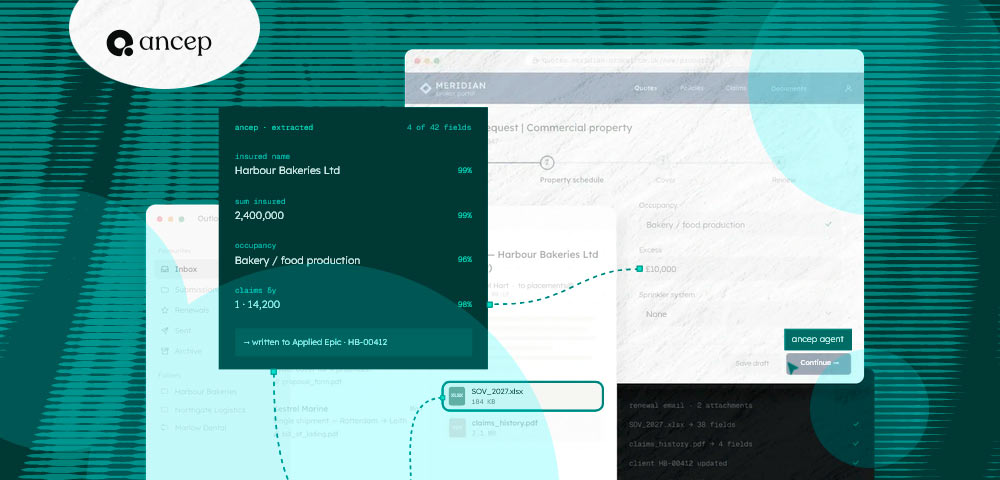
Ancep’s AI agents handle routine tasks involved in placing commercial insurance, including reviewing client submissions, preparing documentation and requesting quotations from insurers through email, online portals and APIs.
The technology operates within brokers’ existing policy administration systems, electronic trading platforms and customer relationship management software.
This approach allows large brokers operating multiple legacy systems to introduce automation without replacing their existing technology infrastructure.
Ancep estimates that up to 30% of risks presented to brokers fall below their normal profitability thresholds because smaller policies require substantial administrative work relative to the commission generated.
The company believes approximately half of these risks could become commercially viable through automation, potentially recovering 5% to 10% in previously unrealized brokerage revenue.
Human oversight remains central to the process. Authorized brokers retain responsibility for reviewing AI-generated outputs and binding insurance coverage.
Ancep reports revenue growth among early customers
Ancep’s technology is already operating at Austrian credit insurance specialist ACIC Financial Advisory, a top-10 UK insurance broker and the specialty insurance division of a major US broker. One customer division reported a 10% revenue increase within six weeks of implementation.
At ACIC Financial Advisory, the technology supports complex policy reviews, comparisons of insurer terms, preparation of market submissions and extraction of information from extensive documentation.
According to the company, these processes now require substantially less time, allowing insurance specialists to serve additional clients without increasing administrative headcount.
ACIC has also redirected resources toward client advisory services, market expansion and insurance product development.
Ancep typically introduces automation one workflow at a time and can demonstrate a working prototype within two days of signing a confidentiality agreement.
Its pricing model is linked to the value generated for brokers rather than traditional software subscription fees.
Insurance market conditions increase pressure on broker profitability
The funding comes as commercial insurance pricing continues to soften globally. According to Marsh’s Global Insurance Market Index, commercial insurance rates declined 6% in the second quarter of 2026 and another 5% in the third quarter, marking nine consecutive quarters of decreases.
Lower insurance pricing can increase pressure on brokerage commissions, reinforcing the commercial case for reducing placement costs and expanding the volume of business brokers can handle.
Ancep Co-founder and CEO Gagan Khurana said the company is concentrating on generating additional brokerage revenue rather than positioning AI primarily as a cost-cutting tool.
The company initially targets the world’s 20 largest insurance brokers. Ancep plans to use the new capital to expand its operations, recruit additional employees and accelerate deployment of its AI agents across commercial insurance markets.