Overview
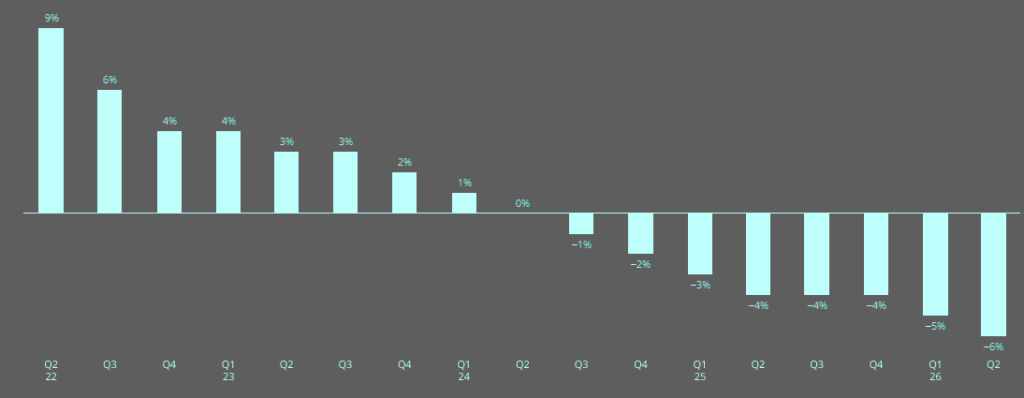
Global insurance rates declined 6% in the second quarter 2026, extending the market’s run of reductions to eight consecutive quarters and giving buyers better conditions across most regions and major product lines. According to Marsh’s Global Insurance Market Index (GIMI), property pricing recorded the steepest decline.
Property insurance rates fell 12% globally as available capacity and insurer competition gave buyers more room to revisit program cost and structure. For many corporate insureds, property remains the largest single premium class, so the drop matters for budgets.
Insurer financial results helped reset the market. Strong capital levels, lower reinsurance costs and higher investment returns increased competition. Insurers also moved beyond price in many markets, offering broader cover, expanded terms and lower deductibles to win or retain accounts.
Key highlights
- Global commercial insurance rates fell 6% in Q2 2026, marking the eighth consecutive quarter of composite rate declines, according to Marsh’s Global Insurance Market Index.
- Property insurance recorded the steepest reduction, with rates down 12% globally after 9% declines in each of the previous two quarters.
- Casualty was the only major product line to rise globally, up 2%, mainly because US casualty rates increased 7% amid claims severity and litigation pressure.
- FINPRO rates fell 3% and cyber rates declined 4%, although both markets moved closer to stable pricing as underwriting became more selective.
- Buyers with strong risk controls used favorable conditions to reduce costs, raise limits, broaden coverage and adjust program structures before the next pricing cycle.
The Global Insurance Market Index (GIMI) is a proprietary measure of global commercial insurance rate change at renewal – providing insights into the world’s major insurance markets.
Insurance pricing outcomes still depended on the risk

Sector exposure shaped insurer appetite. Geography mattered too, especially for buyers with catastrophe exposure.
Financial and professional lines, or FINPRO, and cyber rates also declined globally in the second quarter. The pace of reduction has slowed, though, and pricing has moved closer to a stable level. The US was the only region to record a modest FINPRO rate increase.
Casualty remained the only major product line with a global rate increase. Rates outside the US declined across all regions, but US casualty pricing continued to rise, with claims severity and litigation pressure keeping the market difficult.
Early signs point to a slower pace of increases, yet the US market remains tough. US insurance sector outlook for 2026: capital strength, social inflation risks, P&C returns peak, Florida reforms, life insurance resilience and alt capital trends.
Global composite insurance rate change
All references to rate and rate movements in this report are averages, unless otherwise noted. For ease of reporting, we have rounded all percentages regarding rate movements to the nearest whole number.
Global composite insurance rate change – by region
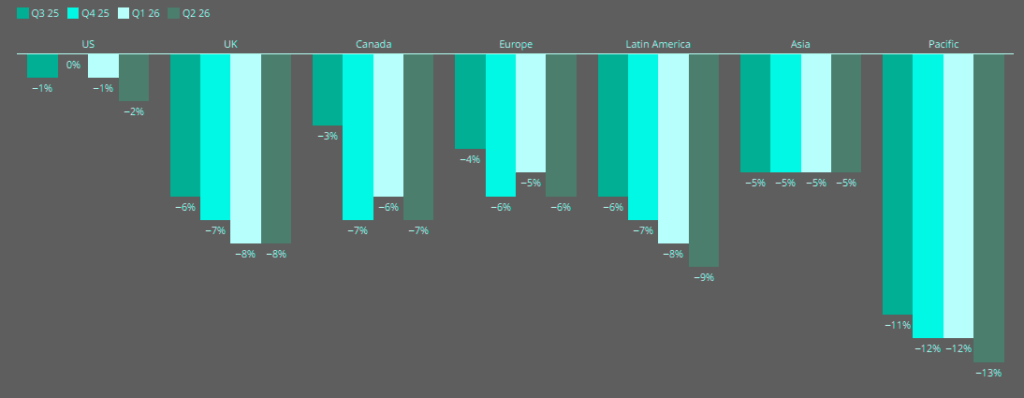
Many buyers have kept premium savings because of global economic uncertainty. Others continue to put capital into alternative risk strategies, including captives.
Current market conditions are expected to continue unless the northern hemisphere storm season produces severe losses or a series of major natural catastrophes hits the market.
“That would give insureds more chances to secure cost reductions, broaden cover and adjust program design before the next pricing cycle”, John Donnelly, President, Global Placement at March says.
Global product line trends, Q2 2026
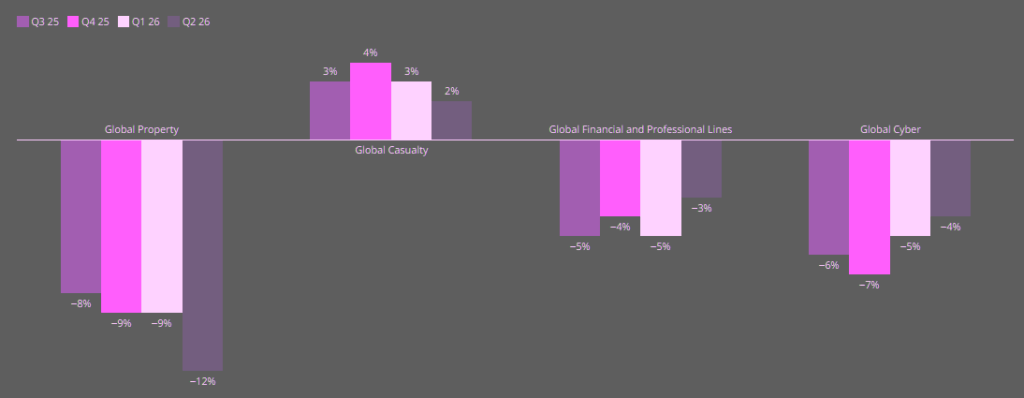
Property insurance rates declined 12% in Q2, compared with 9% decreases in each of the prior two quarters
Favorable reinsurance conditions left more capacity in the market, and insurers competed harder for quality risks. Catastrophe exposure remained the main underwriting concern. Risk quality and exposure controls drove pricing outcomes, especially for accounts in catastrophe-prone regions.
Casualty insurance rates increased 2% globally
Every region recorded rate decreases except the US, where casualty rates rose 7%. Risks with US exposure continued to face tighter underwriting review and pricing pressure across multinational programs. Capacity was still available, but insurers became more selective. They focused on risk quality, loss history and program structure before committing limits.
Financial and professional lines insurance rates decreased 3%, compared with a 5% decrease in the prior quarter
Market conditions continued to settle after several quarters of price reductions. Underwriters also became more selective, which suggests the pace of rate relief is narrowing rather than accelerating.
Cyber insurance rates declined 4%, marking the twelfth consecutive quarter of reductions
Stable capacity and strong insurer competition continued to support buyer-friendly pricing. The line still attracted active underwriting, though insurers kept close watch on controls, ransomware exposure and aggregation risk.
Capacity, favorable reinsurance conditions contribute to composite rate declines

Commercial insurance rates declined by 6% in the second quarter of 2026, compared to a 5% decline in the prior quarter, amid available capacity and favorable reinsurance conditions, according to Marsh’s Global Insurance Market Index (GIMI). This was the eighth consecutive quarter of global composite rate decreases.
Rate declines were observed across all major lines except casualty, driven by conditions in the US, where loss severity and litigation pressure remained elevated.
In addition to rate decreases, broader coverage, higher limits, and reduced retentions were often available. Levels of underwriting scrutiny tended to ease, although focus remained on catastrophe, casualty severity, and systemic risks.
Risk differentiation continued to increase, with underwriting outcomes increasingly driven by exposure quality and risk management.
Many clients used favorable market conditions to adjust program structures, increase limits, and enhance coverage. Those with well-performing risks continued to achieve the strongest renewal outcomes.
U.S. property insurance rates dropped 4% in Q4 2025, a sharper decline than the 1% recorded in the previous quarter. Increased insurer capacity, driven by strong financial results over the past three years, contributed to the trend. Casualty insurance rates rose 7%, with an 11% increase when excluding workers’ compensation.
Why did global insurance rates decline in Q2 2026?
Rates declined because insurers had more available capacity, lower reinsurance costs, stronger capital levels and higher investment returns. These conditions increased competition and gave buyers more room to negotiate.
How much did global insurance rates fall?
Global commercial insurance rates declined 6% in the second quarter of 2026, compared with a 5% decline in the previous quarter.
Which product line saw the largest rate decrease?
Property insurance saw the largest decrease. Global property rates fell 12%, helped by favorable reinsurance conditions and strong insurer competition.
Why does the property rate decline matter for corporate buyers?
Property often represents the largest single premium class for corporate insureds. A 12% rate decline gives many companies more budget flexibility and more options to adjust limits, deductibles and coverage terms.
Why did casualty rates still increase?
Casualty rates rose because the US market remained difficult. US casualty pricing increased 7%, driven by claims severity, litigation pressure and tighter underwriting for risks with US exposure.
What happened in FINPRO and cyber insurance?
FINPRO rates declined 3%, slower than the 5% reduction in the previous quarter. Cyber rates fell 4%, marking the twelfth consecutive quarter of declines, supported by stable capacity and insurer competition.
Will favorable market conditions continue?
Current conditions are expected to continue unless a severe northern hemisphere storm season or a series of major natural catastrophes changes insurer appetite. Buyers with strong risk management are likely to achieve the best renewal results.
…………
AUTHORS: Yana Keller – Insurance Editor at Beinsure Media, Nataly Kramer – Lead Insurance Editor at Beinsure