- Insurers agree that AI will reshape the industry
- Insurance AI adoption and investment
- Main barriers to AI transformation
- Perceived competitive threats to the insurance industry
- Transformation timeline: Expected pace of AI-driven change, by function
- Insurers are actively investing in AI and pursuing a range of initiatives
- AI priorities by insurance segment
- AI-enabled transformation in terms of three horizons
Most insurers recognise the urgency around AI transformation. Investment is rising, senior executives are paying closer attention, and companies continue to test new applications across the business.
Nearly half of insurance executives surveyed believe their organizations are among the industry’s AI leaders, yet new KPMG International research finds that confidence may be running ahead of meaningful business transformation.
Yet research with insurance leaders suggests many organisations are still using AI inside existing processes rather than rethinking how value is created, delivered and measured. That limits the impact of investment and keeps much of the technology focused on incremental process improvement.
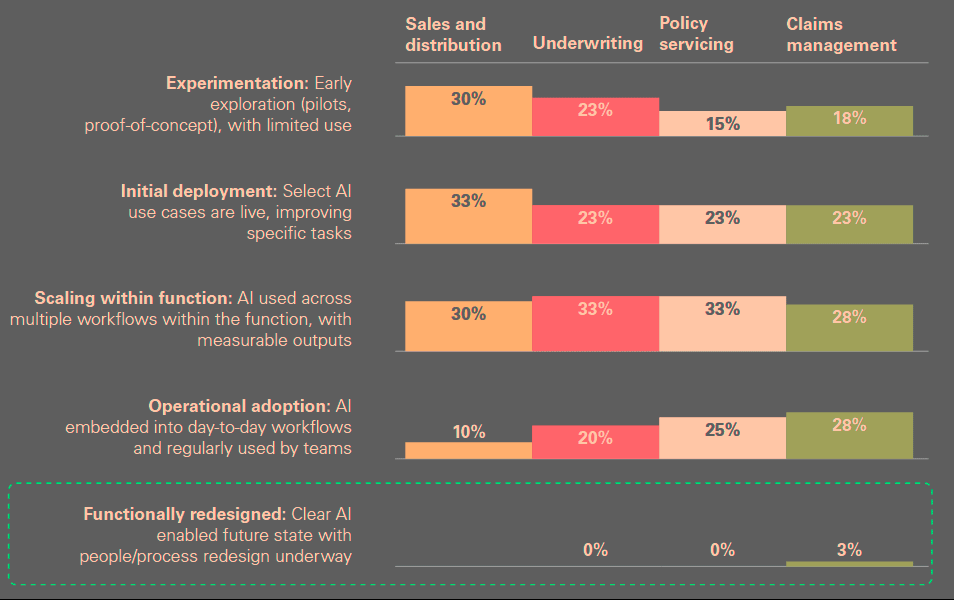
The report, Unlocking AI value in insurance, finds that 44% of respondents place themselves in the top quartile for AI transformation and none consider themselves significantly behind. Yet functional redesign remains rare: no surveyed organization reports having fully redesigned sales and distribution or underwriting around AI, while only three percent have reached that stage in policy servicing and claims management.
Key highlights
- 77% say failing to respond to AI could undermine competitiveness within five years.
- 44% believe they’re in the top 25% of insurance AI leaders.
- 71% use AI mainly for content generation or automating routine tasks.
- Just 5–10% of AI budgets go to new products or revenue-generating opportunities.
- 11% describe their view of AI’s return on investment as very clear.
- 11% claim a strong data foundation and governance.
- 18% have a clear view of how AI will enable their strategy and vision, with leadership aligned on execution.
- 8% rate their workforce as highly proficient with AI tools.
- 45% of insurers place AI ownership with the technology function alone.
This report, based on surveys with insurance executives, is intended to help insurers move from activity to transformation. Drawing on a survey of insurance leaders across 20 countries, it explores where insurers are making progress, where they are falling short, and what separates meaningful transformation from incremental improvement.
The framework moves from improving existing activities toward redesigning customer experiences and operating models, followed by changes to future business models. The report also sets out practical steps for insurers seeking to move beyond isolated pilots and experimentation.
Insurers agree that AI will reshape the industry

From underwriting and claims to policy servicing and operations, insurers are deploying AI to increase productivity, automate routine work and improve operational efficiency. Yet most transformation efforts remain focused on optimizing existing business models rather than creating new products, services or revenue streams.
The challenge is building the data, governance, and operating model needed to deploy AI with confidence and at scale. The leaders of tomorrow will be those who invest in trusted, accessible, and well-governed data.
By strengthening data quality and readiness now, insurers can move beyond efficiency gains to transform underwriting, claims, distribution, finance, and customer engagement. In an AI-enabled future, insurers that get their data right will be best positioned to realize its full potential.
Self-assessed position in AI transformation

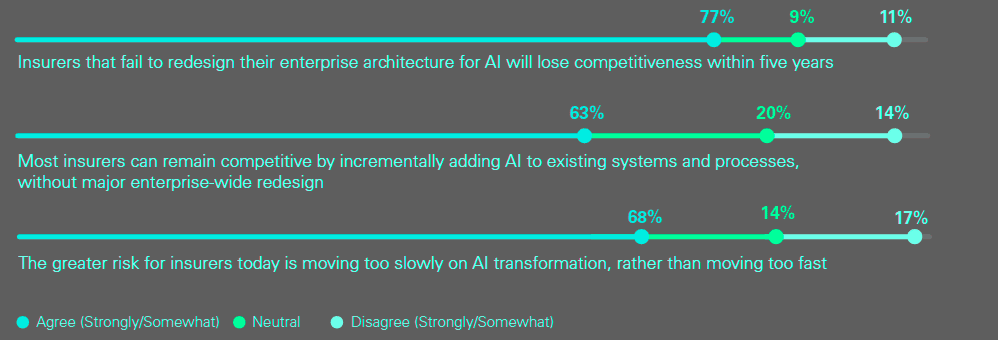
More than three-quarters of insurance executives told us they believe that failure to respond to AI will undermine their competitiveness within the next five years.
More than two-thirds go even further, saying that the greater risk today is moving too slowly on AI transformation versus moving too fast.
The insurance industry understands that AI has the potential to reshape competition, customer expectations and business models. The challenge is that many organizations remain focused on efficiency gains rather than asking how AI might fundamentally change the kind of insurer they could become. The gap between activity and transformation is where the real opportunity and risk now sit.
Dr Frank Pfaffenzeller, Global Head of Insurance, KPMG International
While 77% insurers believe failing to redesign their enterprise architecture for AI will undermine competitiveness within five years, 71% say their primary use of AI remains content generation and routine task automation. Just 29% report running front-to-back processes through AI agents or automation, while 68% say moving too slowly on AI transformation is a greater risk than moving too fast.
Insurers recognize the urgency of transformation, but are divided on depth of transformation
Some insurers have historically believed that the sector’s significant regulatory requirements provide a buffer against major disruption. The pace and range of technological change make those assumptions unsafe, not least against competitors who do not want to follow traditional insurance models in the first place.
Huw Evans, Partner and Head of Insurance at KPMG in the UK
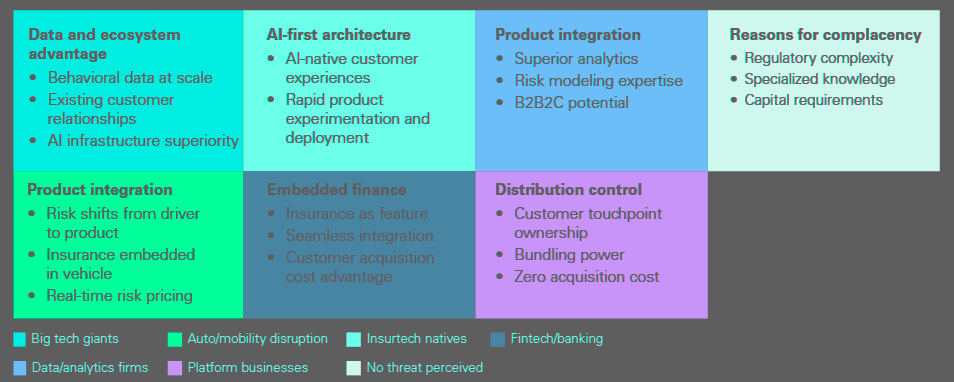
Perhaps not surprisingly, insurers are quick to name the usual industries when asked who is likely to disrupt their future business models – big tech, auto/mobility and insurtech natives, for example (see how AI Agents Push Cyber Insurers to Rethink Policy Language).
Insurance AI adoption and investment
| Metric | Survey result |
| Insurers using AI mainly for content generation or routine automation | 71% |
| Insurers running front-to-back processes through AI | 29% |
| Insurers reporting productivity and cost benefits | 92% |
| Insurers using AI for new revenue opportunities | 25% |
| AI budget directed to new products and revenue models | 5-10% |
| Insurers with very clear AI ROI visibility | 11% |
Investment remains focused on efficiency
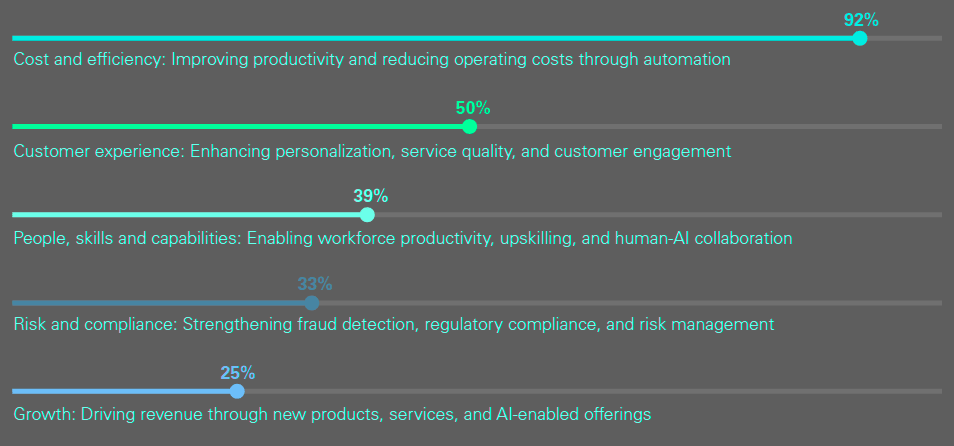
More than nine in ten insurers (92%respondents) say AI is helping improve productivity and reduce operating costs, compared with only one-quarter (25%) using it to drive growth through new products, services and AI-enabled offerings. Nearly half of AI budgets are directed towards operational and back-office efficiency, while just 5-10% goes to new products and revenue models.
Measurement has not kept pace with spending. Only 11% of insurers surveyed describe their view of AI return on investment as very clear, while 23% report limited clarity or no clear view.
Each brings something to the table that insurers may feel they don’t have access to: behavioral data, real-time pricing, or AI-first architecture without a legacy platform to slow it down, for example.
However, experience suggests that the competitors insurers should worry about most may not be any of the names already on their radar. They may not even resemble an insurer, an insurtech, or a technology company at all.
Data remains the biggest barrier to scale
Only 11% of insurers surveyed say they have the strong data foundations and governance needed to scale AI beyond pilots. A further 55% describe themselves as moderately ready, while 21% are only partially ready and 13% are not ready, citing fragmented data, poor quality, unclear ownership and legacy systems.
Data sits at the heart of the insurance industry’s AI ambitions. It underpins everything from underwriting and pricing to claims processing, fraud detection and customer service.
As insurers look to use AI to personalize products, improve decision-making and prevent losses before they occur, the quality, accessibility and governance of their data will increasingly determine who can create new sources of value and who remains focused on efficiency gains alone (see Generative AI Exclusions Spread Across Contractor Insurance Policies).
People and ownership gaps threaten progress
Workforce capability and accountability gaps add to the challenge. Just eight percent of insurers surveyed rate their workforce as highly proficient in AI tools, despite 54% saying they provide effective AI training.
By 2029, 72% expect underwriting to operate through a hybrid model with fewer people and redesigned roles, while 36 percent anticipate significant role elimination in claims management and 33% in policy servicing.
Technology leaders such as Chief Digital, Technology and Information Officers hold primary accountability for AI in 45% of insurance organizations surveyed. However, 43% say ownership is centralized but understanding remains uneven beyond leadership, and only 15% have AI governance fully integrated into strategic planning (see How Are AI, Geopolitics and Regulation Redefine Corporate Risk in 2026).
Main barriers to AI transformation
| Area | Survey finding |
| Data foundations and governance | 11% |
| Moderate data readiness | 55% |
| Partial data readiness | 21% |
| Not ready | 13% |
| Workforce highly proficient in AI | 8% |
| AI ownership held by technology leadership | 45% |
| AI governance fully incorporated into strategic planning | 15% |
The real disruptors may be the organizations that combine strong data with lower-cost capital
If AI makes risk more predictable, they may be able to take on more risks that insurers have traditionally managed, reshaping the industry’s role in the process.
The real threat is whoever has cheaper capital and better data. Pension funds and large corporates with strong balance sheets no longer need a traditional insurance policy to take on risk, provided the data is good enough to model it themselves
Matthew Smith, Global Lead for Insurance Strategy and Transformation and Partner at KPMG in the UK
That’s a bigger threat than any point solution insurers can already see coming, because it bypasses the industry’s business model rather than competing inside it.
Perceived competitive threats to the insurance industry
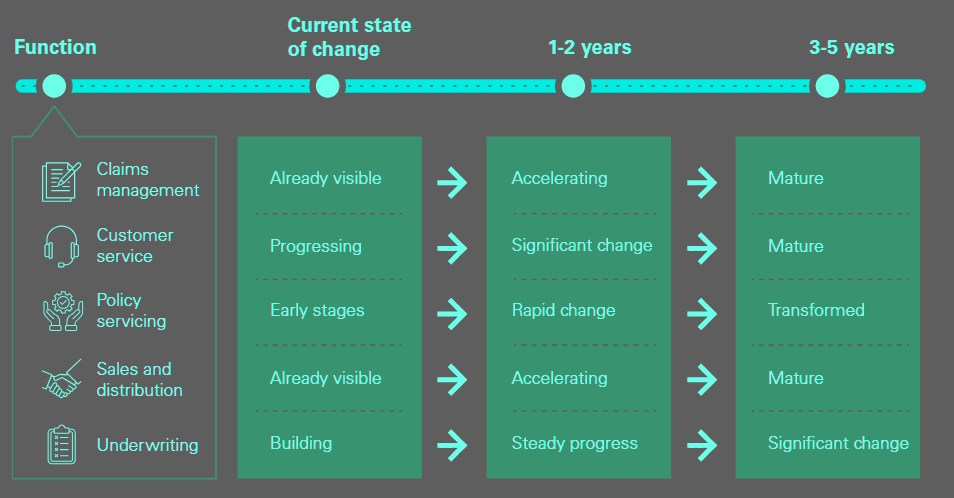
Ask most insurers and they will tell you that they are already seeing visible change in claims management, as well as in sales and distribution. Expectations are that the change trajectory will only accelerate over the next two years.
Insurers enter 2026 with longer settlement cycles, rising volumes, and slow AI adoption, increasing costs and operational risk. AI adoption reflects a different imbalance. Around 82% of insurers expect AI to shape the industry’s future. Only 14% have fully integrated AI into financial operations (see How AI Agents Speed Up the First Step in Insurance Claims). At the lower end, 6% report no AI use in reconciliation workflows.
Transformation timeline: Expected pace of AI-driven change, by function
Insurers are actively investing in AI and pursuing a range of initiatives
71% of insurers primarily use AI for content generation or the automation of routine tasks. These applications help companies work faster, but they generally leave existing processes and operating structures intact.
A similar pattern appears in underwriting. About 57% of respondents said they have developed AI agents or decision-support engines for underwriting, giving companies another way to codify specialist knowledge and support decisions. The underlying workflow, though, often remains largely unchanged.
Only 29% of insurers said they are using AI agents or automation to run front-to-back processes. That gap suggests most companies are still applying AI to individual tasks rather than redesigning complete workflows around the technology.
AI priorities by insurance segment
| Insurance segment | Implementation focus | Transformation focus |
| Property & casualty and auto insurance | 33% are at the operational adoption stage. Claims and operational efficiency remain the main priorities, with most investment directed to operations and back-office functions. | 40% expect significant role elimination in claims by 2029. |
| Life insurance | Underwriting is consistently ranked as the top AI priority. 38% are building proprietary solutions, compared with 20% in P&C. | Life insurers report greater emphasis on data platforms and analytics, allocating 25–30% of AI spending to data platforms. Transformation timelines are longer at 3–5 years. |
| Brokers | Brokers report the lowest confidence in AI returns, with 71% citing limited clarity on ROI. Vendor dependence is highest in this segment, with 86% using external solutions. | AI investment is concentrated on sales and distribution, with limited involvement in claims or underwriting. |
| Health insurance | 60% are at the operational adoption or scaling stage, the highest level among the segments. Customer-facing applications account for 40% of AI spending. | Transformation efforts concentrate on customer experience, service and member engagement. |
| Reinsurance | Reinsurers report the strongest ROI visibility, with 75% describing returns as somewhat clear. A data-driven operating culture supports adoption. | AI is focused on portfolio-level risk assessment and analytics, with less pressure to develop customer-facing applications. |
| Multiple lines | AI adoption is constrained by weak alignment across functions and departments, competing priorities and resource allocation conflicts. | Coordination across business units remains difficult, with no clear unified transformation strategy. |
Organizations are not hiding the fact that they are primarily focused on driving cost and efficiency outcomes. More than nine in ten say AI is helping them unlock improved productivity and reduce operating costs.
Just one in four say they are using the technology to drive new revenue opportunities through new products, services and AI-enabled offerings.
Investment patterns suggest a similar incremental focus on transformation. Consider this: our respondents tell us that nearly 50% of their AI budget is being allocated to operational and back-office efficiency while just 5-10% is being used to develop new products and revenue models.
What kind of transformation is AI driving in insurance companies?
A gap is emerging between ambition and reality. KPMG noted that respondents claimed strong progress adopting AI in claims management. Yet just 3% of respondents say they are even in the process of functionally redesigning their claims management. The vast majority say they are still embedding AI into their day-to-day workflows.
While much of today’s AI activity is focused on productivity gains and targeted use cases, the report suggests the next phase is likely to center on redesigning customer journeys, operating models and decision-making processes around AI.
Over the longer term, AI could enable new approaches to insurance, helping insurers move beyond risk transfer towards more proactive forms of risk management and prevention.
Functional redesign lags AI adoption in insurance
AI-enabled transformation in terms of three horizons
| Horizon | Focus | Typical approach |
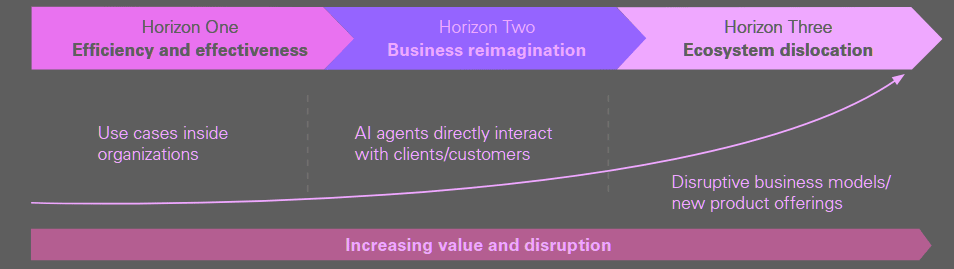
| Horizon One | Efficiency and effectiveness | AI, automation and analytics improve current workflows and employee productivity |
| Horizon Two | Business redesign | Processes, customer experiences, decisions and operating models are rebuilt around AI |
| Horizon Three | Industry and business model change | Traditional functions, industry boundaries and sources of value begin to change |
Most AI discussions in insurance still sit within Horizon One, where the focus is on improving efficiency, effectiveness and decision-making inside existing business models and operating processes. Many insurers are working at this stage today, combining AI with automation and analytics to improve how existing work is performed.
Horizon One remains an important part of the transformation process
Insurers use technologies including generative AI, machine learning and intelligent automation to support employees, simplify workflows and provide faster access to information. Examples include AI assistants that help employees find information and complete tasks more efficiently, as well as contact centre tools that give real-time guidance during customer interactions. These initiatives can produce meaningful operational gains, but they usually improve existing methods of delivering value rather than changing where that value comes from.
Horizon Two moves into business reimagination
AI becomes the starting point for rebuilding major processes and reconsidering how the business creates value. Insurers begin redesigning product delivery, customer experiences, decision-making and operating models rather than adding automation to processes already in place.
Horizon Three, ecosystem dislocation, extends further
Traditional functional and industry boundaries begin to change, altering what the business itself needs to become. Sources of value shift, existing product categories can disappear and new ones emerge.
One example is decentralized, blockchain-enabled risk pools that allow capital providers to underwrite one another directly, with AI pricing and monitoring risk in real time. Under this model, a traditional insurer would no longer need to sit between every transaction.
Three horizons of AI-enabled transformation
“The horizon that matters is the second one,” said Matthew Smith, Global Lead for Insurance Strategy and Transformation and Partner at KPMG in the UK. “Horizon One buys you credibility and a bit of budget. Horizon Two is where the transformation starts to happen and the actual business changes shape.”
Insurers moving faster aren’t spending more time in Horizon One. They are progressing through it deliberately, using efficiency gains to finance the more difficult work in Horizon Two while also watching the ecosystem-level changes associated with Horizon Three.
Methodology
The report is based on primary research commissioned by KPMG on AI-enabled transformation in insurance. It assessed AI maturity, adoption strategies, workforce and operational effects, ROI expectations and emerging competitive threats.
The research used a hybrid qualitative and quantitative discussion board combining structured survey questions with open-ended responses. Results were analysed at the question level, with respondent base sizes reported where relevant.
FAQ
How are insurers currently using AI?
Most insurers are using AI to improve existing processes rather than redesigning the business around the technology. KPMG found that 71% primarily use AI for content generation or routine task automation.
How many insurers use AI for front-to-back processes?
Only 29% of insurers surveyed said they run front-to-back processes through AI agents or automation. Most implementations remain focused on individual tasks and existing workflows.
How much are insurers investing in AI for efficiency?
Nearly 50% of AI budgets are allocated to operational and back-office efficiency. Only 5–10% is directed toward new products and revenue models.
What percentage of insurers report productivity gains from AI?
More than nine in ten insurers, or 92%, said AI is improving productivity and reducing operating costs. Only 25% reported using AI to create new revenue opportunities through products, services or AI-enabled offerings.
What is the biggest barrier to scaling AI in insurance?
Data remains a major constraint. Only 11% of insurers surveyed said they have strong data foundations and governance, while others reported fragmented data, poor quality, unclear ownership and legacy technology.
How prepared is the insurance workforce for AI?
Only 8% of insurers rate their workforce as highly proficient with AI tools, despite 54% saying they provide effective AI training. KPMG also found that technology leaders hold primary accountability for AI in 45% of surveyed organisations.
………………
AUTHORS: Oleg Parashchak – CEO & Founder of Finance Media, Peter Sonner – Lead Tech Editor at Beinsure