Aon projects US employer healthcare costs will rise 9.5% in 2027, taking average annual spending above $19,000 per employee. The forecast extends a run of healthcare cost increases approaching double digits for a fourth consecutive year.
Employers have faced one of the longest periods of elevated medical cost growth in decades. Rising healthcare utilization remains a major source of pressure, alongside higher treatment costs linked to chronic conditions.
Fitch Ratings assigns a deteriorating outlook to the U.S. health insurance sector for 2026, citing sustained pressure from high medical costs, disruption tied to the year-end 2025 expiration of enhanced Affordable Care Act marketplace tax credits, and unresolved regulatory and policy risk.
5 key highligths
- Aon projects US employer healthcare costs will rise 9.5% in 2027, pushing average annual spending above $19,000 per employee.
- Employer healthcare costs increased 8.8% in 2026 to $14,432 per worker, while total plan costs rose 8.3% to $17,562.
- Employees are expected to spend an average $5,297 on healthcare in 2026, including $3,130 in payroll premiums and $2,167 in out-of-pocket expenses.
- Prescription drugs remain a major cost driver as specialty medication spending rises and GLP-1 therapies expand into cardiovascular disease, sleep apnea and chronic kidney disease.
- Finance and insurance recorded the largest employer healthcare cost increase among sectors at 9.8%, followed by technology and communications at 9.1%.
Persistent, elevated medical cost trends and regulatory uncertainty will continue to challenge U.S. health insurers across nearly all major lines of business in 2026. Fitch currently maintains a ‘deteriorating’ sector outlook.
Beinsure expects weaker operating performance as utilization continues to climb, driven by more frequent and more expensive provider visits.
The employer-sponsored medical plan costs worldwide to climb 9.8% in 2026, according to Aon’s Global Medical Trend Rates Report. That projection marks a shift back to single-digit growth for the first time since 2023.
Large health claims are becoming more expensive

Large claims are also becoming more expensive and more frequent. Prescription drug spending adds another substantial expense as employers finance greater use of specialty medicines and GLP-1 therapies.
GLP-1 drugs are moving beyond their earlier use cases into cardiovascular disease and sleep apnea treatment. Chronic kidney disease represents another area of expansion, while emerging oral formulations are expected to widen access to these therapies.
That wider use comes with a larger benefits bill. Employers therefore face harder choices around access and affordability as drug spending consumes a growing share of health plan budgets.
“Employers have now experienced several consecutive years of health care cost increases that are approaching double digits,” said Mike Pasterick, North America Health Solutions Leader for Aon.
Swiss Re says the spread of GLP-1 weight-loss drugs could reshape mortality trends in the coming decades. Its latest modelling suggests that by 2045, broad uptake of the therapies could lower all-cause mortality in the US by 6.4% and in the UK by more than 5%.
GLP-1 drugs hold significant promise to help us beat the obesity epidemic. Our research underscores that the full benefit will come from going beyond medication.
Gallagher Re released a report on the impact of GLP-1 receptor agonists on medical trends and reinsurance. The report highlights how these therapies are altering medical practices and insurance structures, prompting reinsurance providers to adjust their strategies to align with emerging risk profiles.
Technology spending inside healthcare is creating another source of cost pressure. Aon said provider adoption of AI and related tools is supporting more detailed clinical documentation and coding, which in some cases results in higher billed charges.
Employer healthcare spending rose
Increases at this level extend well beyond annual benefits budgeting. Healthcare spending increasingly affects workforce planning and employee affordability, while employers still need competitive benefits to recruit and retain staff.
Aon’s 9.5% projection represents the expected 2027 increase before employers apply cost-management measures. Companies routinely change plan design or introduce other spending controls before renewal, reducing part of the original increase.
Actual 2026 figures show how employers have been absorbing much of the burden themselves. Employer healthcare spending rose 8.8% to $14,432 per employee, compared with $13,269 in 2025.
Annual changes to total cost of care
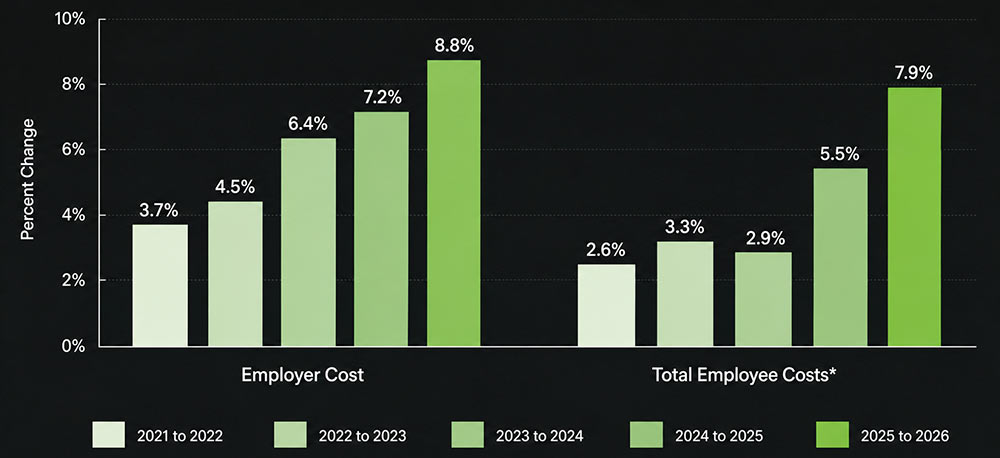
Employee payroll contributions increased 6.4% over the same period, reaching $3,130 from $2,943. Total plan cost climbed 8.3% to $17,562 from $16,212.
Employers funded 82.2% of total plan costs in 2026, up slightly from 81.8% a year earlier. Their share remains high as companies try to shield workers from the full effect of healthcare inflation.
Average figures mask large differences between employers. The middle 50% experienced total healthcare cost increases ranging between 5.5% and 11.5%.
Employee spending is rising as well. Workers are expected to spend an average $5,297 on healthcare in 2026, including $3,130 deducted from paychecks.
| Plan Cost | 2025 | 2026 | Change from 2025 to 2026 |
| Employer Cost | $13,269 | $14,432 | 8.8 % |
| Employee Premiums from Paycheck | $2,943 | $3,130 | 6.4 % |
| Total Plan Cost | $16,212 | $17,562 | 8.3 % |
| Employer Subsidy | 81.8 % | 82.2 % | 0.4 % |
Out-of-pocket expenses reached $2,167, up 10.2% from $1,966 in 2025. Combined employee costs therefore increased 7.9% from $4,909 a year earlier.
| Employee Costs | 2025 | 2026 | Change from 2025 to 2026 |
| Employee Premiums from Paycheck | $2,943 | $3,130 | 6.4 % |
| Employee Out-of-Pocket Costs | $1,966 | $2,167 | 10.2 % |
| Total Employee Costs | $4,909 | $5,297 | 7.9 % |
Aon linked the rise in out-of-pocket spending partly to greater use of medical services. Enrollment in leaner benefit options also leaves employees responsible for more expenses when they receive care.
The “medical trend rate” tracks the yearly increase in unit costs for employer health plans, factoring in price inflation, new technologies, greater usage, and higher prescription drug expenses.
For global employers, this metric sets the baseline for how much more expensive health benefits will be to deliver.
Medical trend refers to the predicted annualpercentage increase in the cost of treating patients and providing healthcare services, serving as a tool to forecast rising healthcare expenses by considering factors like inflation, service utilization, prescription drug costs, and advancements in medical technology, according to Global Benefits Standards.
Healthcare cost growth spread across every major industry
Employer increases ranged between 6.5% and 9.8%, while total plan costs rose more than 6% in every sector.
- Finance and insurance recorded the largest employer cost increase at 9.8%. Employee paycheck contributions in the sector rose 4.7%, taking the total plan cost increase to 8.8%.
- Technology and communications employers recorded a 9.1% increase in their healthcare spending. Employee contributions rose 6.4%, while total plan costs increased 8.6%.
- Public-sector employer costs climbed 8.8%, alongside a 7.7% increase in employee contributions. Total plan spending in the sector rose 8.6%.
- Professional services recorded an 8.7% increase in employer costs. Employee paycheck contributions rose only 3.5%, leaving total plan cost growth at 7.5%.
- Retail and wholesale trade employers spent 7.7% more, while employee contributions rose 6.6%. Total plan costs increased 7.5%.
- Manufacturing employer costs rose 7.5% and worker contributions increased 5.3%. Total plan spending for the sector moved 7.1% higher.
- Healthcare employers recorded the lowest increase among the industries studied, though costs still rose materially. Employer spending increased 6.5%, employee contributions climbed 5.3%, while total plan cost rose 6.3%.
Across those industries, employee contribution increases generally remained below employer cost growth. Companies therefore continued absorbing a larger portion of rising medical expenses rather than passing the full increase to workers.
Health care inflation remains a cross-industry challenge
| Projected Increase by Industry | Employer Cost | Employee Contributions from Paycheck | Total Plan Cost |
| Manufacturing | 7.5% | 5.3% | 7.1% |
| Professional Services | 8.7% | 3.5% | 7.5% |
| Finance and Insurance | 9.8% | 4.7% | 8.8% |
| Health Care | 6.5% | 5.3% | 6.3% |
| Retail and Wholesale Trade | 7.7% | 6.6% | 7.5% |
| Public Sector | 8.8% | 7.7% | 8.6% |
| Technology and Communications | 9.1% | 6.4% | 8.6% |
The 2027 outlook leaves little sign of a near-term slowdown
Medical utilization remains elevated, and chronic disease continues to increase demand for treatment.
Drug costs present another persistent challenge. Wider GLP-1 use and continued specialty pharmacy spending are expected to keep pressure on employer-sponsored plans.
Aon expects employers to put more attention on identifying where claims expenses originate before making benefit changes. Better use of health plan data gives companies more detail on spending patterns and which interventions produce measurable results.
“The organizations best positioned for the future will be those that proactively identify emerging risks and take targeted action before costs escalate,” said Debbie Ashford, North America Chief Actuary, Health Solutions for Aon.
Traditional cost-management methods are becoming less effective on their own as healthcare expenses rise. Employers will need more detailed data to understand where spending is increasing and make better decisions about future healthcare investment.
For employers, the 9.5% forecast raises the prospect of average healthcare costs exceeding $19,000 per worker in 2027. The size of the increase also means benefit strategy is moving closer to broader financial planning as companies decide how much of the additional expense they will absorb and how much reaches employees.
The historical information and projections shown above were developed using Aon’s Health Value Initiative database, which captures health care costs and benefit designs for more than 1,100 U.S. employers representing 7.9 mn employees and $135 bn in 2026 health care spend.
The projections above are developed after taking plan design changes as well as demographic and geographic population adjustments into account.
FAQ
How much will US employer healthcare costs increase in 2027?
Aon projects employer healthcare costs will increase 9.5% in 2027 before cost-management measures. Average annual healthcare spending is expected to exceed $19,000 per employee.
Why are employer healthcare costs rising?
Higher medical utilization and growing treatment costs for chronic conditions are increasing spending. Large claims and prescription drug expenses, including greater use of specialty medicines and GLP-1 therapies, are adding further pressure.
How much did employers spend on healthcare per employee in 2026?
Average employer healthcare spending reached $14,432 per employee in 2026, up 8.8% from $13,269 in 2025. Employers funded about 82.2% of total plan costs.
How much are employees paying for healthcare in 2026?
Employees are expected to spend $5,297 on average in 2026. That includes $3,130 in payroll premium contributions and $2,167 in out-of-pocket medical costs.
Which industries recorded the largest healthcare cost increases?
Finance and insurance recorded a 9.8% increase in employer costs, the highest among sectors tracked by Aon. Technology and communications followed at 9.1%, while public-sector costs increased 8.8%.
How are GLP-1 drugs affecting employer health plan costs?
Greater use of GLP-1 therapies is increasing prescription drug spending for employer-sponsored plans. Their expansion into cardiovascular disease, sleep apnea and chronic kidney disease is expected to widen eligible patient populations further.
What are employers doing to manage healthcare inflation?
Employers are changing plan design and applying cost-management measures to reduce part of the projected increase. Aon also expects greater use of claims data to identify spending patterns and determine where benefit changes or targeted interventions produce better financial results.
………………..
AUTHORS: Debbie Ashford – North America Chief Actuary, Health Solutions for Aon, Mike Pasterick – North America Health Solutions Leader for Aon