Employee engagement is different from job satisfaction. Gallup defines engagement as involvement in and enthusiasm for work and the workplace, a useful distinction because a person might like the employer, pay and colleagues while investing little discretionary effort in the job.
The numbers remain weak. Gallup reported 31% of U.S. employees engaged in the first half of 2026, unchanged from 2025, while 18% were actively disengaged. Global engagement fell to 20% in 2025. Gallup estimates low engagement costs the U.S. economy about $2 tn a year in lost workplace productivity.
There is a commercial reason to care. Meta-analysis covered 736 studies, 347 organizations, 53 industries, 90 countries and more than 3.3 mn employees. Business units in the top engagement quartile recorded 23% higher profitability, 18% higher sales productivity and 14% higher production productivity than bottom-quartile units, alongside lower absenteeism, turnover, safety incidents and defects.
Key highlights
- Employee engagement remains weak. Gallup reported that 31% of U.S. employees were engaged in the first half of 2026, while 18% were actively disengaged.
- Managers have the biggest direct influence. Gallup estimates managers account for 70% of the variance in team engagement, making management quality one of the strongest variables employers can address.
- Engagement has measurable business effects. Gallup’s research found top-quartile engagement teams recorded 23% higher profitability, 18% higher sales productivity and 14% higher production productivity than bottom-quartile teams.
- Feedback quality matters more than formal review frequency. Employees who receive valuable feedback are five times more likely to be engaged, while only around one in four strongly agree they receive useful feedback at work.
- Workload and fairness are major engagement risks. Employees who consistently feel overloaded are 2.2 times more likely to report frequent burnout, while perceived unfair treatment raises burnout risk even further.
- Growth and recognition remain weak spots. Only about one-third of U.S. employees strongly agree they have opportunities to learn and grow, and fewer than one-third say they recently received recognition for good work.
- Surveys alone don’t improve engagement. Employers get better results when survey findings lead to visible changes in priorities, workload, manager behavior, development and team processes. Repeated measurement without action often damages trust.
Employee engagement data at a glance
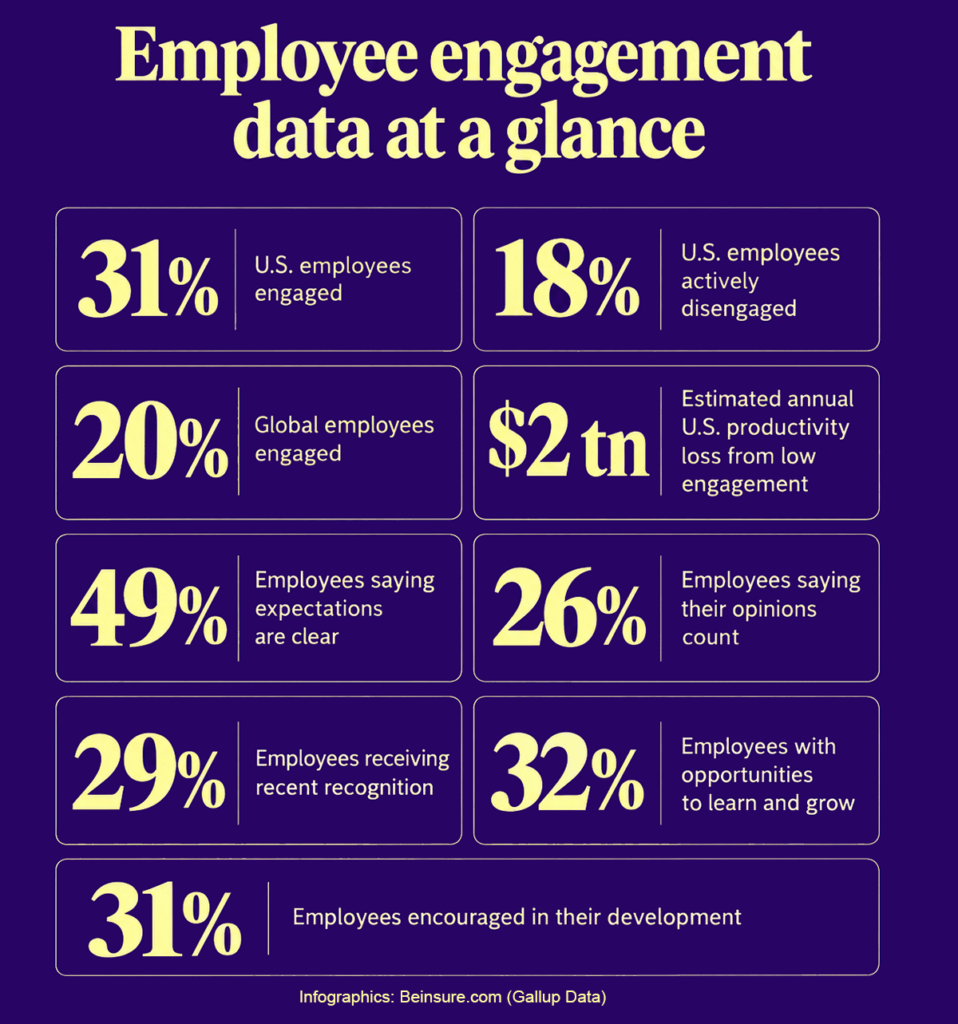
| Metric | Latest figure |
| U.S. employees engaged | 31% |
| U.S. employees actively disengaged | 18% |
| Global employees engaged | 20% |
| Estimated annual U.S. productivity loss from low engagement | $2 tn |
| Employees saying expectations are clear | 49% |
| Employees saying their opinions count | 26% |
| Employees receiving recent recognition | 29% |
| Employees with opportunities to learn and grow | 32% |
| Employees encouraged in their development | 31% |
The practical lesson is less glamorous than most culture programs. Engagement is built or damaged through everyday operating choices: what managers ask for, how priorities move, who gets heard, who gets rewarded, how work is distributed and whether leaders act after asking for feedback.
1. Leadership ownership and action

Treating employee engagement as an HR campaign
Engagement often gets parked inside HR, then expressed through an annual survey, a recognition week or a new benefits message. Daily work keeps running under the same managers, deadlines, approval chains and incentives, so the program has little influence on the experience employees judge each day.
Gallup identifies this separation as a common reason engagement programs fail. Engagement improves when executives own the subject, managers receive clear responsibility for local conditions and teams discuss specific barriers to performance rather than chasing a corporate score.
The practical fix is to put engagement measures beside operating measures. A department head should review engagement data with turnover, absenteeism, internal mobility, quality and customer outcomes, then assign a small number of actions to named managers. HR supplies the method and data. Line leadership owns execution.
Employee engagement in the U.S. fell to its lowest level in a decade, with only 31% of employees engaged. This matches the figure last seen in 2014. The percentage of actively disengaged employees, at 17%, also reflects 2014 levels.
Asking employees for feedback and doing nothing with it
A pulse survey creates an implicit deal: employees spend time giving information and expect visible action afterward. Repeated surveys with no response teach people the opposite lesson. Speaking up produces another dashboard, not a change.
Gallup warns engagement is likely to fall when organizations collect survey feedback and fail to act. Current U.S. data also show only 26% of employees strongly agree their opinions count at work as of May 2026.
A better process starts before the survey launches. Leaders should decide which topics are open to change, who owns each result and when employees will hear back.
After results arrive, publish what will change, what will stay, who owns each action and the reason behind decisions. Then report progress before sending another questionnaire.
Practice case: Leadership ownership and action at Allianz
Allianz offers a practical example of turning employee feedback into management action rather than leaving engagement with HR. Its Allianz Engagement Survey collects anonymous feedback across the group, and management has used the findings to create an internal engagement hub covering health and wellbeing, management and strategy, work processes, learning, and recognition. In 2025, 84% of employees participated in the survey and the Employee Engagement Index reached 80%. The useful part of the practice is the follow-through: survey findings feed into initiatives across teams and functions instead of ending with a score presented once a year.
2. Manager capability and accountability
Leaving managers unprepared for the job
Companies often promote strong individual performers into management and assume technical credibility will translate into coaching skill. The new manager inherits hiring, performance discussions, workload decisions, conflict, development and increasingly AI adoption, often without enough time or preparation.
This matters because managers account for 70% of the variance in team engagement in Gallup’s research. Manager engagement itself has also deteriorated globally, falling from 31% in 2022 to 22% in 2025.
Manager development should focus on work managers perform every week: setting expectations, prioritizing, giving useful feedback, dealing with weak performance, recognizing good work and removing obstacles. Training without time is pointless.
Leaders also need to strip low-value administration from manager roles so coaching isn’t squeezed between approvals and status reporting.
Tolerating poor performance while relying on strong employees
Few things damage engagement faster than watching weak performance go unaddressed while reliable employees carry the extra load. Managers often avoid difficult conversations because they want to preserve harmony, lack confidence in the performance process or assume the team will compensate. The team usually does compensate, but the strongest people pay for it.
Employees start questioning whether standards mean anything when missed deadlines, weak output or poor behavior have no consequences. High performers also learn that doing more earns them additional work, while doing less appears relatively safe. Over time, effort starts to look irrational.
Managers should separate temporary performance problems from persistent ones, set specific expectations and give employees a reasonable opportunity to improve. If the problem continues, address it directly instead of redistributing the work indefinitely. Accountability protects the rest of the team as much as it manages the individual employee.
Practice case: Manager capability and accountability – AXA
AXA changed its global Performance Management Policy in May 2024 to give managers a more defined role in employee performance and development. Employees and managers set individual and team goals together, with business and development objectives included in the process. The policy calls for regular check-ins during the year so managers can address obstacles and adjust expectations before the annual review. Career discussions are held separately from performance reviews, with managers expected to act as coaches and help employees identify skills and development plans. This structure makes management responsibility continuous rather than concentrating it in one annual appraisal meeting.
3. Priorities, workload and focus
Keeping priorities vague or changing them without resetting expectations
Ambiguity drains attention. An employee with five priorities, each described as urgent, does not have five priorities. The person has a sequencing problem delegated downward by management.
Only 49% of U.S. employees strongly agreed they knew what was expected of them at work in the first half of 2026. Gallup also reports employees who strongly agree their job description matches the work they perform are 2.5 times more likely to be engaged.
Managers need to define outcomes, decision rights, deadlines and trade-offs. When a new priority enters, something else should move, shrink or stop. A useful weekly conversation includes four questions: what matters most now, what changed, what is blocked and what work should be deprioritized.
Business impact of high employee engagement
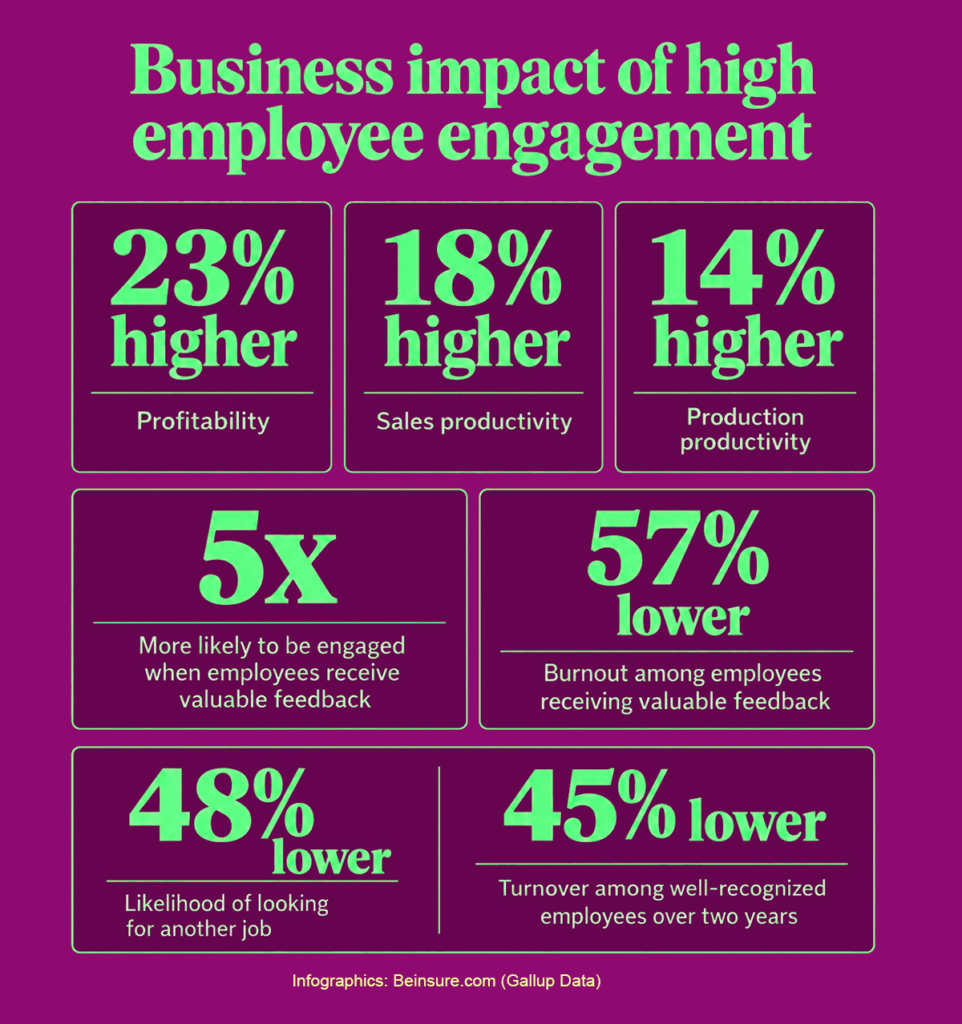
| Outcome | Top engagement quartile vs. bottom quartile |
| Profitability | 23% higher |
| Sales productivity | 18% higher |
| Production productivity | 14% higher |
| Employee engagement when receiving valuable feedback | 5x more likely |
| Burnout among employees receiving valuable feedback | 57% lower |
| Likelihood of looking for another job | 48% lower |
| Turnover among well-recognized employees over two years | 45% lower |
Turning every request into an emergency
Permanent urgency is poor prioritization wearing a management badge. When every client request, executive idea and internal task gets an ASAP label, employees lose any rational basis for planning and start optimizing for whoever shouts loudest.
Workload has a direct relationship with burnout. Gallup reports employees who strongly agree they always have too much to do are 2.2 times more likely to experience frequent burnout, while employees who often or always have enough time for their work are 70% less likely to report high burnout.
Leaders should separate true emergencies from normal high-priority work and planned commitments. Use explicit service levels, capacity limits and escalation rules. If demand exceeds capacity for several weeks, the response is a staffing, scope or process decision, not another message asking people to move faster.
Rewarding high performers with endless extra work
Reliable employees often become the default destination for unfinished work. Managers trust them, so more projects land on the same desks while weaker performers carry lighter loads. The short-term logic is understandable. The long-term message is rotten: competence earns workload.
Gallup finds employees who report frequent unfair treatment are 2.3 times more likely to experience high burnout. Uneven workload also damages peer relationships because employees see effort and accountability being priced differently inside one team.
Managers should review workload by hours, complexity, emotional demand and deadline pressure, not task count alone. Stretch assignments need a benefit for the employee, such as exposure, learning, authority or a plausible path to advancement. Persistent underperformance needs direct management rather than quiet redistribution to the strongest people.
Filling the week with meetings and interruptions
Meeting overload often looks like collaboration from the organizer’s calendar and fragmentation from everyone else’s. Employees sit through status calls, then complete the work after hours because the workday itself was consumed by coordination.
Microsoft’s research found 68% of workers said they lacked enough uninterrupted focus time, while inefficient meetings ranked as the leading productivity disruption in its survey.
More recent Microsoft telemetry found employees interrupted by a meeting, email or notification every two minutes on average during the workday.
Every recurring meeting should earn its place. Require a decision, discussion or coordination purpose which asynchronous work does not cover well. Cancel meetings used for one-way updates, cut attendee lists, protect blocks for focused work and measure meeting hours by team. Calendar volume is an operating cost.
Practice case: Priorities, workload and focus – insurance underwriting case
An insurance underwriting case reported by Hexaware shows what happens when skilled employees spend too much time on intake work. Underwriters at an unnamed insurer were manually reading submission documents, extracting facts and performing first-level appetite checks, which slowed broker responses and reduced time available for risk analysis. Hexaware introduced an AI Insurance Copilot while keeping final risk decisions with underwriters. According to the company, around 90% of initial triage for complex accounts was automated. Routine work moved through the process faster, while underwriters gained more time for complex risks and higher-value analysis instead of repeatedly performing document intake.
4. Feedback and recognition
Giving feedback too late
Annual reviews are a weak delivery mechanism for information someone needed eight months ago. Employees need enough feedback to adjust while the work, decision and context are still fresh.
Gallup and Workhuman found only one in four employees strongly agree they receive valuable feedback from people at work.
Employees who do receive valuable feedback are five times as likely to be engaged, 57% less likely to be burned out and 48% less likely to be looking or watching for another job.
Frequent does not mean constant commentary. A 15- to 30-minute weekly conversation often gives enough room to cover priorities, recent work, obstacles and development. Formal reviews then become a documented discussion of a year already discussed, rather than an ambush.
Using feedback mainly to discuss mistakes
Some managers become visible only when work goes wrong. Silence follows good execution, then a missed deadline or bad call suddenly produces detailed attention. Employees quickly learn visibility equals danger.
KPMG’s research on meaningful manager conversations finds discussions centered only on weaknesses are less useful than conversations including goals, strengths, recent work and recognition. Public criticism adds another problem by raising the personal cost of speaking openly about mistakes.
Correct errors directly and specifically, but keep the discussion tied to future behavior. Ask what happened, what information was missing, what decision should change next time and whether the system contributed. Good performance deserves equally specific feedback so employees know which behaviors the organization wants repeated.
Treating recognition as fluff
Recognition is often reduced to birthday posts, generic praise or annual awards. None tells an employee what contribution mattered or why. Worse, leaders sometimes take credit upward while distributing blame downward.
Only 29% of U.S. employees strongly agreed they had received recognition or praise for good work during the previous seven days. Workhuman also found well-recognized employees were 45% less likely to have left their organization two years later.
Useful recognition is timely and specific. Name the work, the effect and the judgment or effort behind it. Credit should travel to the person who did the work, including in executive meetings, customer conversations and project summaries where reputation affects future opportunity.
Practice case: Feedback and recognition – Allianz
Allianz has also tied employee feedback directly to recognition practices. Its annual engagement survey asks employees about their workplace experience, then uses those findings to shape group initiatives. Employee feedback led Allianz to create an engagement hub in which recognition and rewards became one of five areas for action. The insurer’s approach treats recognition as part of everyday management rather than an occasional award program. Allianz also uses survey data to identify where employee experience needs attention across teams and functions. The case shows why feedback works better when employees see a visible connection between what they report and the management practices that follow.
5. Fairness and consistent standards
Applying different standards to different people
Employees notice who gets flexibility, desirable assignments, forgiveness, visibility and promotion. They also notice who gets scrutinized for behavior tolerated elsewhere. Once decisions look personal rather than principled, trust erodes fast.
Pew found only 30% of U.S. workers were highly satisfied with pay in its 2026 survey, while only 26% were highly satisfied with promotion opportunities. Among workers dissatisfied with pay, 71% said pay was too low for the quality of their work and 70% said it was too low for the amount of work.
Researchers has separately reported only 22% of employees strongly agree their performance review process is fair and transparent.
Manager practices with the biggest engagement effect
| Management practice | What good execution looks like |
| Expectations | Employees know the outcome, deadline and decision boundaries |
| Workload | Work is distributed by capacity and complexity, not reliability alone |
| Feedback | Specific, timely and tied to work employees recently completed |
| Recognition | Names the contribution and its business effect |
| Development | Employees have a realistic next skill, project or responsibility |
| Communication | Teams understand what changed and why |
| Autonomy | Experienced employees control how agreed outcomes are delivered |
| Fairness | Comparable situations are handled using comparable criteria |
Managers need written criteria for performance, pay decisions, promotion and access to high-visibility work. Exceptions will exist, but the reasoning needs to survive scrutiny. Consistency is not identical treatment. It is comparable logic applied to comparable cases.
Practice case: Fairness and consistent standards – Zurich Insurance
Zurich Insurance has built a recurring process around pay equity rather than relying on individual managers to judge whether compensation looks fair. Most Zurich businesses with at least 100 employees conduct annual pay-equity analysis as part of the remuneration cycle, examining whether gender affects pay for equivalent work. Where abnormalities appear, the company says corrective action is taken. In 2025, Zurich also recommended that its country operations work toward a pay-equity range of ±5%, unless local rules require another standard. Women accounted for 53.8% of promotions during the year. The practice puts measurable criteria behind decisions employees often perceive as subjective.
6. Autonomy, flexibility and growth
Micromanaging capable employees
Micromanagement usually starts with risk aversion. Managers want visibility, consistency or reassurance, then turn those needs into approval loops, repeated check-ins and detailed instructions on work an experienced employee already knows how to perform.
The cost appears in slower decisions and weaker ownership. Research on work flexibility also finds stronger engagement and wellbeing where employees experience control over work and boundaries.
Engagement framework similarly places emphasis on employees having the opportunity to use their strengths in daily work.
Common employee engagement problems and practical fixes
| Problem | What employees experience | Practical management response |
| Unclear priorities | Conflicting demands and constant reprioritization | Set explicit priorities and remove lower-value work when new requests arrive |
| Excessive workload | Burnout, longer hours and declining quality | Review capacity, staffing, deadlines and scope |
| Micromanagement | Low autonomy and slower decisions | Manage outcomes, constraints and checkpoints instead of every task |
| Weak feedback | Employees don’t know where they stand | Hold regular conversations tied to recent work and future actions |
| Poor recognition | Strong work feels invisible | Recognize specific contributions close to when they occur |
| Unequal standards | Perceived favoritism and weak trust | Use written criteria for performance, pay and promotion |
| No growth path | Stagnation and increased turnover risk | Create skill, project and internal mobility opportunities |
| Too many meetings | Fragmented attention and after-hours work | Remove status meetings and protect uninterrupted work time |
| Weak communication | Rumors and uncertainty during change | Explain confirmed decisions, open questions and business reasoning |
| Survey inaction | Employees stop believing feedback matters | Assign owners, deadlines and visible follow-up to survey results |
A manager should define the outcome, constraints, budget, deadline and points where consultation is required. The employee owns the route between those points. Closer supervision belongs around genuine performance problems, new roles or high-risk work, with a clear reason and an exit condition.
Offering no credible path for growth
A promotion is one form of growth, not the entire concept. Employees also develop through harder assignments, new skills, broader authority, mentoring and movement across functions.
Only 32% of U.S. employees strongly agreed they had opportunities to learn and grow during the previous year, and 31% said someone at work encouraged their development. Separate research in 2025 found one in four U.S. employees reported no advancement opportunities in their organization.
Managers should discuss development as work design, not as an annual career question. Identify one skill to deepen, one new responsibility to test and one person or project offering exposure. If promotion is unlikely in the near term, say so plainly. False hope damages trust more than an honest constraint.
Calling flexibility a benefit while ignoring boundaries
Flexible work loses much of its value when employees have little control over where work ends. A remote employee expected to answer evening messages, join meetings across time zones and remain visibly online has location flexibility without meaningful boundary control.
APA’s Work in America survey found 45% of employed adults said they worked more hours per week than they wanted, while 67% reported at least one experience associated with burnout during the previous month.
Academic research published in the Journal of Vocational Behavior also found better engagement and work-life outcomes among flexible workers who had stronger control over both work and social boundaries.
Teams need explicit norms for response times, after-hours contact and time-zone scheduling. Managers should model them. Sending an email at 11 p.m. is harmless only when employees believe, through repeated experience, no response is expected before working hours resume.
Practice case: Autonomy, flexibility and growth – Zurich Insurance UK
Zurich Insurance UK tested what happens when flexible work becomes the default rather than something employees must negotiate. In a Government Equalities Office field trial, new vacancies were advertised as open to part-time work or job sharing unless a manager provided a business reason to opt out. Female applicants increased from 36.4% to 42.4%, a 16.4% rise, while female applications for senior roles increased 19.3%. Part-time employees also reported an 8% increase in their sense of belonging. The study did not establish causality, but it showed how changing job design and manager assumptions can widen access to career opportunities.
7. Communication and purpose
Keeping people in the dark during change
Employees do not need access to every executive discussion. They do need enough context to understand what is changing, why it is changing, what remains undecided and how their work is affected.
People pause decisions, duplicate contingency work or fill gaps with rumor. PwC’s 2026 data show only 31% of U.S. employees strongly agree their organization’s mission or purpose makes their job feel important, while only 26% strongly agree their opinions count.
During a reorganization, technology rollout or strategy shift, leaders should communicate in stages rather than waiting for a perfect announcement. Separate confirmed decisions from open questions. Give managers a briefing before employees ask them for answers, and update old guidance once decisions move.
Failing to connect daily work with a credible purpose
Corporate purpose becomes empty when leaders talk about mission while employees spend most days on work whose value nobody explains. People do not need lofty language. They need a believable connection between effort and an outcome someone cares about.
Only 31% of U.S. employees strongly agreed in May 2026 their employer’s mission or purpose made their job feel important. Stand Together found employees who strongly agree their organization’s mission makes their job important are 3.6 times more likely to report a strong sense of purpose at work.
Managers should make purpose concrete at the level of the job. Show whose problem the work solves, what decision it improves, which customer benefits or which risk it reduces. Then remove low-value work with no defensible link to an outcome. Purpose loses credibility when employees hear inspirational language beside obvious busywork.
Practice case: Communication and purpose – AXA France
AXA France created a formal process for discussing AI with employees as the technology began changing insurance work. In June 2025, management signed an agreement with CFDT, CFE-CGC and UNSA establishing regular dialogue around AI experiments and deployment. Employee representatives receive information at several stages, including the start of experiments, before wider rollout and during subsequent monitoring. AXA also agreed to discuss effects on jobs and skills and provide AI training to employee representatives. An annual update covers major deployments across the French group. Instead of announcing AI projects after decisions are complete, the process gives employees structured visibility while changes are still being introduced.
Declines in employee engagement: key trends
Among the 12 engagement elements saw the most significant declines in 2026 (by three points or more in “strongly agree” ratings) include:
- Just 46% of employees clearly know what is expected of them at work, down 10 points from a high of 56%.
- Currently, 39% of employees feel strongly that someone cares about them, a drop from 47%.
- Only 30% strongly agree that someone at work encourages their development, down from 36%.
Global employee engagement edges down
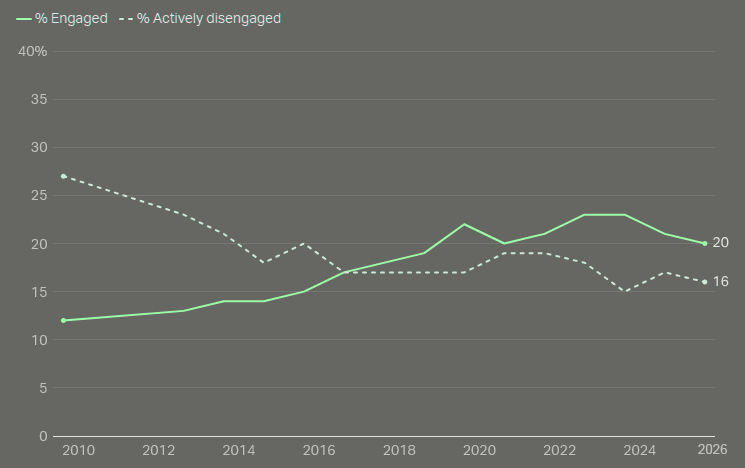
People of all ages come to work seeking role clarity, strong relationships and opportunities for development, but managers, combined, are progressively failing to meet these basic needs. However, managers themselves are faring no better than those they manage, with only 31% engaged.
Annual employee engagement in the U.S., World and Best-Practice Organizations
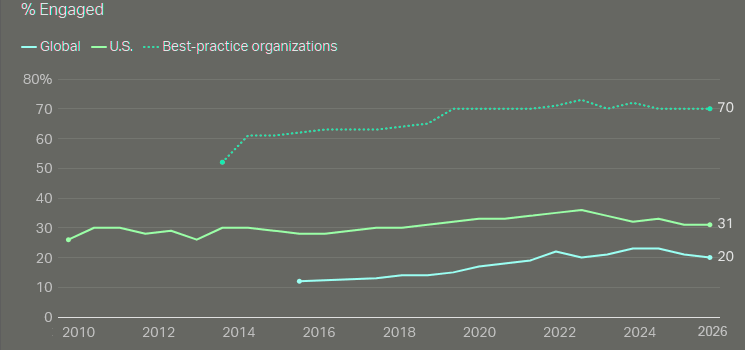
In 2026, 20% of employees were engaged globally and 31% were engaged in the U.S. These engagement levels have held fairly steady over the last several years, though they pale in comparison to what best-practice organizations achieve (an average engagement rate of 70%).
Where leaders should start
Fixing employee engagement does not require launching 7 key initiatives at once. Start with team-level data and operating evidence: engagement items, regretted turnover, absence, workload, meeting hours, internal moves, performance outcomes and exit themes.
Look for clusters rather than company averages, because one strong corporate score often hides large differences between managers. Gallup specifically recommends action at team level and warns against treating surveys as the end of the process.
The first management cycle should be short. Pick two conditions employees experience every week, assign an owner, define a behavior managers will change and review the evidence after 30 to 60 days.
- If employees said priorities are unclear, the response is not another communication campaign.
- If recognition is weak, managers need to name useful work when it happens.
- If workload is broken, leaders need to change demand, staffing or scope.
Employee engagement improves when the operating environment gives people a fair chance to perform well. Clear expectations, sane workload, useful feedback, credible recognition, growth, voice and manager support are ordinary management disciplines. Companies lose engagement when those disciplines become optional.
What highly engaged employees achieve
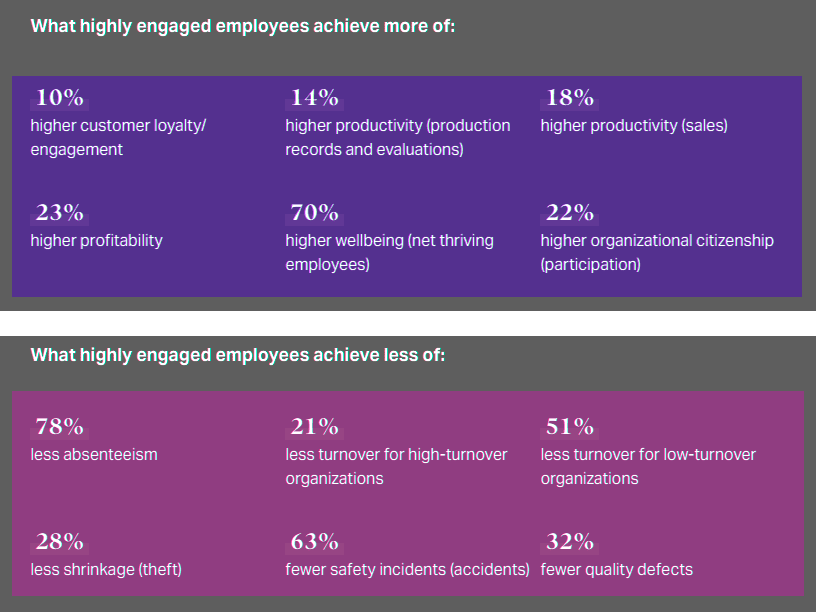
Employees make decisions and take actions every day that can affect both the workforce and organizational effectiveness. The way a company treats employees and how employees treat one another can positively affect their actions or can place an organization at risk.
- Engaged employees are highly involved in and enthusiastic about their work and workplace. They are psychological “owners,” drive high performance and innovation, and move the organization forward.
- Not engaged employees are psychologically unattached to their work and company. Because their engagement needs are not being fully met, they’re putting time, but not energy or passion, into their work.
How leaders can increase employee engagement
- Align engagement efforts with the organization’s broader employee experience strategy.
- Communicate the importance of employee engagement.
- Build trust in the benefits of engagement.
- Model engaging behaviors.
- Redefine managers’ roles and expectations.
- Provide employee engagement tools, resources and development that managers need to coach team members and meet those expectations.
- Create evaluation practices that help managers accurately measure performance and hold employees accountable.
Once executives are committed, managers are essential to engagement. In fact, 70% of the variance in team-level engagement is determined solely by the manager.
………………
AUTHORS: Oleg Parashchak – CEO & Founder of Finance Media, Tetiana Mykhailova – Senior Analyst & CFO of Beinsure, Commercial Director of Finance Media