Insurers have spent the past few years testing AI one use case at a time, from underwriting support to claims automation. Google and CoverGo argue the next phase will look less like a collection of tools and more like an operating model built around autonomous agents, shared data and human control. Their new whitepaper examines what needs to change before those agents start working across the same insurance organisation.
Insurance in the Agentic Era: From AI use cases to an Agentic Insurance Core Operating System, a new whitepaper by Maxim Afanasyev of Google and Tomas Holub of CoverGo, examines what Agentic AI means for insurance.
We read the whitepaper as a shift away from isolated AI projects. The paper draws on experience spanning AI, insurance technology and modernisation. Its argument goes well beyond automation of isolated tasks. AI agents isn’t presented as another productivity layer placed over existing processes.
Key highligths
- Agentic AI shifts insurance beyond isolated automation. Agents begin working across underwriting, claims, distribution and servicing, which forces insurers to rethink operating structures and technology foundations.
- The Agentic Insurance Operating System connects specialised agents with insurance data, business tools and existing systems. Human judgement remains part of sensitive decisions, especially where customer impact or regulatory exposure is high.
- Underwriting faces a new information problem. Generative AI makes credible-looking signals easier to produce, weakening some indicators insurers historically used to assess risk.
- Legacy systems present a structural constraint. Fixed workflows and fragmented data estates make real-time agent coordination difficult, especially across older policy and claims platforms.
- Human control remains embedded in the proposed model. Confidence thresholds, mandatory review steps and audit records limit agent authority and preserve accountability.
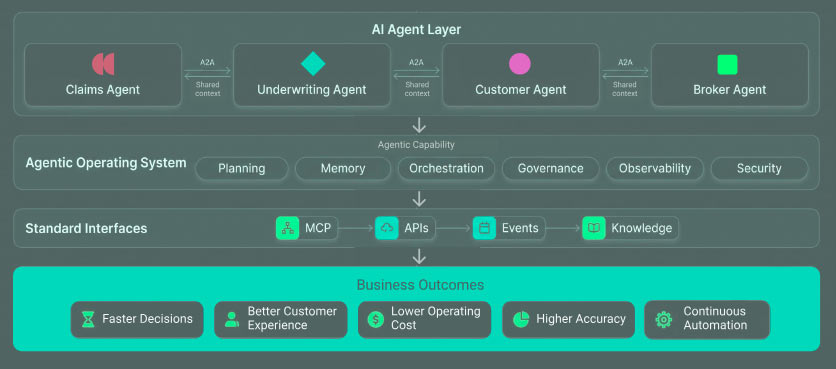
The paper introduces the idea of an Agentic Insurance Operating System. In this environment, specialised agents receive access to insurance context and operational tools. They work with other agents, interact with existing systems and pass decisions to people when human judgement is required.
As AI agents spread across distribution, underwriting, claims and servicing, insurers face a more structural question. Their operating models and technology foundations need to change alongside those agents.
Such an operating model introduces new problems too. Agents might conflict, authority boundaries require definition, and poor data becomes more damaging. Governance and human supervision also move closer to system architecture rather than remaining separate control functions.
The whitepaper includes a reference architecture showing how these elements work together. It also proposes a five-step modernisation path for insurers moving beyond isolated AI projects. The end goal is coordinated agentic operations across a wider insurance organisation.
How market forces inside insurance change under Agentic AI
The first part of the approach focuses on the business domain. It asks how market forces inside insurance change under Agentic AI. It also considers where insurers create value and what position each organisation wants to occupy. This part receives less attention than technology (see What Drives the Accelerated AI Adoption in the Insurance Industry?). According to the paper, ignoring it exposes insurers to long-term strategic risk.
Business-domain thinking is inherently long term. Many Asian organisations remain privately controlled and face less pressure from quarterly reporting cycles. Management therefore has more room to prioritise longer-term business needs.
Rapid economic change across Asia has shaped this behaviour further. Companies across the region have become used to practical business decisions and regular challenges to established operating assumptions.
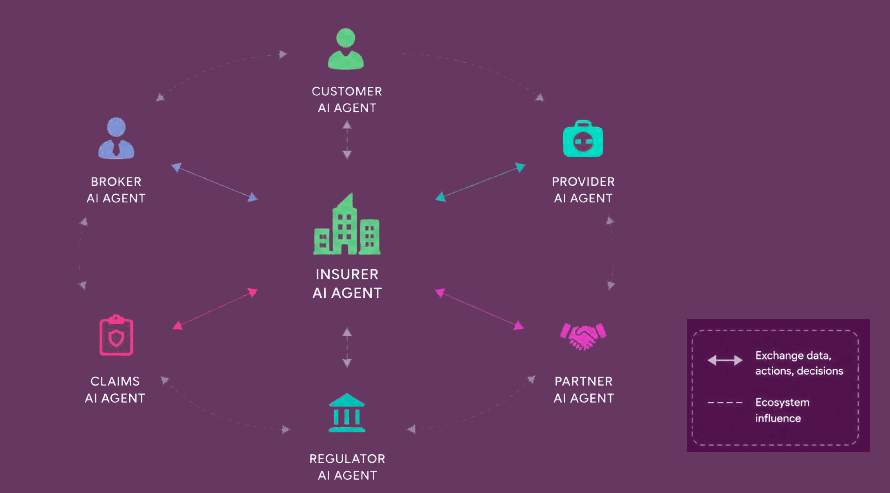
AI agents across the insurance ecosystem interact, collaborate, and compete in real time
The economics of Agentic AI differ sharply by market
In developed economies with expensive labour, many insurers initially view Agentic AI through an efficiency lens. The obvious use case is automating existing work and reducing labour costs (see Artificial Intelligence Promises to Revolutionize P&C Insurance Industry).
Much of Asia starts from a different cost base. Labour remains relatively inexpensive across many markets. Financial institutions in the region therefore question an AI business case built mainly around operational savings.
Customer behaviour provides another reason to look further ahead. Younger consumers represent a large share of Asia’s population and are adopting AI agents quickly for financial tasks. This behaviour is already changing how customers interact with financial services. Similar shifts might remain less visible in developed markets.
Legacy insurance model vs agentic model
| Area | Traditional operating model | Agentic operating model |
| Workflows | Fixed and centrally prescribed | Modular and adaptable |
| Decision execution | Employee follows defined procedures | Agent executes within assigned authority |
| Data access | Often fragmented across systems | Designed for near real-time retrieval |
| Exceptions | Escalated through manual processes | Routed according to confidence and authority rules |
| Technology structure | Applications operate separately | Agents communicate across systems |
| Human role | Executes much of the workflow | Reviews exceptions and sensitive decisions |
| Change management | Processes change through formal releases | Agent behaviour responds faster to business changes |
Customers aren’t the only actors using agents. Partners and other insurance participants are doing the same. Once agents begin acting on behalf of several parties, long-established processes start losing relevance. The change reaches underwriting directly.
Agentic AI changes insurance signals
The paper uses underwriting to illustrate a deeper economic problem. Generative AI weakens signalling mechanisms used across modern insurance markets.
Insurance has always faced information asymmetry. In some cases, policyholders know more about their loss probability than insurers. The market for lemons theory describes one possible consequence.
People expecting larger or more frequent losses have stronger incentives to buy coverage. Insurers therefore depend on credible signals when judging individual risk (see about Artificial Intelligence in Insurance. How Does AI Technology Help Insurers?).
In life insurance, medical records provide one example. Such signals have value partly because weak-risk actors cannot easily imitate them.
Generative AI changes this equation
An actor with poor risk characteristics now has access to systems able to produce convincing information. Quality of presentation no longer guarantees quality of the underlying signal.
For insurers, this weakens confidence in information previously used during decision-making. The paper points to empirical research already finding reduced trust in signals across several industries.
This problem extends beyond underwriting models. It reaches how insurers organise people and processes. For every 100 men using generative AI, only 78 women use the technology, according to research from Harvard Business School. The difference raises concerns about unequal access to AI tools, workplace opportunities and participation in decisions affecting how artificial intelligence is developed and deployed.
CRM platforms and online connectivity helped large institutions impose standard procedures across global operations. Employees followed rule books created by senior management and headquarters.
Many legacy financial institutions therefore operate much like industrial production systems. Processes resemble fixed production lines, and employees receive limited discretion outside prescribed procedures.
Such structures worked better in a deterministic operating environment. Agentic AI introduces a more stochastic economy, with continuous and less predictable change.
Building an Agentic Insurance OS
Agentic AI requires a technology foundation built for autonomous software participants. Agents need room to operate, coordinate and change inside an institutional framework.
Most legacy insurance platforms weren’t designed for this purpose. Their architecture assumes fixed workflows and deterministic, rule-based operations.
Agentic systems need modular interoperability instead. Interfaces must remain open enough for processes to be broken into smaller pieces. Individual tasks then move between agents, systems and people as requirements change (see about Generative AI Exclusions Spread Across Contractor Insurance Policies).
Agentic Insurance Operating System components
| Component | Purpose | Insurance application |
| AI agents | Execute specialised tasks within defined authority | Underwriting assessment, claims review, servicing |
| Insurance context | Supplies product, customer and policy information | Coverage checks, eligibility review, risk assessment |
| Open interfaces | Connect agents with existing technology | Policy systems, claims platforms, CRM environments |
| Human review | Handles sensitive or uncertain decisions | Large claims, unusual risks, regulatory exceptions |
| Audit records | Record agent decisions and interventions | Compliance reviews, internal controls, regulatory examination |
CoverGo sees insurers adopting AI separately across departments. This approach has a clear operational logic. Isolation limits exposure and gives individual teams space to prove value (see how AI Agents Push Cyber Insurers to Rethink Policy Language). It also creates a larger problem later. Separate AI modules eventually need to operate together.
Once several independent agents pursue one objective, new failure modes appear. Those problems don’t necessarily exist when each agent works alone.
An underwriting agent might optimise risk selection. A claims agent might optimise settlement speed. A servicing agent might prioritise customer retention. Their objectives won’t always agree.
Agentic OS: Multi-Agent Collaboration Reference Architecture
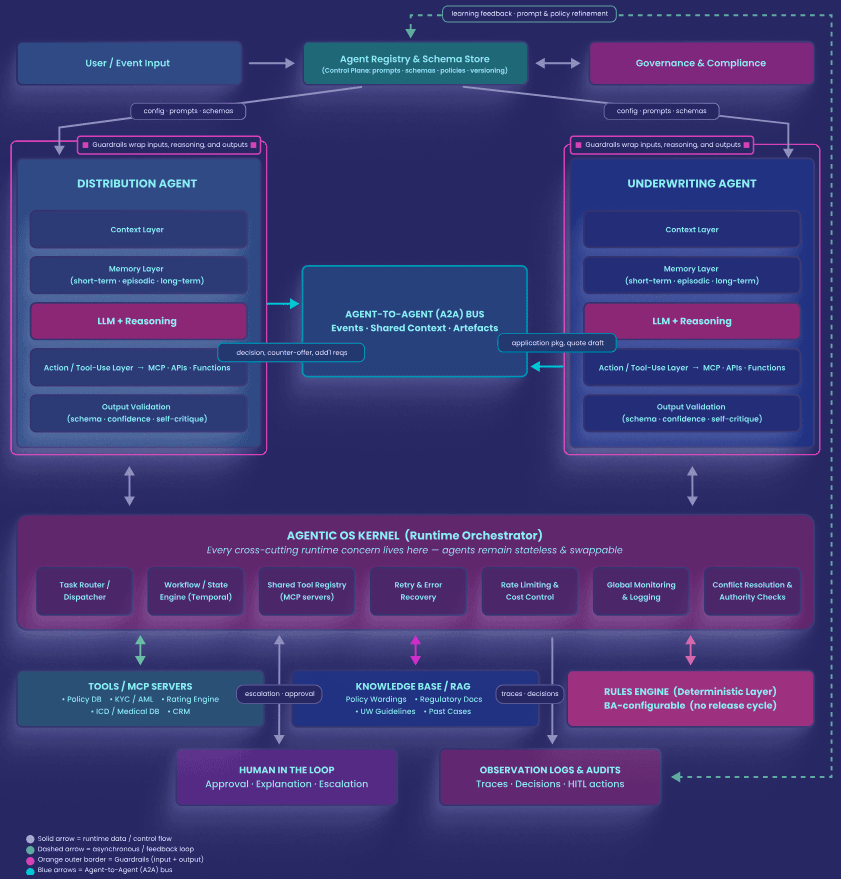
The operating system therefore needs more than agent access. It needs rules governing authority, coordination, escalation and intervention.
Insurance data remains a major constraint
Insurance presents another problem through the scale and variety of unstructured information. Decades of paper policies, claims files and inconsistent digitisation created fragmented data estates (see why Most AI Projects Fail to Deliver ROI). Conditions differ between markets, product lines and older technology stacks.
The paper identifies three main investment areas. Vector databases support semantic search across large document collections. Agents retrieve relevant context without relying only on exact keyword matching.
Structured extraction pipelines convert unstructured documents into records suitable for machine processing. Agents then reason and act using cleaner information.
Data foundations for agentic insurance
| Investment area | Function | Insurance example |
| Vector databases | Retrieve context by meaning rather than exact wording | Searching policy wording or claims documents |
| Structured extraction | Convert documents into machine-readable records | Extracting fields from claims forms or medical files |
| Master data management | Maintain authoritative reference information | Provider networks, diagnosis codes, benefit tables |
Master data management provides authoritative reference datasets. Provider networks, diagnosis codes and benefit tables are typical examples.
Agents use these datasets for lookup, matching and adjudication during live workflows. Weak data foundations leave agentic programmes stuck in pilots.
Agentic AI in insurance must be designed with human oversight
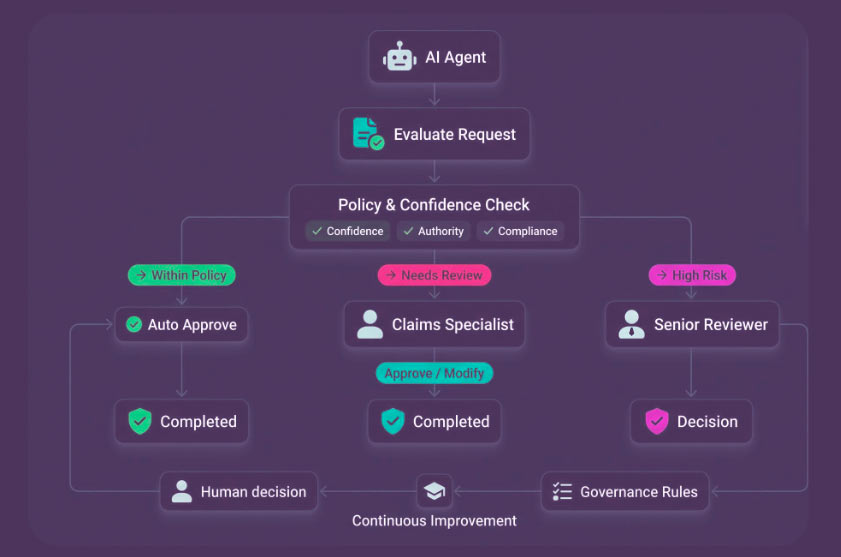
Agentic AI in insurance still requires people. Human oversight needs to be part of system design from the beginning. The authors and regulators take a similar position. Autonomous systems affecting customers need auditability, explainability and interruption mechanisms, referring to IAIS guidance from 2024. Safeguards therefore belong inside the architecture. Agents shouldn’t receive unlimited authority over sensitive decisions.
Confidence scoring offers one control. Each AI output receives a numerical confidence estimate. Results below configured thresholds move to human staff automatically.
Mandatory review workflows provide another layer. High-value claims, unusual underwriting profiles and regulatory exceptions move through human approval before execution. Those approval steps aren’t optional under the proposed model. Agents remain blocked until the required review is completed.
Governance controls for insurance AI agents
| Control | How it works | Purpose |
| Confidence scoring | Each output receives a confidence value | Routes uncertain results to people |
| Mandatory review | Selected decisions require human approval | Restricts autonomous action in sensitive cases |
| Feedback loops | Human corrections feed future system behaviour | Improves later agent decisions |
| Audit trails | Decisions and overrides are recorded | Supports review and accountability |
| Authority limits | Agents operate within defined permissions | Prevents actions outside approved scope |
Human corrections feed back into the models and improve later agent performance. Audit trails record what an agent decided and its confidence level. They also show whether a person later changed or rejected the recommendation.
The resulting model is less about adding AI tools to legacy insurance processes. It describes a different operating structure built around agents, data access and human authority.
For insurers, the harder work starts when separate AI experiments begin interacting. Technology alone won’t resolve those conflicts. Operating rules, data quality and institutional judgement still determine how far agentic insurance progresses.
What is Agentic AI in insurance?
Agentic AI refers to AI systems able to perform tasks with greater operational autonomy. In insurance, agents might assess underwriting information, review claims, retrieve policy data or coordinate work across several systems.
What is an Agentic Insurance Operating System?
It is the operating environment described in the Google and CoverGo whitepaper. Specialised AI agents access insurance information, use business tools, communicate with other agents and involve people when required.
How does Agentic AI differ from traditional insurance automation?
Traditional automation usually follows predefined workflows. Agentic systems operate with broader decision authority, using available context to select actions within defined boundaries.
Why does Agentic AI create new underwriting risks?
Generative AI makes convincing documents and signals easier to produce. Some information previously treated as credible evidence therefore becomes less reliable during underwriting.
Why are legacy insurance systems a problem for Agentic AI?
Many older platforms were built around fixed processes and isolated applications. Agentic operations require faster data access and interfaces that allow tasks to move between agents, systems and people.
What data infrastructure does Agentic AI require?
The paper points to semantic retrieval, structured document extraction and authoritative reference data. These systems give agents usable information during underwriting, claims and servicing workflows.
Will Agentic AI remove human decision-making from insurance?
The proposed model keeps people involved in sensitive decisions. Low-confidence outputs and high-impact cases move to human review, while audit records document agent actions and later overrides.
………………
AUTHORS: Oleg Parashchak – CEO & Founder of Finance Media, Peter Sonner – Lead Tech Editor at Beinsure