Artificial intelligence presents a material credit downgrade risk for issuers in a relatively small group of sectors under adverse conditions, according to Fitch Ratings. Most issuers and transactions would avoid broad rating changes under the scenarios tested.
Fitch assessed AI-related credit exposure across Corporates, Financial Institutions, Infrastructure and Structured Finance over a five-year period.
The agency modeled three adverse scenarios covering disruption, over-investment and asset impairment, each assigned an estimated 10-20% likelihood over the next five years.
The disruption scenario assumes AI weakens incumbent competitive positions faster than companies adapt their business models. The over-investment scenario assumes AI monetization falls short of expectations and capital flows supporting AI-related capex decline, while the asset-impairment scenario examines deterioration in loans and investments tied to AI-exposed entities.
Key highlights
- 86% of sub-sectors show limited ratings impact. Fitch tested 107 sub-sectors across 21 broader sectors, and about 86% scored 40 or below under its AI stress scenarios.
- Only 14 sub-sectors show stronger downgrade pressure. These scored either 60 or 80, levels associated with more pronounced pressure on credit factors and the potential for one or more notch downgrades.
- Services face the greatest disruption exposure. Business process outsourcing and outsourced production services scored 80, while insurance brokers, IT services, and cybersecurity/IT operations scored 60.
- AI over-investment risk is concentrated in infrastructure and hardware. Semiconductors, memory/storage and AI training facilities each scored 60. GPU/AI compute ABS received the highest Structured Finance score at 50.
- Insurance and most financial institutions remain relatively insulated. Insurance, real estate, transportation and natural resources were among the least affected sectors. Most Financial Institution scores fell between 0 and 20, supported by diversification, regulation, capital buffers and risk management.
The scenarios aren’t mutually exclusive. Fitch scored sector exposure on a scale of 0 to 100, with scores of 40 or higher indicating potential negative rating pressure for a representative issuer under an adverse scenario, based on the agency’s rating criteria.
Most insurers recognise the urgency around AI transformation. Investment is rising, senior executives are paying closer attention, and companies continue to test new applications across the business.
Nearly half of insurance executives surveyed believe their organizations are among the industry’s AI leaders, yet new KPMG International research finds that confidence may be running ahead of meaningful business transformation.
Yet research with insurance leaders suggests many organisations are still using AI inside existing processes rather than rethinking how value is created, delivered and measured. That limits the impact of investment and keeps much of the technology focused on incremental process improvement.
While 77% insurers believe failing to redesign their enterprise architecture for AI will undermine competitiveness within five years, 71% say their primary use of AI remains content generation and routine task automation. Just 29% report running front-to-back processes through AI agents or automation, while 68% say moving too slowly on AI transformation is a greater risk than moving too fast.
AI stress-test framework
| Scenario | What Fitch tests | Main areas exposed |
| Disruption | AI weakens incumbent business models faster than firms adapt | Services, software, insurance brokers, IT services, cybersecurity/IT operations |
| Over-investment | AI monetization disappoints and capital flows into AI capex decline | Semiconductors, memory/storage, AI training facilities, GPU/AI compute ABS |
| Asset impairment | Loans and investments tied to AI-exposed entities deteriorate | Business development companies, parts of Structured Finance |
Some insurers have historically believed that the sector’s significant regulatory requirements provide a buffer against major disruption (see how AI Agents Push Cyber Insureers). The pace and range of technological change make those assumptions unsafe, not least against competitors who do not want to follow traditional insurance models in the first place.
Most sectors show limited ratings exposure

The stress test covered 107 sub-sectors grouped into 21 broader sectors. About 86% scored 40 or below, indicating limited or no expected rating impact under the tested AI scenarios.
Fourteen sub-sectors received scores of either 60 or 80, pointing to greater pressure on credit factors and the possibility of one or more notch downgrades. Those exposures were concentrated in services, data centers and telecommunications, media and technology.
Insurance, real estate, transportation and natural resources were among the sectors with the lowest exposure in Fitch’s assessment.
Within Financial Institutions, a small number of sectors scored 40, including businesses with greater private-client exposure, such as private banking and wealth management, and firms with higher asset portfolio risk, including business development companies.
Sector AI stress scores
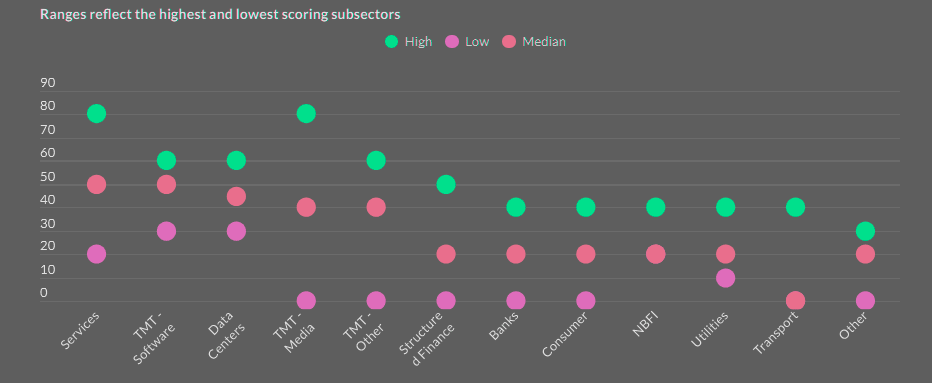
Most Financial Institution scores were between 0 and 20, supported by diversification, regulation, capital buffers and risk management.
Exposure by selected sub-sector
| Sub-sector | Scenario | Fitch score |
| Business process outsourcing | Disruption | 80 |
| Outsourced production services | Disruption | 80 |
| Insurance brokers | Disruption | 60 |
| IT services | Disruption | 60 |
| Cybersecurity / IT operations | Disruption | 60 |
| Semiconductors | Over-investment | 60 |
| Memory / storage | Over-investment | 60 |
| AI training facilities | Over-investment | 60 |
| GPU / AI compute ABS | Over-investment | 50 |
| Business development companies | Asset impairment | 40 |
Stress Test Scores and Indicative Rating Impact
| Score | Indicative Ratings Impact Under an Adverse Scenario |
| 0 | Not relevant. |
| 20 | Minor credit pressure (under the applicable criteria) possible but not enough to move the rating. |
| 40 | Some pressure on the relevant credit factors under applicable criteria sufficient to warrant a Negative Outlook, leading possibly to an eventual one-notch downgrade. |
| 60 | Notable downward pressure on the relevant credit factors under applicable criteria leading to a one- to two-notch downgrade. |
| 80 | Major downward pressure on the credit factors leading to a three- to four-notch downgrade. |
| 100 | Severe downward pressure on the relevant credit factors under applicable criteria leading to a multiple category downgrade and/or a distressed credit profile (i.e. ‘CCC’ category or lower). |
Services face the highest disruption risk
Fitch’s disruption scenario examines the effect of rapid AI deployment on business models, including tasks currently considered too complex or prone to error for AI substitution.
The scenario assumes incumbents have limited time to respond as barriers to entry, switching costs and other competitive protections weaken.
Services recorded the highest exposure. Business process outsourcing and outsourced production services received scores of 80, the highest in the disruption assessment.
Several other services, media and software sub-sectors scored 60. These included insurance brokers, IT services and cybersecurity and IT operations.
Other sectors received lower scores because regulation, long-standing client relationships, enterprise system connections or switching costs provide greater protection against rapid AI-driven displacement.
Sector-level result
| Measure | Result |
| Sub-sectors tested | 107 |
| Broader sectors | 21 |
| Sub-sectors scoring 40 or below | ~86% |
| Sub-sectors scoring 60 or 80 | 14 |
| Highest-risk areas | Services, data centers, TMT |
| Lowest-risk areas | Insurance, real estate, transportation, natural resources |
AI investment slowdown pressures chips and data centers
The over-investment scenario examines what happens if confidence in AI investment returns falls and access to capital becomes more restricted. Under this scenario, hyperscalers and other participants in the AI value chain sharply reduce capital expenditure.
Semiconductors, memory and storage, and AI training facilities each scored 60. Fitch said AI training centers in remote locations with concentrated exposure to lower-quality tenants face greater risk under this scenario.
GPU and AI compute asset-backed securities received the highest Structured Finance score at 50. The rating reflects their exposure to AI-specific collateral and counterparty performance if investment in AI infrastructure weakens (see How Are AI, Geopolitics and Regulation Redefine Corporate Risk in 2026).
Asset impairment matters more for selected financial firms
The asset-impairment scenario focuses on stress affecting AI-related loans and investments rather than direct disruption to a company’s operations. Fitch found this risk is more relevant for certain Financial Institutions and parts of Structured Finance.
Business development companies scored 40 because of their exposure to asset portfolios that include AI-sensitive borrowers and investments. Most other Financial Institution categories remained below levels associated with material rating pressure.
Fitch said this sector-level assessment is the first phase of its AI Stress Test. The next stage will apply the same three-scenario framework to individual Corporate, Financial Institution and Infrastructure issuers.
………………..
AUTHOR: Peter Sonner — Lead Tech Editor at Beinsure Media