- Workplace support contributes to the AI gender gap
- Women’s concerns about AI risk deserve attention
- AI automation poses different risks across occupations
- AI search research finds limited visibility for women experts
- Corrales calls for wider participation in AI governance
- Community AI projects offer another approach
For every 100 men using generative AI, only 78 women use the technology, according to research from Harvard Business School. The difference raises concerns about unequal access to AI tools, workplace opportunities and participation in decisions affecting how artificial intelligence is developed and deployed.
AI adoption continues across the United States. According to Lorka AI’s State of AI report, 61% of Americans expect to maintain or increase their use of artificial intelligence over the next 12 months.
Yet broader adoption doesn’t guarantee equal participation, especially when access to training, managerial support and professional opportunities differs between groups.
Lorka AI examined these concerns in an interview with Azahara Corrales, an AI governance strategist, author and speaker specializing in responsible AI adoption and women’s leadership in technology. Corrales argues that participation affects whose expertise becomes visible in AI systems and whose needs receive attention during development.
Key Highlights
- For every 100 men using generative AI, only 78 women use the technology. This figure highlights a measurable gender gap in generative AI adoption and suggests that women are participating in the use of these tools at a lower rate than men.
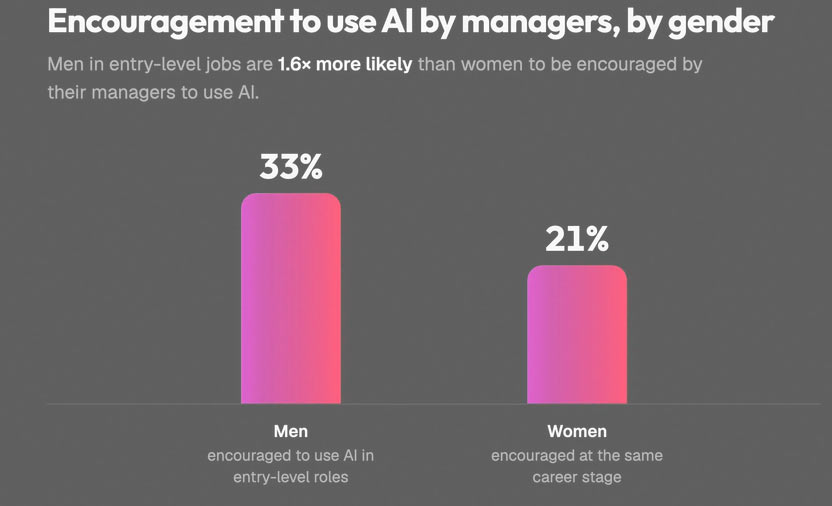
- Among entry-level employees, 33% of men reported being actively encouraged by managers to use AI, compared with 21% of women.
- Entry-level men were approximately 1.6 times as likely as women to receive managerial encouragement to use AI.
- Women represented approximately 20% of experts surfaced by neutral AI search prompts. The study tested 42 expert-discovery questions across 8 sectors and 6 AI search services, including ChatGPT, Google AI Overviews, Google AI Mode, Perplexity, Gemini and Microsoft Copilot.
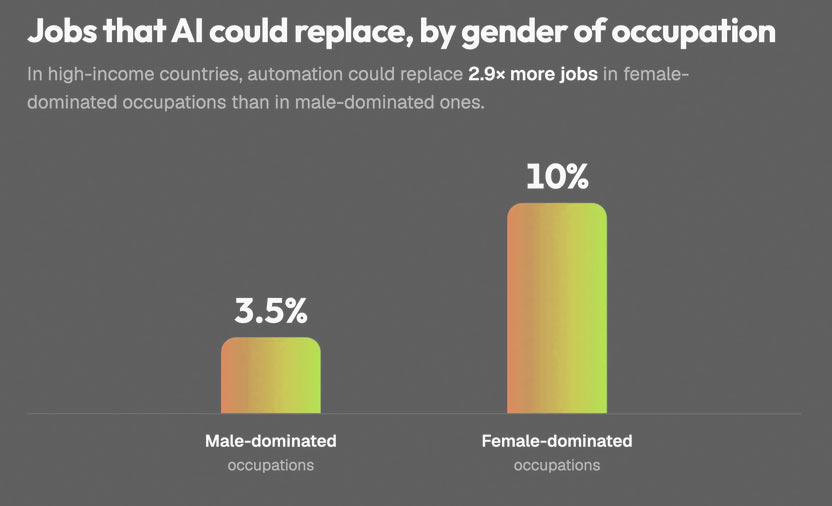
- Automation could affect approximately 10% of jobs in female-dominated occupations in high-income countries, compared with 3.5% in male-dominated occupations.
“If only one part of society is using them, that is the only part of the world they will reflect,” Corrales said. Her concern extends beyond current adoption figures to the influence different groups have over technology increasingly used in professional and personal decisions.
Workplace support contributes to the AI gender gap

Research cited from the McKinsey Global Institute suggests differences in workplace encouragement begin early in employees’ careers. Among workers in entry-level positions, 33% of men reported being actively encouraged by their managers to use AI, compared with 21% of women.
Men in these positions were approximately 1.6 times as likely to receive managerial encouragement. The difference matters because employees who receive support have more opportunities to experiment with AI applications and develop experience using them in their daily work.
Corrales identifies several possible barriers, including confidence, concerns about technical complexity and the language frequently used by people presenting themselves as AI specialists. She argues that unnecessarily complicated explanations make the technology appear less accessible than it needs to be.
Unequal encouragement also raises questions about professional development (see Why Insurers Are Still Struggling to Turn AI into Real Transformation). Employees regularly using AI have opportunities to gain practical experience, assess its limitations and participate in decisions about workplace applications. Those receiving less support have fewer opportunities to acquire comparable experience through their jobs.
That gap alone is striking, and then there are the more familiar barriers: imposter syndrome, lack of confidence, and the fact that so many so-called AI experts use unnecessarily complicated language that makes the whole field feel technical and unapproachable.
Azahara Corrales, an AI governance strategist
The effects extend into professional visibility. Corrales conducted a separate analysis of how AI search tools identify experts and found that approximately one in five experts appearing in responses to neutral prompts were women.
Her findings suggest unequal representation in AI-generated expert recommendations under the conditions tested. The research doesn’t establish whether AI systems create the imbalance themselves or reproduce differences already present in available online sources.
Women’s concerns about AI risk deserve attention
Corrales questions the assumption that lower AI adoption among women necessarily indicates weaker interest in technology (see how AI Agents Push Cyber Insurers to Rethink Policy Language). She suggests greater caution about privacy, safety and potential consequences of AI use might contribute to differences in adoption.
Women are not less interested; they are more cautious. And that is not a weakness.
This is Corrales’s interpretation of the adoption gap rather than an established explanation for the statistical difference. The available figures measure participation and workplace encouragement, but don’t determine why individual users choose to adopt or avoid AI applications.
Key data at a glance
| Indicator | Women | Men / Comparison | Main Finding |
| Generative AI usage ratio | 78 users | 100 users | Women use generative AI at a lower rate |
| Entry-level managerial encouragement to use AI | 21% | 33% | Men receive substantially more encouragement |
| Experts surfaced in neutral AI search prompts | ~20% women | ~80% others | Women had limited visibility in tested searches |
| Potential automation exposure in female-/male-dominated occupations | 10% | 3.5% | Exposure is higher in female-dominated occupations |
Corrales argues that concerns about technology risks deserve consideration during product development. People questioning how AI systems handle information, produce decisions or affect users have perspectives relevant to governance and testing.
Limited participation creates a potential problem for developers seeking feedback from different user groups. If certain populations use products less frequently, their experiences might receive less attention during evaluation, particularly when development teams rely heavily on feedback from existing users.
Corrales believes improving participation requires addressing trust and access alongside technical training. Encouraging adoption without responding to users’ concerns would leave some of the reasons for hesitation unresolved.
AI automation poses different risks across occupations
Differences in AI adoption are emerging alongside concerns about automation and employment. Research cited from the International Labour Organization estimates that automation could replace approximately 10% of jobs in female-dominated occupations in high-income countries, compared with 3.5% in male-dominated occupations.
These figures describe estimated exposure to potential job replacement rather than confirmed employment losses. Actual outcomes depend on how employers introduce technology, which tasks are automated and whether workers receive opportunities to move into different responsibilities.
The disparity nevertheless raises questions about access to AI training. Workers in occupations facing greater automation exposure have reasons to understand how the technology affects their roles, especially when routine tasks are being redesigned.
Corrales warns that unequal access to AI experience could affect future employment opportunities. She argues that women risk exclusion from emerging roles when employers fail to provide comparable access to training and practical experience.
They will be excluded from the jobs of the future, not because they are not capable, but because nobody made sure they had the same opportunity to get there.
Training alone doesn’t resolve differences in occupational exposure. Managerial encouragement, opportunities to experiment and involvement in decisions about workplace technology also affect how employees experience changes associated with AI.
For organizations deploying AI, these findings raise practical workforce questions. Employers need to understand which employees receive training, who participates in implementation and whether staff in more exposed occupations have opportunities to develop relevant skills.
AI search research finds limited visibility for women experts
Corrales examined gender representation in AI-generated expert recommendations through a study conducted in the United States in late May 2026.
The research used 42 expert-discovery questions across eight sectors, including technology, finance, medicine, leadership and AI governance.
Each question was written in three versions: a neutral prompt, a version explicitly requesting women experts and another requesting men.
Researchers tested the questions across six AI search services: ChatGPT, Google AI Overviews, Google AI Mode, Perplexity, Gemini and Microsoft Copilot. Testing took place during the same period to support comparisons between platforms and prompt types.
Workplace AI support
| Workplace Factor | Evidence in the Article | Potential Significance |
| Managerial encouragement | 33% of entry-level men vs. 21% of women reported encouragement | May affect opportunities to experiment with AI |
| Practical AI exposure | Employees using AI regularly gain hands-on experience | Can influence future skills and professional opportunities |
| Accessibility of AI communication | Corrales criticizes unnecessarily technical language | Complex terminology may make AI appear less approachable |
| Participation in implementation | Unequal access can limit involvement in workplace AI decisions | May affect whose experience shapes deployment |
Every cited source was recorded. Researchers classified identifiable authors using declared pronouns where available, followed by name-based inference when necessary. Company accounts, organizational sources, anonymous references and sources without attributable authors were excluded from the gender comparison.
The analysis compared results by platform, sector and prompt wording. It also examined LinkedIn content types and distinguished between how often women appeared and how prominently they were presented within generated answers.
The findings showed that women accounted for approximately 20% of experts surfaced through neutral prompts in the tested conditions.
The methodology has limitations. AI-generated responses vary between requests, and some prompts didn’t produce usable results. Gender classifications based on names also introduce uncertainty where declared pronouns weren’t available.
Researchers lacked sector-level data on the gender distribution of LinkedIn authors. Consequently, the study couldn’t establish whether the observed imbalance originated in AI search behavior or reflected existing differences in the underlying sources.
The results document patterns within a defined testing period rather than guaranteeing the same outcomes across subsequent searches or different user populations.
Corrales calls for wider participation in AI governance
Corrales argues that organizations should treat access and representation as part of AI governance rather than restricting oversight to technical performance and regulatory compliance.
Her proposed approach includes participation throughout development, from selecting training data and designing applications to testing systems and deciding how they will be used.
I would make diversity mandatory at every stage, in who builds the technology, who trains it, who reviews it, who uses it, and who decides what data goes in
Azahara Corrales, an AI governance strategist
Corrales developed the MATRIZ governance framework, covering Mindset, Assessment, Targeted Use Cases, Responsibility, Integration and Z-Value. Her work examines responsible adoption and the organizational decisions involved in introducing AI systems.
She maintains that people with different professional backgrounds and experiences identify problems others overlook. Broader participation, in her view, gives development teams more opportunities to detect weaknesses before applications enter widespread use.
What one person misses, another will catch. We are all different, not only because we are individuals but because we come from different backgrounds, cultures, genders, and experiences.
Her position places responsibility on organizations developing and deploying AI. Decisions about hiring, training, testing and oversight influence which groups participate in implementation and whose experiences inform subsequent changes.
Corrales also argues that AI should support human judgment, professional knowledge and productivity rather than eliminate human involvement. She sees a need for users who question system reliability and demand safeguards, alongside those pursuing new applications.
Community AI projects offer another approach
Corrales pointed to an initiative in South Africa as an example of technology developed around a specific community need. According to her account, a woman created an AI-based community tool through which women facing danger could access immediate safety resources.
The example illustrates her argument that people directly affected by a problem should participate in developing technological responses. It also places attention on the intended users and their circumstances rather than the sophistication of the AI application itself.
Lorka AI’s research and interview present several related concerns: lower generative AI participation among women, differences in workplace encouragement, uneven visibility in AI search results and greater estimated automation exposure in female-dominated occupations.
The evidence comes from different studies measuring separate aspects of AI use and employment. It doesn’t establish a single cause for the adoption gap or demonstrate that increasing participation alone will eliminate differences in employment outcomes or AI-generated recommendations.
FAQ
What is the AI gender gap?
The AI gender gap refers to differences between men and women in areas such as AI adoption, workplace support, training opportunities, professional visibility and participation in decisions about AI. The article cites research showing that for every 100 men using generative AI, approximately 78 women use it.
Why are women using generative AI less frequently?
The evidence presented does not establish a single cause. Possible explanations discussed by Corrales include differences in managerial support, confidence, perceptions of technical complexity, privacy concerns, safety concerns and trust. The article explicitly notes that these remain possible explanations rather than proven causes of the statistical gap.
How does workplace support affect AI adoption?
Managerial encouragement can give employees more opportunities to experiment with AI and build practical experience. Among entry-level workers, 33% of men said managers actively encouraged them to use AI, compared with 21% of women.
Are women less interested in AI?
The article does not establish that women are less interested. Corrales instead argues that women may sometimes be more cautious about privacy, safety and the consequences of AI use. The article identifies this as her interpretation rather than a proven explanation for lower adoption.
Are women underrepresented in AI-generated expert recommendations?
In the specific study described, yes. Women represented approximately 20% of experts surfaced through neutral prompts. However, the researchers could not determine whether the imbalance was caused by AI search systems or reflected existing disparities in online sources and professional visibility.
Does AI automation pose a greater employment risk to women?
Research cited from the International Labour Organization estimates that about 10% of jobs in female-dominated occupations in high-income countries could be exposed to replacement by automation, compared with 3.5% in male-dominated occupations. These figures measure estimated exposure, not confirmed job losses.
What can organizations do to improve participation in AI?
The article presents several areas for attention: equal access to AI training, consistent managerial encouragement, opportunities for employees to experiment with AI, broader involvement in implementation decisions, attention to privacy and trust concerns, and diverse participation in system design, testing and governance. Corrales argues that representation should be considered throughout the AI lifecycle rather than only after systems are deployed.
………………
AUTHOR: Peter Sonner — Lead Tech Editor at Beinsure Media