- InsurTech funding rebounds as deal activity declines
- Quarterly InsurTech funding volume (all stages)
- Quarterly InsurTech funding volume (early stage)
- Insurance technology talent shifts back toward established carriers
- Digital infrastructure growth requirements to power the AI boom
- Insurers reconsider whether to buy or build AI technology
- AI adoption could reshape insurance employment and innovation
Gallagher Re has highlighted the growing insurance risks associated with artificial intelligence infrastructure, warning that the rapid expansion of data centers and increasingly complex computing equipment is placing new demands on underwriters.
The second edition of Gallagher Re’s 2026 Global InsurTech Report examines the intersection of AI infrastructure, data center development and the opportunities emerging for insurers and reinsurers.
The report forms part of the 2026 year of a three-year series examining AI’s impact on the insurance industry, which began in 2024. AI entered a defining growth phase in 2025, with more than $1 trn invested by big tech into data centers and related infrastructure, making it one of the fastest-scaled technology waves in history. AI-focused InsurTech startups attracted the majority of capital, securing roughly two-thirds of total annual funding and dominating Q2 2026 with nearly 99% of all quarterly investment.
Key highlights
- AI infrastructure is creating new insurance risks. Rapid AI data center construction, expensive computing equipment and interconnected operational exposures are increasing pressure on insurers and reinsurers.
- Global InsurTech funding reached $2.44 bn in Q2 2026, its highest quarterly level since Q2 2022. Mega-round investments of at least $100 mn accounted for $1.67 bn.
- InsurTech funding averaged $1.65 bn per quarter in Q4 2025 and Q1 2026, compared with $1.1 bn over the preceding two and a half years. However, deal activity fell to its lowest level since 2016.
- AI-focused InsurTech companies attracted 99.1% of quarterly funding, receiving $2.42 bn across 95 transactions. Total deal activity increased to 107 transactions, matching the highest quarterly count since Q1 2024.
- Early-stage InsurTech investment declined 51.8% to $264.19 mn, despite an increase in early-stage deal activity. P&C InsurTech funding more than doubled to $1.84 bn.
- Established insurers are increasingly developing AI applications internally. Gallagher Re expects this shift to intensify competition for InsurTech startups offering relatively simple AI software products.
While previous editions focused on how artificial intelligence is transforming existing insurance operations, the latest analysis considers longer-term risks and opportunities arising from the infrastructure supporting AI adoption.
However, the speed and scale of data center construction, combined with the cost and technical complexity of specialized AI hardware, are creating challenges for insurers assessing these facilities (see Why Insurers Are Still Struggling to Turn AI into Real Transformation).
The speed at which data centers are being built, and the expense and complexity of the AI-supporting hardware within, has placed a lot of pressure on underwriters.
Dr. Andrew Johnston, Global Head of InsurTech at Gallagher Re
Data centers, which house servers, storage systems and networking equipment, have become essential to modern digital operations. Their role is expanding as businesses deploy increasingly demanding AI applications.
The expansion also creates opportunities for insurers and reinsurers prepared to develop underwriting capabilities for this growing category of infrastructure risk.
InsurTech funding rebounds as deal activity declines

Alongside its examination of AI infrastructure, Gallagher Re analyzed developments in the InsurTech investment market. The report identified a significant increase in funding during the final quarter of 2025 and the first quarter of 2026 (see about Agentic AI in Insurance).
Investment averaged $1.65 bn per quarter across those two periods, compared with a longer-term quarterly average of approximately $1.1 bn during the preceding two and a half years.
Median InsurTech deal size reached $10 mn in Q1 2026, nearly twice the $5.3 mn recorded during the venture capital funding boom of 2021. Global InsurTech funding in 2025 rose 66.8%, climbing from $1.01 bn in Q3 2025 to $1.68 bn in Q4 2025. P&C drove much of the increase, with funding up 90.5% quarter over quarter to $1.31 bn. L&H also moved higher, rising 14.9% to $361.52 mn.
However, the number of transactions moved in the opposite direction. Only 81 InsurTech deals were completed during Q1 2026, the lowest quarterly total since Q2 2016, when the market recorded 67 transactions. The figures suggest that although investment capital remains available, funding is becoming concentrated among fewer companies.
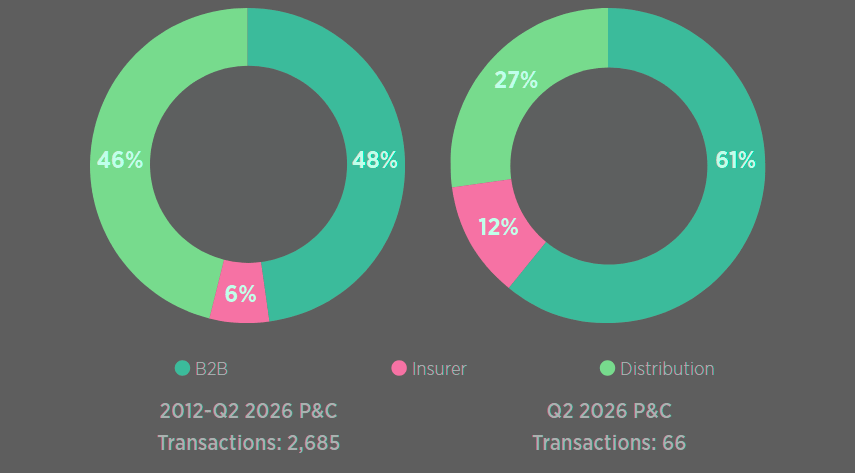
P&C InsurTech transactions by subsector
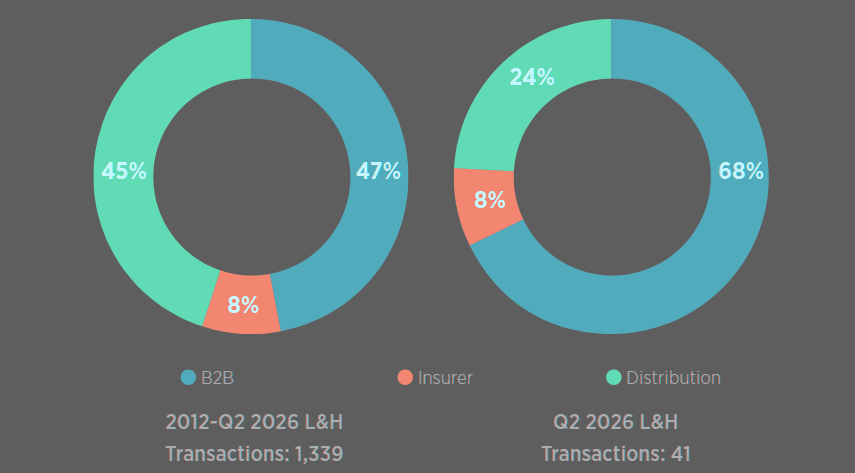
L&H InsurTech transactions by subsector
Gallagher Re raised concerns that this concentration could narrow the range of technology providers available to established insurers and reinsurers.
A smaller pipeline of innovative businesses could reduce the number of potential partners and acquisition targets for carriers seeking new technologies.
The trend also reflects changes in how the insurance industry develops and retains specialist talent.
P&C and L&H InsurTech funding comparison
| Market segment | Q1 2026 funding | Q2 2026 funding | Q2 deal count |
|---|---|---|---|
| Property and casualty | $0.91 bn | $1.84 bn | 66 |
| Life and health | $0.72 bn | $0.60 bn | 41 |
| Total | $1.63 bn | $2.44 bn | 107 |
InsurTech startup funding update
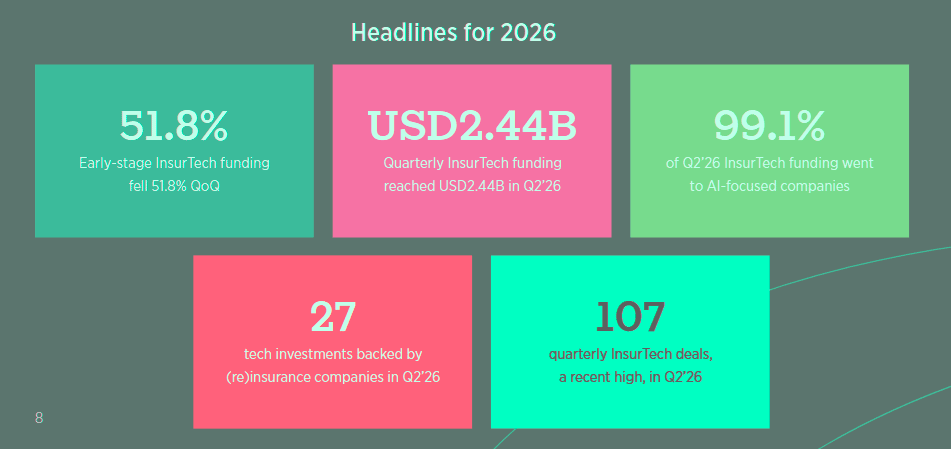
In Q2 2026, we observed a continuation of the fascinating fundraising trends that we saw in Q1. Notably, quarterly InsurTech funding reached $2.44 bn in Q2’26, the highest since Q2’22.
Quarterly InsurTech deal count reached a recent high of 107 in Q2’26. Early-stage InsurTech funding fell 51.8% QoQ, from $548.50 mn to $264.19 mn. An incredible 99.1% of Q2’26 InsurTech funding went to AI-focused companies, and (re)insurance companies backed 27 tech investments during the quarter (see about AI Gender Gap).
Annual total insurtech funding volume and transaction count
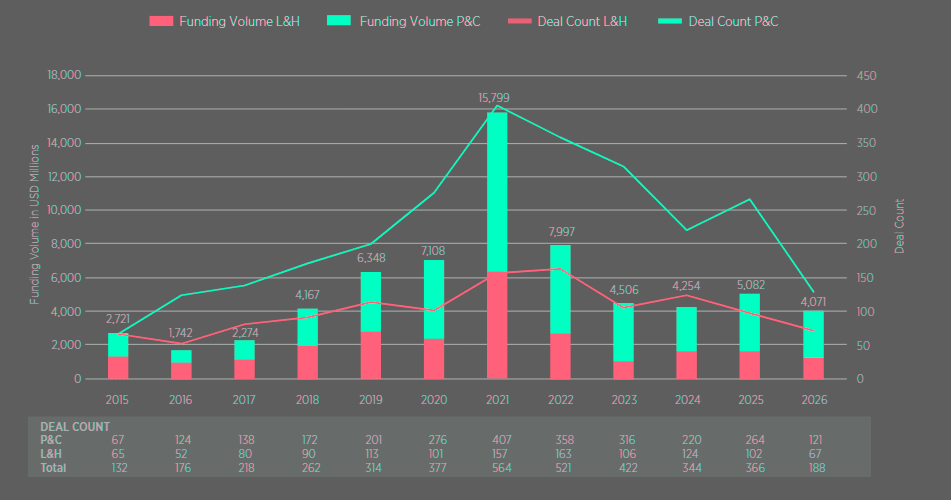
Quarterly InsurTech funding reached $2.44B in Q2’26, the most since Q2’22.
The increase was primarily due to $1.67B in funding that was attributable to $100 mn+ mega-round deals. This was the highest total for mega-round funding and deals since Q4’21 ($3.78bn in funding across 13 deals). The increase in mega-round deals coincided with the average InsurTech deal size increasing for the fourth consecutive quarter ($29.46 mn in Q2’26).
P&C InsurTech drove the quarter-over-quarter funding increase, more than doubling from $0.91 bn to $1.84 bn. Earth imagery startup ICEYE alone raised roughly a fifth of the quarter’s total funding in a $0.52B Series F deal. At the same time, L&H funding dipped from $0.72 bn in Q1’26 to $0.60 bn in Q2’26. Note that the report methodology excludes secondaries, including health insurer Alan’s reported Q2’26 funding.
Quarterly InsurTech funding volume (all stages)
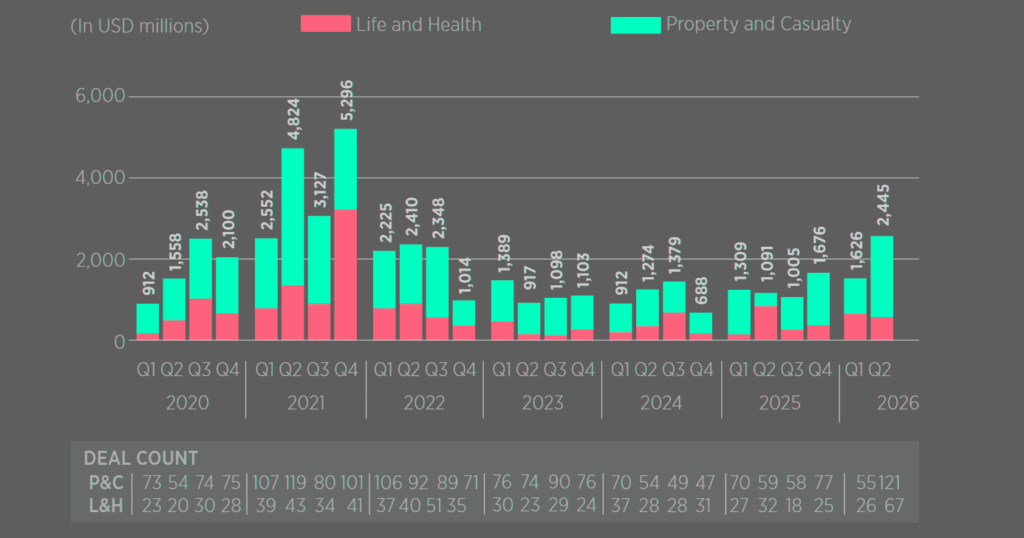
Quarterly InsurTech deal count reached a recent high of 107 in Q2’26.
Q2’26 saw deal count reach its highest level since Q1’24 (which also saw 107 deals). L&H InsurTechs raised funding across 41 deals, the highest count since Q3’22. Meanwhile, P&C InsurTech saw a more modest deal count increase, from 55 in Q1’26 to 66 in Q2’26.
12.1% of P&C InsurTech deals also went to “insurer-classified” InsurTechs, the highest percentage since Q4’14 (12.5%). This includes two $100 mn+ mega-round deals to Corgi, a startup-focused insurer.
Quarterly InsurTech funding volume (early stage)
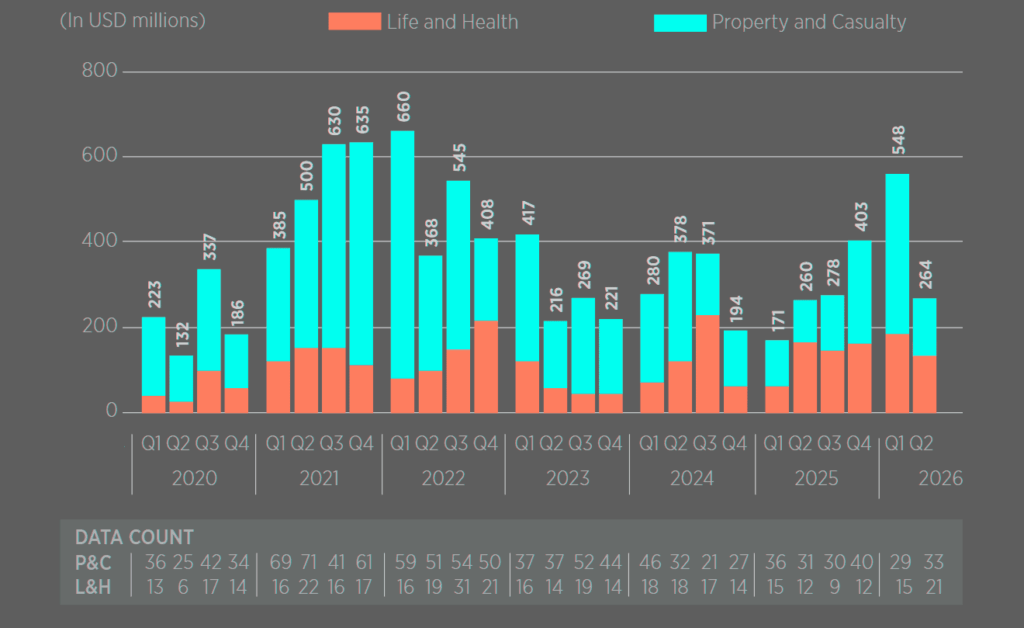
Early-stage InsurTech funding fell 51.8% QoQ, from $548.5 mn to $264.2 mn
Unlike the broader funding picture, early-stage InsurTech fell to a four-quarter low. This was despite early-stage deal count reaching 54 deals (the most since Q1’24, which saw 64 deals). As a result, the average early-stage InsurTech deal size fell 50.6% QoQ, from a recent high of $14.06M in Q1’26 to $6.95 mn in Q2’26.
The decline in early-stage funding was visible across both L&H and P&C InsurTech (34.4% and 61.4%, respectively).
Global InsurTech investment: Q1 vs. Q2 2026
| Indicator | Q1 2026 | Q2 2026 | Change or context |
|---|---|---|---|
| Total funding | $1.63 bn | $2.44 bn | +50% |
| Number of transactions | 81 | 107 | +26 deals |
| P&C InsurTech funding | $0.91 bn | $1.84 bn | x2 |
| L&H InsurTech funding | $0.72 bn | $0.60 bn | -16% |
| Early-stage funding | $548.50 mn | $264.19 mn | -51.8% |
| Reported average early-stage deal size | $14.06 mn | $6.95 mn | -50.6% |
| (Re)insurer-backed investments | 32 | 27 | -5 deals |
99.1% of Q2’26 InsurTech funding went to AI-focused companies.
This comprised $2.42B of funding across 95 deals, including all deals greater than $5M.
(Re)insurance companies backed 27 tech investments in Q2’26.
(Re)insurance-backed funding rounds ticked down from 32 in Q1’26 to 27 in Q2’26. 51.9% of these deals were early-stage.
MS&AD Group-linked investors led Q2’26 dealmaking activity among insurers: Mitsui Sumitomo Insurance Venture Capital backed 7 companies and MS&AD Ventures backed 3 companies.
Notable partnerships from Q2’26 between (re)insurance companies and tech companies include:
- Ageas UK and Wrisk
- Allianz Turkey and nettle
- Chubb and Insify
- Liberty Mutual and ICEYE
- Munich Re and Sixfold
Insurance technology talent shifts back toward established carriers
Before the InsurTech funding peak in 2021, experienced insurance professionals frequently moved from established carriers to technology startups. Those movements provided emerging companies with access to underwriting, claims and other specialist expertise.
Gallagher Re now observes a shift in the opposite direction, with InsurTech employees increasingly moving into established insurance businesses.
The report describes this as a possible sign of market maturity, while acknowledging that reduced movement into startups could limit the development of new business ideas.
At the same time, artificial intelligence is changing the economics of software development. Advanced AI models, including Anthropic’s Claude, allow users with limited programming expertise to build functional software applications.
This approach, commonly described as “vibe coding,” could make technology development more accessible to insurance professionals with deep operational knowledge.
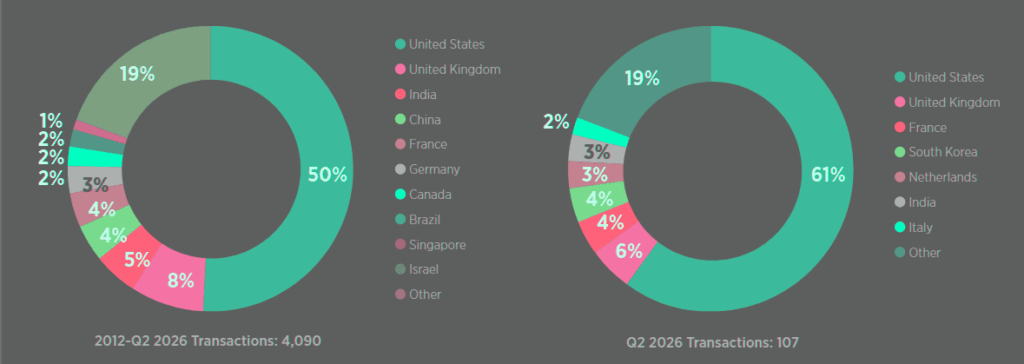
Quarterly InsurTech transactions by target country
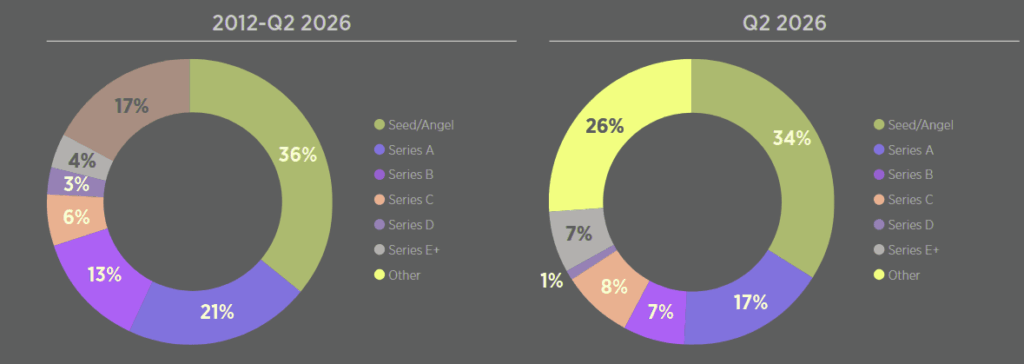
Quarterly InsurTech transactions by investment stage
Employees familiar with underwriting, policy administration, pricing, distribution and claims handling may increasingly be able to develop tools that previously required specialist engineering teams.
That capability could reduce the cost of developing internal applications and create new opportunities for established insurers to automate their operations.
Digital infrastructure growth requirements to power the AI boom
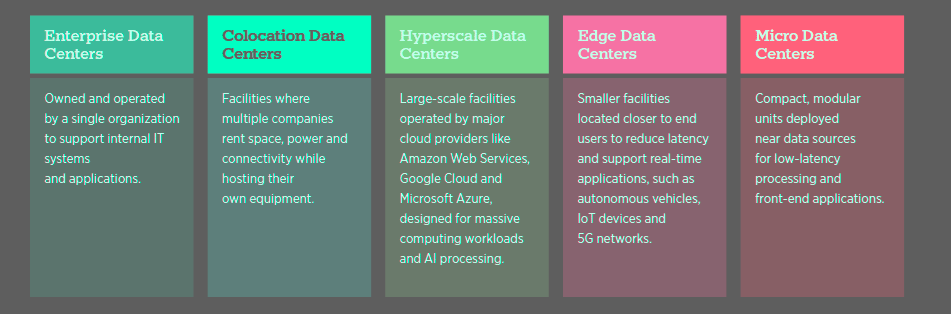
In the first report of this 2026 series, we focused on the business risks created by increasing digitization. We looked at AI liability products and the evolution of existing cyber products as two of the main classes of (re)insurance affected.
In this second report we will focus on the infrastructure that is being built to support AI – sometimes at breakneck speed and remarkable scale.
At the heart of this story sit data centers, physical facilities that house the servers, storage and networking equipment. In recent years data centers have grown to become the backbone of modern digital operations, but they are now increasingly powering AI workloads. As these workloads continue to grow, so does the demand for data centers themselves.
Global cloud-computing spend is projected to rise by almost a fifth by 2028
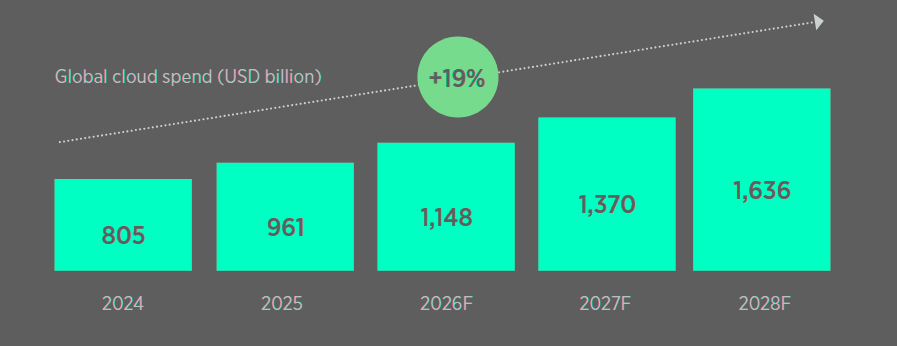
As demand for AI computing capacity accelerates, technology companies and infrastructure investors are expanding the physical facilities needed to support increasingly powerful computing systems. AI data center boom creates new insurance risks.
McKinsey estimates that global investment in the data center sector could reach $6.7 tn by 2030, with approximately $5.2 tn allocated to infrastructure supporting AI workloads.
The expansion is also increasing demand for electricity generation and supporting infrastructure, introducing additional operational, environmental and sustainability considerations.
Data center pressures include more than just natural perils
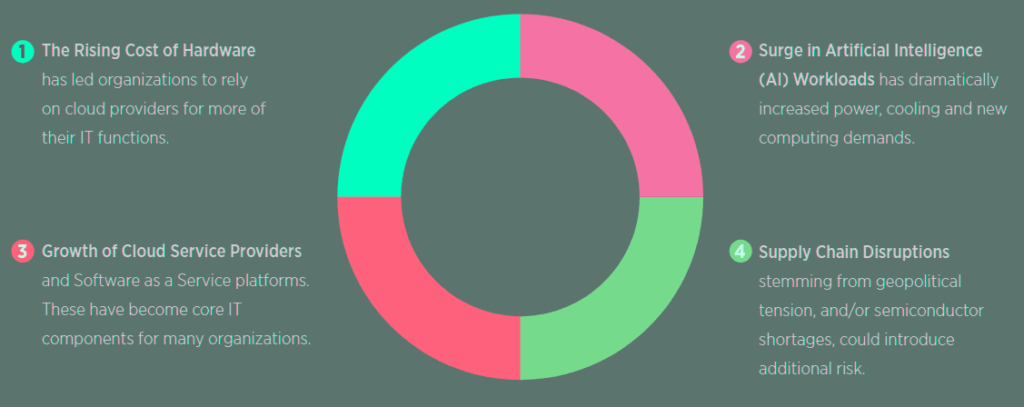
A particular challenge involves assessing insurance clash, where a single event could generate claims under multiple policies or lines of business.
Gallagher Re identifies systemic contagion as another area requiring attention, particularly when an incident combines exposures that have historically been assessed separately.
Cyber and environmental risks are one example. The interaction between technological failures, infrastructure dependencies and environmental consequences may create loss scenarios that traditional underwriting models have not adequately considered together.
Data center exposures relevant to insurers and reinsurers
| Risk category | Main underwriting challenge | Potential insurance implications |
|---|---|---|
| Construction and expansion | Accelerated development of large, complex facilities | Construction exposures and project-related insurance requirements |
| Expensive AI equipment | High-value servers, storage systems and specialized computing hardware | Property values, replacement costs and equipment-related losses |
| Power infrastructure | Greater dependence on electricity generation and delivery | Operational disruption and infrastructure dependencies |
| Cyber and technology failures | Dependence on interconnected digital and physical systems | Cyber losses, operational interruption and possible cross-policy claims |
| Environmental exposures | Interaction between computing infrastructure, energy demand and environmental consequences | Environmental liability and overlapping coverage considerations |
| Insurance clash | A single event affecting multiple insured interests or coverage lines | Aggregation risk and potentially correlated claims |
Insurers reconsider whether to buy or build AI technology
Gallagher Re identified growing interest among insurers and reinsurers in developing proprietary AI tools instead of relying exclusively on external software vendors.
The industry’s traditional decision between purchasing software and building it internally has become more competitive than at any point in the past decade.
Purchasing established technology remains attractive where suitable products already exist. However, enterprise AI platforms are allowing insurers to test and develop their own applications with fewer technical barriers.
As a result, more established insurance companies may invest in internal AI systems tailored to their operational requirements.
Q2 2026 InsurTech investment concentration
| Investment indicator | Q2 2026 |
|---|---|
| Total InsurTech funding | $2.44 bn |
| AI-focused funding | $2.42 bn |
| AI share of total funding | 99.1% |
| AI-focused transactions | 95 |
| Total transactions | 107 |
| Mega-round funding | $1.67 bn |
| Largest cited financing round (ICEYE) | $520 mn |
| (Re)insurer-backed technology investments | 27 |
For insurers, the immediate competitive risk is falling behind companies that are already providing employees with AI assistants and workflow automation tools. For InsurTech vendors, the consequences may be more significant.
Startups whose products consist primarily of relatively simple AI interfaces built around third-party models could face increasing competition from both established insurers and the underlying AI platform providers.
As insurers adopt technology from OpenAI, Anthropic and other enterprise AI developers directly, the commercial value of standalone applications offering similar capabilities may diminish.
AI adoption could reshape insurance employment and innovation
The implications of AI for employment across the wider economy and insurance industry. Gallagher Re draws parallels with the Industrial Revolution and the growth of the internet, both of which displaced existing jobs while creating employment opportunities in new industries.
It cites estimates that companies including Google, Amazon and Facebook have contributed approximately three million jobs over the past two decades.
The report also references studies suggesting that internet adoption has created as many as 2.5 jobs for every job displaced in certain sectors. On that basis, Gallagher Re expects AI to generate new employment opportunities over the longer term, although the distribution of those benefits remains uncertain.
The firm acknowledges that some InsurTech businesses could experience substantial disruption, particularly where multiple vendors provide similar technology solutions.
For established insurers, AI could enable experienced insurance professionals to build applications that improve operational efficiency without relying entirely on outside technology providers.
Gallagher Re expects the strongest AI-focused InsurTech companies to differentiate themselves by helping insurers deploy AI safely and deliver measurable improvements across underwriting, pricing, claims and other workflows.
Another potential path involves using AI to transform areas of the insurance value chain where established carriers have been slower to innovate.
The report suggests that competitive advantage will increasingly depend on specialist insurance expertise, practical implementation and demonstrable business value rather than access to AI technology alone.
What does Gallagher Re’s 2026 Global InsurTech Report cover?
The second report in Gallagher Re’s 2026 series examines the insurance risks and opportunities associated with AI infrastructure, particularly data centers. It also analyzes InsurTech investment activity, industry talent movements and the growing interest among insurers in developing AI tools internally. The publication belongs to a three-year series that began in 2024.
How much funding did InsurTech companies raise in Q2 2026?
Global InsurTech funding reached $2.44 bn in Q2 2026, its highest level since Q2 2022. A substantial share came from large financing transactions, with deals worth at least $100 mn contributing $1.67 bn. Total deal count reached 107, compared with 81 in Q1.
What percentage of InsurTech funding went to AI companies?
AI-focused InsurTech companies received 99.1% of total Q2 2026 funding, equivalent to approximately $2.42 bn across 95 deals. According to Gallagher Re, all financing transactions exceeding $5 mn involved businesses classified as AI-focused.
Why did early-stage InsurTech funding decline despite higher total investment?
The recovery in total funding was driven mainly by larger financing rounds. Early-stage investment fell 51.8% to $264.19 mn in Q2 2026, even as early-stage deal count reached 54. Gallagher Re’s reported average early-stage deal size declined from $14.06 mn to $6.95 mn.
Which InsurTech sector attracted the most investment in Q2 2026?
Property and casualty InsurTech attracted the most funding, raising $1.84 bn across 66 deals. Life and health InsurTech companies received $0.60 bn across 41 transactions. P&C funding more than doubled from Q1, while L&H funding declined.
What are the main insurance risks associated with AI data centers?
Gallagher Re identifies challenges arising from rapid data center development, expensive computing equipment, infrastructure dependencies and interconnected exposures. Particular concerns include insurance clash, when one incident triggers claims across multiple policies, and systemic contagion, where failures can spread through connected systems. Cyber and environmental risks may also interact in ways requiring more integrated underwriting assessments.
Will AI allow insurers to replace external InsurTech software providers?
AI tools are making it easier for insurers to build internal applications, potentially reducing their dependence on vendors offering relatively simple workflow products. However, external technology providers remain relevant where they offer specialized expertise, reliable deployment, measurable business value or capabilities that insurers cannot efficiently reproduce internally. Gallagher Re expects the competitive balance between buying and building insurance technology to continue evolving.
……………………….
AUTHOR: Dr. Andrew Johnston, Global Head of Gallagher Re
Edited by Peter Sonner, Lead Tech Editor at Beinsure Media / Reviewed by Oleg Parashchak, CEO Finance Media & Editor-in-Chief at Beinsure