- Reinsurer profitability strengthens capital positions
- Catastrophe bonds and sidecars expand reinsurance capacity
- Property reinsurance pricing declines ahead of January renewals
- Casualty reinsurance capacity improves despite emerging risks
- Emerging risks create demand for new reinsurance structures
- Insurers urged to focus on capital efficiency and earnings protection
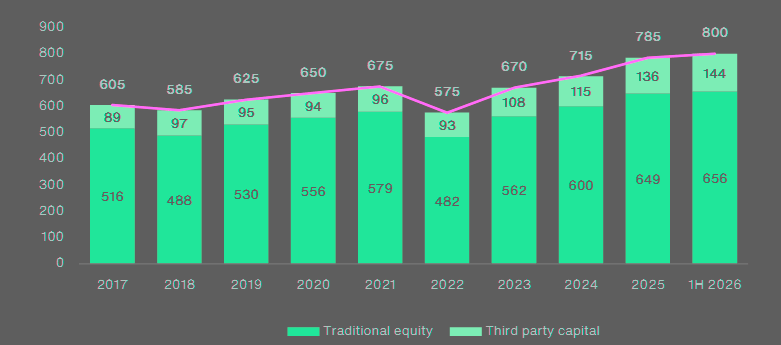
January 2027 renewals present insurers with a significant opportunity to turn record reinsurance capital into profitable growth, reduce volatility and improve earnings across the cycle. Global reinsurance capital reached a record $800 bn in the first half of 2026, strengthening buyers’ negotiating positions ahead of January 2027 renewals as traditional reinsurers and alternative capital investors increased their capacity, according to Aon’s latest reinsurance market report.
The expansion reflects strong underwriting profitability, retained earnings and continued investment in insurance-linked securities (ILS). Third-party capital increased to $144.5 bn, with catastrophe bonds and reinsurance sidecars accounting for much of the growth.
Aon expects favorable conditions for reinsurance buyers across several business lines, particularly property catastrophe, where competition has already produced double-digit pricing reductions and more flexible contractual terms.
Key highlights
- Global reinsurance capital reached a record $800 bn at June 30, 2026, including $144.5 bn in third-party capital, as reinsurers benefited from strong underwriting results and retained earnings.
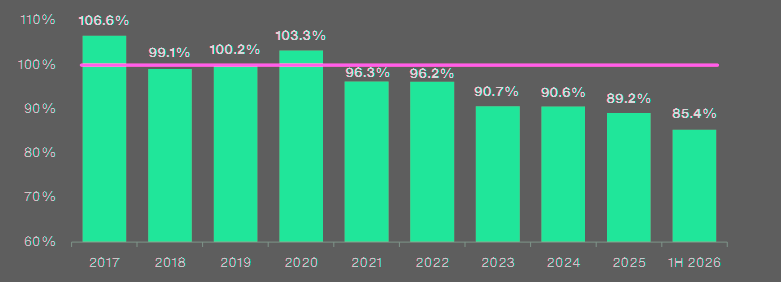
- The average P&C reinsurance combined ratio improved to 85.4% in H1 2026 from 94.8% a year earlier, while annualized return on equity reached 15.5%.
- Property reinsurance rates recorded double-digit reductions across most placements in 2026, while expanding catastrophe bond and sidecar capacity is improving conditions ahead of January 2027 renewals.
Insurers can use the additional capacity to improve earnings protection, reduce retained volatility and support underwriting growth rather than concentrating exclusively on premium savings.
The outlook follows a relatively benign first half for global catastrophe losses. Insured natural catastrophe losses during H1 2026 were the lowest for the corresponding period since 2019, supporting reinsurers’ profitability and capital accumulation.
Provided the industry avoids unusually large losses during the remainder of the year, Aon expects 2026 to become the fourth consecutive year of strong reinsurance financial performance.
Reinsurer profitability strengthens capital positions

Traditional reinsurance capital reached approximately $656 bn at June 30, 2026, while third-party capital increased to $144.5 bn. Reinsurers remain profitable despite softer pricing and rising loss risks. The sector has enough earnings capacity to absorb an insured loss event of $50 bn to $75 bn, on top of normal natural catastrophe losses during the second half, and still earn its cost of equity for the year.
The combined $800 bn represents an increase from $785 bn at the end of 2025 and a substantial recovery from the $575 bn recorded in 2022.
Most of the recent growth has come from retained and redeployed earnings rather than substantial new equity issuance. Fresh investment has been concentrated primarily in catastrophe bonds and sidecar transactions.
Global reinsurer capital dynamics, $ bn
Property and casualty reinsurers continued to report strong underwriting results during the first half. Across a group of 19 global reinsurers, the average P&C reinsurance combined ratio improved to 85.4%, compared with 94.8% in the corresponding period of 2025.
Global reinsurance capital reaches a record
| Capital source | Year-end 2025 | H1 2026 |
|---|---|---|
| Traditional reinsurance capital | $649 bn | $656 bn |
| Third-party capital | $136 bn | $144.5 bn |
| Total global reinsurance capital | $785 bn | $800 bn |
Reinsurance buyers expect property pricing to fall further at the January 2027 renewals, with double-digit reductions increasingly entering negotiations. The improvement reflects relatively low ceded catastrophe losses and the continued contribution of business written at more favorable pricing levels in previous years.
P&C reinsurance sector combined ratio
Reinsurance industry financial performance
| Financial indicator | 2026 |
|---|---|
| Average P&C combined ratio | 85.4% |
| Average P&C combined ratio, H1 2025 | 94.8% |
| Improvement in combined ratio | 9.4 pp |
| Annualized return on equity | 15.5% |
| Annualized ordinary investment return | 4.0% |
| Global reinsurance capital | $800 bn |
Reinsurance market participants increasingly favour life and health (L&H) business when deciding where to allocate capital, according to a Fitch Ratings survey.
More than 90% of reinsurers ranked L&H, financial solutions or specialty as their highest-priority business line for capital deployment. Fewer than 10% selected property or property catastrophe reinsurance.
The results come as available reinsurance capital continues to exceed demand. Fitch expects excess capacity to prolong buyer-friendly conditions across the property and casualty market, where pricing has softened following several years of stronger rates.
Investment income also supported profitability
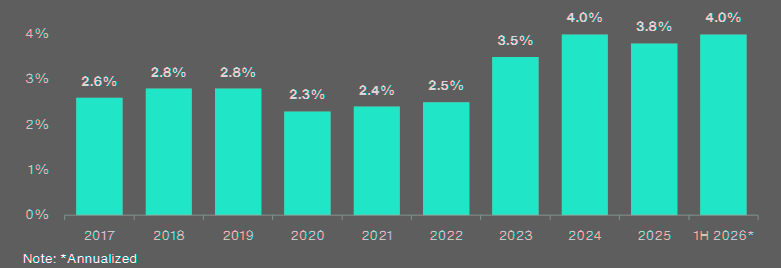
The average annualized ordinary investment return was 4% in H1 2026. Reinvestment yields generally remained above existing portfolio book yields at the end of June, suggesting scope for further investment income growth as securities mature and proceeds are reinvested.
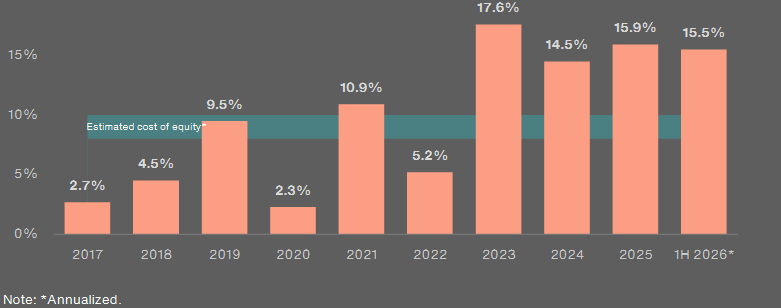
Across 31 global reinsurers, average annualized return on equity reached 15.5%, remaining above Aon’s estimated cost of equity.
These results have strengthened reinsurers’ ability to compete for business, particularly as pricing conditions become more favorable for buyers.
Ordinary Investment Return
Return on Equity
Catastrophe bonds and sidecars expand reinsurance capacity
Alternative reinsurance capital continued to grow during the first six months of 2026, supported by investor demand and broader use of capital markets structures.
The outstanding catastrophe bond market reached $63.4 bn at June 30, approximately 17% higher than a year earlier. New catastrophe bond issuance totaled $17.3 bn in H1 2026, exceeding issuance during the equivalent period in 2025.
Larger transactions also became more common. Ten catastrophe bond deals of at least $600 mn were completed during the first half, representing an increase of approximately 40% compared with the previous year.
Property Catastrophe Bonds Issued and outstanding by quarter
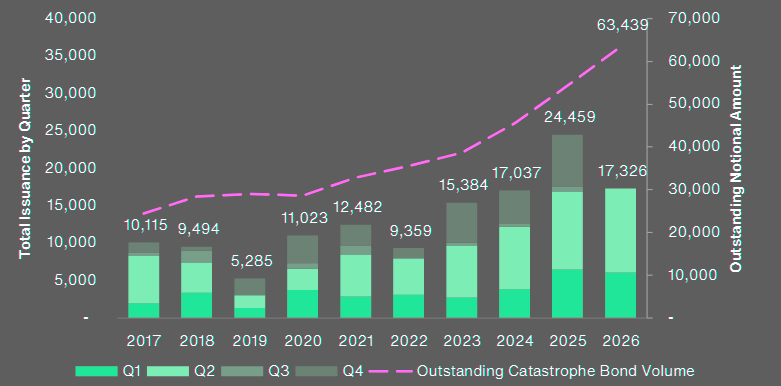
Aon attributed issuance growth to investor appetite, favorable market conditions and increased demand for catastrophe protection covering a broader range of risks and geographical regions.
Catastrophe bonds and reinsurance sidecar market
| Market indicator | 2026 |
|---|---|
| Outstanding catastrophe bonds | $63.4 bn |
| Catastrophe bond market growth | ~17% YoY |
| New catastrophe bond issuance | $17.3 bn |
| Catastrophe bond deals of $600 mn or more | 10 |
| Outstanding reinsurance sidecar capital | $23 bn |
| Reinsurance sidecar capital growth | ~35% YoY |
| Total third-party reinsurance capital | $144.5 bn |
Reinsurance demand rises as catastrophe and liability losses grow. The global reinsurance market heads into Rendez-Vous de Septembre and the coming renewal season with a broader mix of connected risks. Swiss Re says clients increasingly rely on data, analytics and underwriting expertise to identify new exposures and concentrations across portfolios.
The reinsurer is also developing tailored structures for risks that standard capacity alone doesn’t address. Its approach combines modelling, underwriting knowledge and risk-transfer solutions as clients face higher volatility across property and casualty business.
Demand for protection continues to rise as exposures become more connected. Clients increasingly expect reinsurers to provide technical expertise and data alongside capacity.
Reinsurance sidecars experienced similarly strong expansion
Outstanding sidecar capital reached $23 bn at June 30, up approximately 35% from $17 bn a year earlier.
Casualty and whole-account sidecars were particularly active, including structures in which investors manage the underlying investment assets.
These arrangements provide reinsurers with proportional capacity to support underwriting growth while creating asset management opportunities for institutional investors.
Sidecars have become an established source of capital across property, casualty and specialty reinsurance, adding financing alternatives beyond traditional reinsurer balance sheets.
Property reinsurance pricing declines ahead of January renewals
The property reinsurance market has become increasingly favorable for buyers as available capital exceeds demand across many placements. Aon reported double-digit pricing reductions and more flexible terms and conditions through 2026, particularly for US risks. Other regions have also benefited from increased capacity and fewer placement constraints, although market conditions continue to vary by exposure.
The additional competition gives insurers opportunities to purchase higher limits, broaden coverage and restructure reinsurance programs to reduce earnings volatility.
Aon identified frequency protection, aggregate covers and lower-attaching occurrence layers as areas where more attractive pricing could make additional protection economically viable.
Property vs. casualty reinsurance outlook for 1/1 2027
| Indicator | Property reinsurance | Casualty reinsurance |
|---|---|---|
| Market conditions | Buyer-friendly | Stable, improving |
| Pricing | Double-digit reductions for most placements | Gradual improvement in terms |
| Capacity | Abundant across most regions | Increasing, including US casualty |
| Alternative capital | Catastrophe bonds and sidecars | Casualty ILS and sidecars |
| Buyer opportunities | Higher limits, lower attachment points, aggregate coverage | Expanded capacity, aggregate and catastrophe protection |
| Principal risks | Climate extremes, catastrophe frequency, exposure concentration | Nuclear verdicts, reserve deterioration, AI-related liabilities |
| January 2027 outlook | Favorable for buyers | Positive, varies by risk class |
Such arrangements can reduce earnings volatility from repeated smaller catastrophes, rather than focusing protection exclusively on severe individual events.
Insurers may also use multi-year reinsurance contracts and automatic capacity facilities to secure favorable pricing and capacity beyond a single renewal.
The development of additional trading relationships with traditional reinsurers and institutional investors provides greater flexibility in how insurers allocate risk.
Capital markets platforms in Lloyd’s and Bermuda are helping connect institutional investment with reinsurance underwriting opportunities.
Despite the improving market, catastrophe exposure remains significant
Aon pointed to the strong El Niño phase and the continuing 2026 Atlantic hurricane season as reasons for insurers to assess portfolio resilience against current and future climate conditions. Aon is using catastrophe modeling, exposure management, accumulation analysis and stress testing to evaluate how severe weather and changing climate patterns could affect insured portfolios.
These assessments can help insurers determine appropriate attachment points, limits and retention levels as reinsurance becomes more competitively priced.
Casualty reinsurance capacity improves despite emerging risks
Casualty reinsurance conditions are also becoming more favorable, although pricing and capacity developments remain less uniform than in property.
Aon described the casualty market ahead of January renewals as broadly stable, with gradual improvements in terms and conditions during 2026.
Capacity has returned to the US casualty market, while competition for international casualty business continues to increase.
Some traditional reinsurers are selectively expanding casualty underwriting to preserve broader customer relationships as property reinsurance becomes more competitive.
Third-party investors are also increasing their participation through casualty sidecars and specialized ILS structures. These vehicles provide additional long-tail capacity and allow insurers to diversify their reinsurance capital sources.
Greater competition could enable casualty insurers to negotiate improved terms, purchase additional aggregate protection and obtain coverage for risks that have historically been difficult to reinsure.
Aon also identified opportunities for insurers to use premium savings to lower attachment points and purchase additional casualty catastrophe protection.
The expansion comes despite persistent concerns about adverse litigation developments, nuclear verdicts, reserve adequacy and emerging exposures associated with artificial intelligence.
Some of these risks can produce correlated or systemic losses that conventional casualty treaty structures may not adequately address.
Aon is developing casualty catastrophe reinsurance solutions using multiple modeling approaches to identify, aggregate and price such exposures.
The broker also expects continued demand for adverse reserve development covers and legacy transactions, which can transfer existing liabilities, protect earnings and release capital for new underwriting.
Reinsurer appetite nevertheless differs considerably by class, jurisdiction and underlying portfolio performance.
Renewal outcomes will depend on the quality of exposure information, claims handling, reserve adequacy and insurers’ ability to demonstrate effective portfolio management.
Emerging risks create demand for new reinsurance structures
Alongside traditional catastrophe and casualty risks, insurers are facing greater exposure to cyber incidents, artificial intelligence, data centers, supply chain disruptions and climate extremes. These risks can create concentrated losses across multiple policies or business lines, increasing the importance of portfolio-level analytics and appropriate capital allocation.
Digital Infrastructure Risk Aggregator to help insurers and reinsurers assess concentrations of exposure associated with data centers. The technology is intended to improve visibility into accumulated infrastructure risks and support underwriting decisions where limited exposure information may otherwise constrain capacity.
Facultative facilities, structured reinsurance products, casualty catastrophe coverage and legacy risk transfer arrangements are among the solutions available to address increasingly complex exposures.
The growing range of products also allows insurers to combine traditional reinsurance with third-party capital in ways that better match the characteristics and duration of individual risks.
Insurers urged to focus on capital efficiency and earnings protection
For January 2027 renewals, Aon recommends that insurers reassess how reinsurance supports their overall capital and underwriting strategies.
Rather than treating renewal negotiations primarily as a pricing exercise, insurers can evaluate the value of expanded coverage, improved contractual terms, attachment points and additional capital relief.
Aon also recommends developing integrated gross-to-net underwriting strategies that account for emerging concentration risks and changing loss volatility.
Using different sources of traditional and alternative capital may help insurers improve capital efficiency and stabilize results through changing market conditions.
The broker identified investment in analytics, artificial intelligence, specialist talent and mergers and acquisitions as additional opportunities to strengthen competitive positions.
Strong current profitability does not eliminate the risk of future earnings deterioration. As pricing advantages from earlier underwriting years diminish, insurers face greater pressure to maintain underwriting discipline and allocate capital effectively.
Overestimating growth, deploying capital inefficiently or failing to invest in technology and expertise could weaken performance as market conditions change.
The January 2027 renewal season is therefore expected to offer opportunities for insurers to secure additional protection and improve capital structures while reinsurance capacity remains abundant.
The extent of those benefits will depend on portfolio characteristics, underwriting performance and the ability to match emerging exposures with suitable reinsurance capital.
……………………..
AUTHORS: Steve Hofmann – Americas CEO, Reinsurance Solutions Aon, George Attard – Chief Strategy Officer & Global Head of Analytics, Reinsurance Solutions Aon, Alfonso Valera – International CEO, Reinsurance Solutions Aon
Edited by Yana Keller – Re/Insurance Editor at Beinsure Media