- Catastrophe bond issuance and investor participation
- Investor returns remain strong despite tighter spreads
- Catastrophe bonds move into higher-risk reinsurance layers
- Wildfire, flood and public-sector risks broaden the market
- Reinsurance sidecars expand into casualty and asset management
- ILS market outlook for 2027
The global insurance-linked securities (ILS) market reached a record $145 bn in capital at June 30, 2026, as strong investor demand, favorable catastrophe loss experience and expanding risk transfer opportunities supported another year of growth.
The market has grown at an average annual rate of approximately 8.3% over the past five years, according to Aon Securities’ ILS Annual Report.
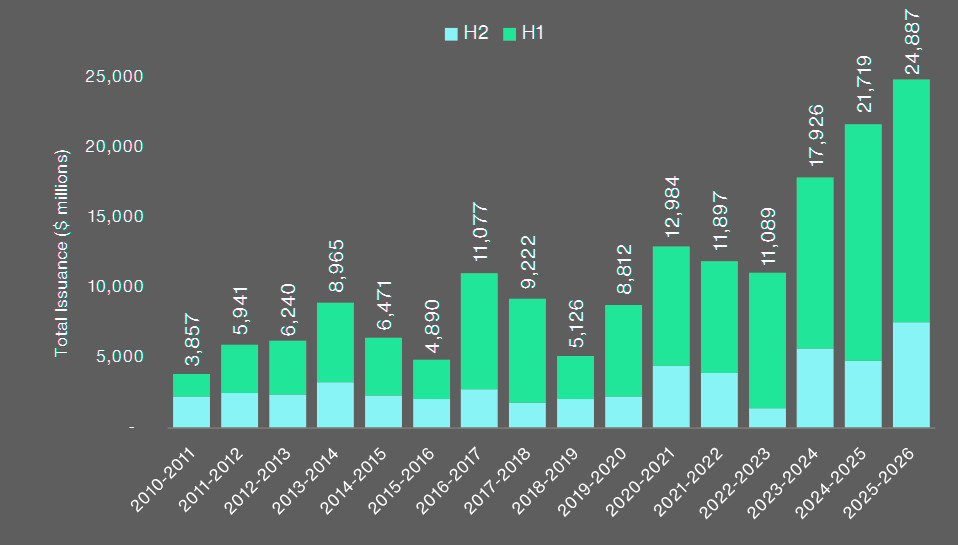
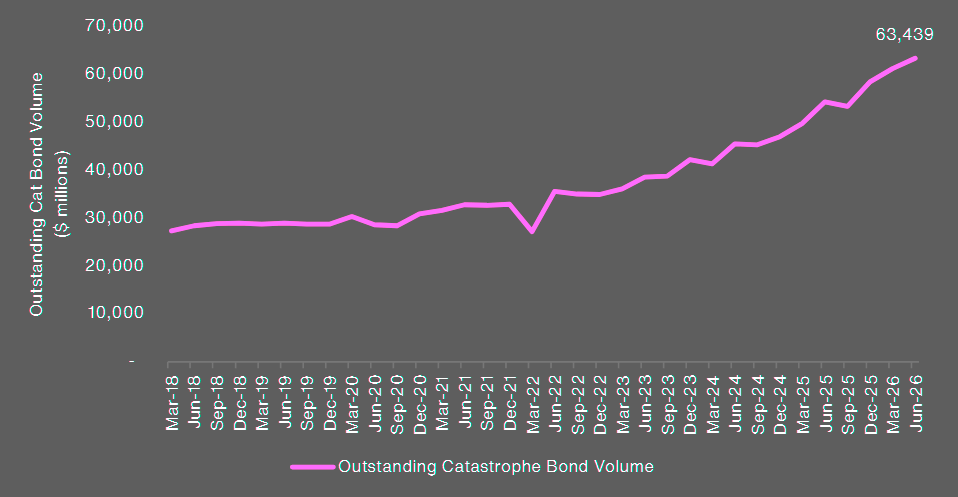
Catastrophe bonds remain the largest identifiable segment of alternative reinsurance capital. Issuance totaled $24.9 bn during the 12 months ended June 30, 2026, increasing 15% from the preceding period. Outstanding catastrophe bond volume reached $63.4 bn, up 17% year over year.
Key highlights
- Global ILS capital reached a record $145 bn, while annual catastrophe bond issuance increased 15% to $24.9 bn and outstanding volume rose 17% to $63.4 bn.
- Catastrophe bonds delivered a 12.5% total return over the 12 months to June 2026, supported by limited catastrophe losses, risk premiums and elevated collateral yields.
- Reinsurance sidecar capital reached $23 bn, approximately 50% above its level at the end of 2024, as institutional investors expanded into casualty and whole-account reinsurance.
The expansion reflects more than an increase in available investment capital. Catastrophe bonds are being used across a wider range of insurance risks, including higher-risk layers that previously relied more heavily on traditional reinsurance.
For insurers, the growing market provides additional access to fully collateralized, multi-year protection. For investors, insurance-linked risks offer returns driven primarily by insured events rather than conventional financial market performance, although collateral interest rates also influence investment income.
Catastrophe bond issuance and investor participation
The catastrophe bond market has nearly doubled in size since 2021, with outstanding capacity growing at a compound annual rate of approximately 11.6% over the past decade.
New issuance has consistently exceeded maturities, expanding the amount of capital available to absorb insured catastrophe losses.
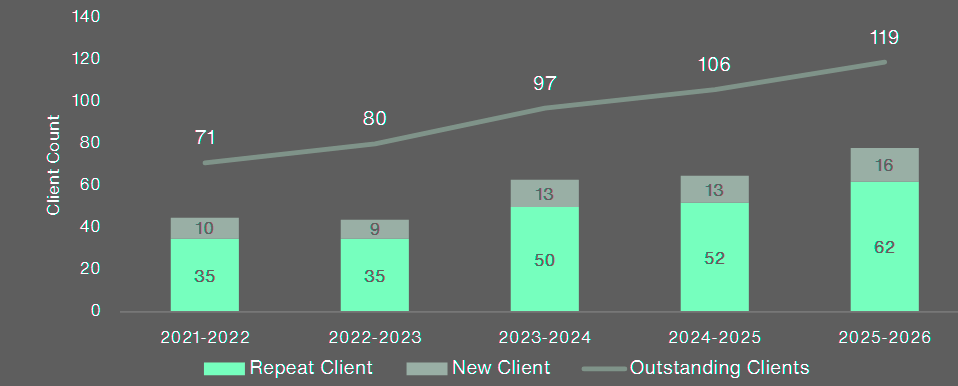
Participation has also broadened. A record 119 sponsoring entities had outstanding catastrophe bonds at June 30, an increase of 12% from the previous year.
Global ILS and catastrophe bond market in 2026
| Market indicator | Value | Growth |
|---|---|---|
| Total ILS capital | $144.5 bn | 8.3% annualized over 5 years |
| Outstanding catastrophe bonds | $63.4 bn | +17% YoY |
| Annual catastrophe bond issuance | $24.9 bn | +15% YoY |
| Reinsurance sidecar capital | $23 bn | +50% since end-2024 |
| Outstanding catastrophe bond sponsors | 119 | +12% YoY |
| Active sponsors during reporting period | 78 | +20% YoY |
| First-time sponsors | 16 | – |
During the reporting period, 78 sponsors accessed the market, including 16 first-time issuers and 62 returning participants. Active sponsor participation increased approximately 20%, with international organizations accounting for 35% of new entrants.
Insurers represented 65.2% of new issuance volume, followed by reinsurers at 17.1%, government entities at 16.2% and corporations at 1.5%.
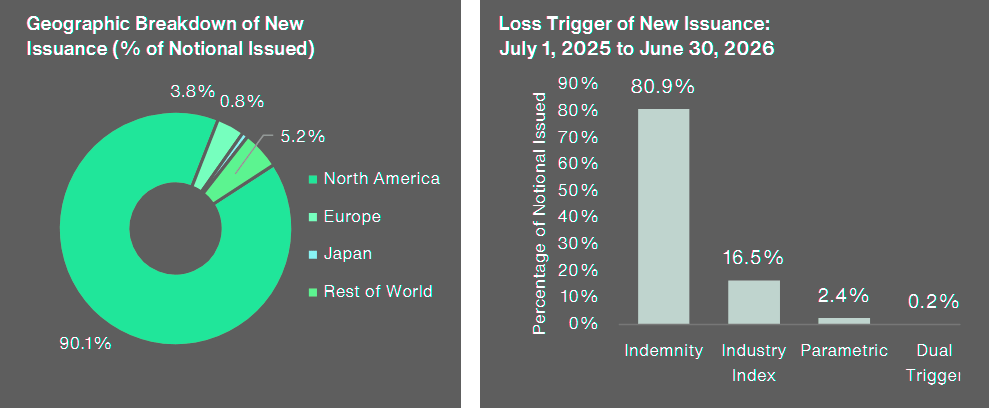
North America remained dominant, accounting for 90.1% of issuance. Europe represented 3.8%, Japan 0.8% and other regions 5.2%.
Property Catastrophe Bond Issuance
Indemnity-triggered catastrophe bonds accounted for 80.9% of new issuance, compared with 16.5% for industry loss index structures, 2.4% for parametric arrangements and 0.2% for dual-trigger transactions.
These figures indicate that traditional indemnity protection remains central to the catastrophe bond market, even as alternative structures attract additional participants.
Investor returns remain strong despite tighter spreads
Catastrophe bonds generated a 12.5% total return during the 12 months ended June 2026, measured by the Aon Securities Catastrophe Bond Total Return Index for the Rule 144A market.
Performance benefited from limited catastrophe losses triggering bond principal reductions, continued risk premium income and relatively elevated returns on collateral investments.
Total coupon income across outstanding catastrophe bonds reached approximately $7.1 bn during the reporting period. Average annualized coupon returns declined from 11.8% in the previous period to 10.5%, remaining in double-digit territory despite moderating risk spreads and lower short-term interest rates.
Outstanding Property Catastrophe Bond Volume
Pricing conditions have become more competitive as investor capital expands
Seasonally adjusted secondary market spreads for US hurricane-exposed catastrophe bonds declined 16% over the reporting period, compared with a 26% reduction in the previous year.
Since the post-Hurricane Ian peak in early 2023, spreads have fallen approximately 51%. The pace of compression slowed during the first half of 2026, when spreads declined 4.4%.
The moderation suggests a more balanced relationship between investor return requirements and the cost of protection for issuers.
Property Catastrophe Bond Client Count
Secondary market activity remained strong, particularly in shorter-dated securities. Investors purchased bonds approaching maturity while anticipating opportunities to reinvest proceeds into new transactions.
Approximately $13.8 bn of catastrophe bonds matured during the reporting period, including a record $4.3 bn in June alone.
Maturing principal and coupon payments supplied additional capital for new issuance, reducing the market’s dependence on entirely new investor allocations.
Catastrophe bonds move into higher-risk reinsurance layers
One of the most consequential developments is the increasing use of catastrophe bonds to cover higher-frequency, higher-risk layers of reinsurance programs.
Historically, catastrophe bonds were concentrated in remote layers designed to protect against particularly severe events. Their role is expanding as insurers seek protection across more of their retained catastrophe exposure.
Transactions carrying modeled expected annual losses of 5% or more represented 10.1% of issuance during the reporting period, compared with 4.7% a year earlier.
The shift was particularly evident among industry loss index transactions, where approximately one-third of issuance fell within the 5% to 9% expected loss range.
Higher modeled expected losses were generally accompanied by higher risk spreads, reflecting the additional exposure assumed by investors.
Industry loss catastrophe bonds now provide approximately $12 bn of outstanding protection across 32 sponsoring entities, representing about 18% of total outstanding catastrophe bond capacity.
Outstanding industry loss capacity has increased 22% over five years, while annual issuance exceeded $5 bn for the first time in 2025.
Catastrophe bond investor returns and pricing trends
| Performance indicator | 2025-2026 |
|---|---|
| Catastrophe bond total return (144A index) | 12.5% |
| Total coupon income | $7.1 bn |
| Average annualized coupon return | 10.5% |
| Previous period’s average annualized coupon return | 11.8% |
| Secondary market spread change | -16% |
| Previous period’s spread change | -26% |
| Spread decline since early 2023 peak | -51% |
| Catastrophe bonds maturing during period | $13.8 bn |
Secondary spread changes refer to seasonally adjusted US hurricane-exposed catastrophe bonds
The expansion also changes the potential financial consequences of major catastrophe events for investors.
Aon Securities estimates that an insured industry loss event of $100 bn could generate approximately $5 bn to $10 bn in losses across the catastrophe bond market. Within industry loss-triggered bonds specifically, estimated losses from such an event could reach $6 bn to $8 bn.
These estimates are scenario-based rather than forecasts of actual losses. They demonstrate that the growing catastrophe bond market is assuming a more substantial portion of major insured catastrophe exposure.
Wildfire, flood and public-sector risks broaden the market
North American hurricane exposure continues to account for most catastrophe bond issuance, but transactions covering wildfire, European flooding, convective storms and other regional hazards are becoming more common.
California wildfire protection has attracted particularly strong interest. The California FAIR Plan Association entered the catastrophe bond market in 2026 through Golden Bear Re, securing a combined $1.15 bn of protection across two transactions.
The first issuance raised $750 mn, tripling its initial target, while a subsequent $400 mn transaction doubled its original planned size.
Both provide three-year indemnity protection against California wildfire losses, covering different layers of the FAIR Plan’s catastrophe exposure.
European insurers have also expanded their use of capital markets protection
- Germany’s Gothaer Allgemeine Versicherungs AG issued a €100 mn catastrophe bond covering domestic flood losses, with a modeled expected annual loss of 0.21% and a pricing spread of 1.95%.
- France’s Groupama secured €120 mn in aggregate protection against convective storms in France and Monaco, while Mapfre Re accessed the market for European windstorm protection.
Public-sector disaster financing represents another area of expansion
The Asian Development Bank arranged two $80 mn parametric catastrophe bonds in 2026 to provide earthquake and extreme precipitation protection for Tajikistan and the Kyrgyz Republic.
Each transaction includes a $70 mn earthquake sublimit and a $10 mn extreme precipitation sublimit, with protection extending through April 2029.
These structures can release disaster relief funding when predetermined event parameters are met, without relying exclusively on conventional claims adjustment.
Reinsurance sidecars expand into casualty and asset management
Growth in alternative reinsurance capital is no longer concentrated in catastrophe bonds.
Outstanding property and casualty reinsurance sidecar capital reached approximately $23 bn at June 30, 2026, representing growth of around 50% since the end of 2024.
The expansion has been supported by returns from existing sidecars and new transactions involving casualty and whole-account portfolios.
Alternative Reinsurance Capital, 2002-2026 ($ bn)
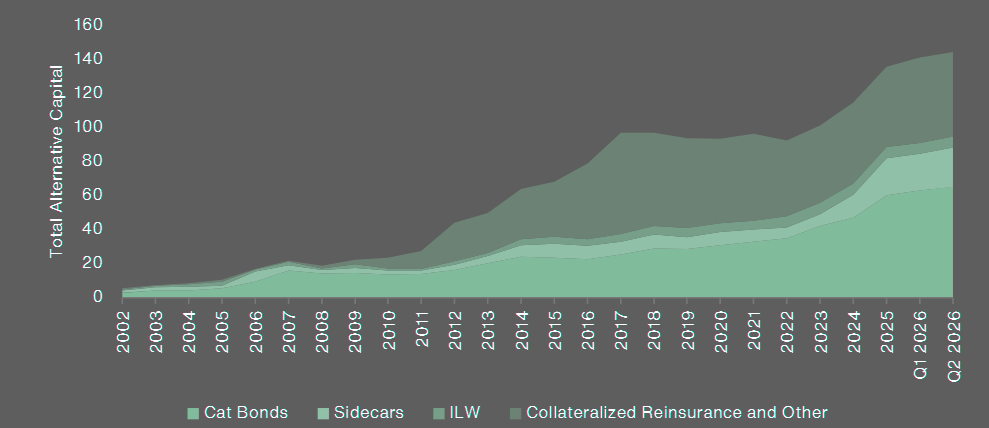
Traditional property catastrophe sidecars generally provide capacity for relatively short-duration insurance exposures. Newer asset-intensive structures increasingly combine underwriting risk with investment strategies suited to longer-duration casualty liabilities.
These arrangements allow insurers and reinsurers to expand underwriting capacity without committing equivalent amounts of their own capital, while institutional investors gain access to insurance-related returns and asset management opportunities.
Hamilton Group’s casualty reinsurance sidecar, established through Ada Re with investment backing from Sixth Street, illustrates the model.
The multi-year arrangement is expected to generate approximately $300 mn in ceded premiums and provide additional capacity for Hamilton’s casualty reinsurance portfolio.
Major catastrophe bond transactions in 2025-2026
| Sponsor | Transaction | Protection | Risk covered |
|---|---|---|---|
| California FAIR Plan | Golden Bear Re 2026-1 | $750 mn | California wildfire |
| California FAIR Plan | Golden Bear Re 2026-2 | $400 mn | California wildfire |
| Groupama | Quercus II Re | €120 mn | French and Monaco convective storms |
| Gothaer | Yardstick Re | €100 mn | German flooding |
| Asian Development Bank | Kyrgyz Republic 2026-1 | $80 mn | Earthquake and extreme precipitation |
| Asian Development Bank | Tajikistan 2026-1 | $80 mn | Earthquake and extreme precipitation |
| Mercury Insurance | Luca Re, two issuances | $300 mn | California wildfire and fire following earthquake |
Transaction amounts represent issued protection, not insured losses
Two principal sidecar structures remain in use
Assumed sidecars accept liabilities directly from insurers, reinsurers or managing general agents, typically providing additional underwriting capacity and associated fee income.
Ceded sidecars receive a portion of an existing reinsurance program from the sponsoring organization, supporting more consistent capacity and risk transfer execution.
Both approaches are increasingly being applied across portfolios containing multiple business lines rather than individual property catastrophe exposures.
The development gives institutional investors a larger role in insurance capital allocation, particularly where underwriting expertise can be combined with long-term investment management capabilities.
ILS market outlook for 2027
The expansion of alternative capital is expected to continue influencing reinsurance pricing, capacity and program structures heading into 2027.
Growing investor participation has improved access to multi-year protection and expanded the range of risks that can be financed through capital markets.
At the same time, lower catastrophe bond spreads reduce risk compensation for new investors, making underwriting discipline and accurate risk modeling increasingly important.
Catastrophe bond issuance by geography, trigger and sponsor
| Category | Segment | Share of issuance |
|---|---|---|
| Geography | North America | 90.1% |
| Europe | 3.8% | |
| Japan | 0.8% | |
| Rest of world | 5.2% | |
| Trigger | Indemnity | 80.9% |
| Industry loss index | 16.5% | |
| Parametric | 2.4% | |
| Dual trigger | 0.2% | |
| Sponsor | Insurers | 65.2% |
| Reinsurers | 17.1% | |
| Government entities | 16.2% | |
| Corporations | 1.5% |
Shares are based on notional issuance volume during July 2025 – June 2026. Totals may differ slightly from 100% because of rounding.
Higher-risk bond issuance introduces additional exposure to loss events that may affect investor returns more frequently than traditional remote-layer structures.
For insurers, the principal opportunity is to use catastrophe bonds and sidecars more selectively within broader reinsurance programs, combining capital markets protection with conventional treaty coverage.
The development of asset-intensive casualty sidecars also creates scope for further integration between insurance underwriting and institutional asset management.
Future growth will depend on investor appetite, catastrophe experience, pricing conditions and the ability to model emerging exposures with sufficient confidence.
With $144.5 bn in alternative reinsurance capital and a record $63.4 bn of catastrophe bonds outstanding, insurance-linked securities have become an established source of global reinsurance capacity.
The next phase will depend increasingly on how effectively that capital is allocated across different risks, rather than issuance growth alone.
……………………….
Richard Pennay – CEO of Aon Securities
Edited by Yana Keller – Re/Insurance Editor at Beinsure Media