- Global cyber insurance premiums exceed $16 bn
- US cyber insurance premiums recover
- Top 20 US cyber insurance companies by premiums
- Cyber Insurance Distribution
- Large-business cyber claim severity doubles
- Cyber claims frequency rises globally as smaller losses decline
- Ransomware remains the costliest cyber insurance claim type
The US cyber insurance market returned to growth in 2025-2026, with total direct written premiums reaching approximately $9.46 bn, up 3.5% from $9.14 bn in 2024, according to data published by the National Association of Insurance Commissioners (NAIC).
The recovery followed the market’s first recorded premium contraction in 2024, as competition and expanding underwriting capacity continued to influence pricing.
Claims trends were less uniform, with large businesses experiencing substantially higher losses despite fewer reported claims. Between 2017 and 2022, the cyber market expanded at an impressive 32% annual rate. Global premiums doubled from 2017 to 2020 and then doubled again from 2020 to 2022, with projections initially anticipating this robust growth to continue.
Key highlights
- US cyber insurance direct written premiums increased 3.5% to $9.46 bn in 2025, reversing the market’s first contraction in 2024.
- Large-business cyber claim severity doubled to approximately $4.4 mn, a 586% increase since 2021, despite declining claims frequency.
- Global cyber insurance premiums exceeded $16 bn, with insurers facing rising ransomware costs, systemic accumulation risks and AI-enabled cyber threats.
The NAIC’s Report on the Cybersecurity Insurance Market draws on its Property & Casualty Annual Statement Cybersecurity Insurance Coverage Supplement and alien surplus lines data collected by the NAIC International Insurers Department (IID).
The reporting framework distinguishes primary, excess and endorsement coverage under the three-part structure introduced in 2024. Primary policies are recorded in Part 2, excess policies in Part 3 and endorsements in Part 4, separating stand-alone cyber insurance from coverage added to other insurance products. Part 5 provides state-level reporting.
The report covers financial performance and market statistics, the cyber threat environment from an underwriting perspective, and regulatory developments and supervisory priorities.
Global cyber insurance premiums exceed $16 bn

Global cyber insurance premiums surpassed $16 bn in 2025, although growth slowed compared with previous years, according to AM Best’s July 2026 market outlook.
Much of the slowdown reflected declining US direct written premiums amid stronger competition and increased market capacity.
The US remained the world’s largest cyber insurance market, accounting for more than half of global premiums. Including US cyber exposures insured through Lloyd’s raises the estimated American share to approximately 60%.
AM Best expects international markets to account for a greater proportion of global premiums over time, particularly in Europe, Latin America and developed Asian markets serving small and medium-sized enterprises.
Direct Written Premium Showing Percent Change
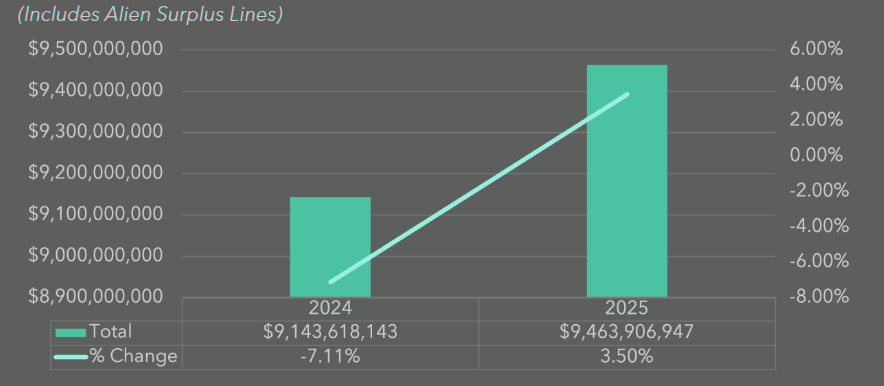
The rating agency maintained a stable outlook for the global cyber insurance segment, citing sustained demand, favorable intermediate-term profitability, stronger cybersecurity practices and continued inflows of reinsurance and alternative capital (see AI Agents Push Cyber Insurers to Rethink Policy Language).
Policies in Force Showing Percent Change
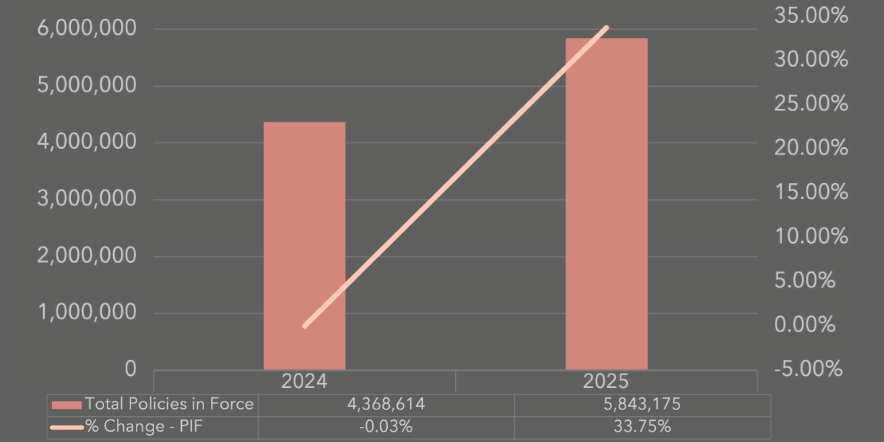
Those conditions are balanced by increasing ransomware activity, business email compromise and funds transfer fraud. Systemic risk accumulation, AI-enabled cyberattacks and geopolitical uncertainty remain significant concerns for insurers.
US cyber insurance premiums recover
Domestic US insurers generated $7.46 bn in cyber insurance direct written premiums during 2025, while alien surplus lines insurers reporting through the NAIC’s IID contributed approximately $2 bn (see 2026 Outlook for Global Cyber Insurance Segment).
Domestic premiums have increased from $2.75 bn in 2020 to $7.46 bn in 2025, representing a compound annual growth rate of approximately 22%.
The market’s development has shifted considerably during that period, according to Global RiskScan 2026. Rapid premium expansion during the hard market has given way to a more measured growth trajectory as competition, capacity and underwriting discipline influence insurer performance.
US cyber insurance market premiums and growth
| Market indicator | 2025 |
| Total US direct written premiums | $9.46 bn |
| Annual premium growth | +3.5% |
| Domestic insurer premiums | $7.46 bn |
| Alien surplus lines premiums | $2 bn |
| Global cyber insurance premiums | $16 bn |
| US share of global premiums | 50% |
| US share including Lloyd’s exposures | 60% |
Domestic US cyber insurance premiums increased from $2.75 bn in 2020 to $7.46 bn in 2025, representing a compound annual growth rate of approximately 22%.
Top 20 US cyber insurance companies by premiums
| Rank | Insurance group | Direct written premiums | Loss ratio with DCC | Market share |
| 1 | Chubb | $629 mn | 58.81% | 8.44% |
| 2 | Beazley | $571 mn | 16.28% | 7.65% |
| 3 | St Paul Travelers | $544 mn | 58.26% | 7.29% |
| 4 | Sompo | $342 mn | 60.78% | 4.58% |
| 5 | Tokio Marine Holdings | $319 mn | 56.60% | 4.28% |
| 6 | Fairfax Financial | $302 mn | 53.62% | 4.05% |
| 7 | American International | $296 mn | 62.28% | 3.97% |
| 8 | Arch Insurance | $284 mn | 41.60% | 3.81% |
| 9 | At Bay Specialty Insurance | $268 mn | 73.45% | 3.60% |
| 10 | Starr | $251 mn | 3.75% | 3.36% |
| 11 | QBE Insurance | $231 mn | 74.42% | 3.10% |
| 12 | AXIS Capital | $231 mn | 61.73% | 3.10% |
| 13 | CNA Insurance | $212 mn | 59.51% | 2.85% |
| 14 | AXA Insurance | $204 mn | 72.29% | 2.74% |
| 15 | AmTrust Financial Services | $201 mn | 60.28% | 2.69% |
| 16 | Intact Financial | $199 mn | 26.15% | 2.66% |
| 17 | Berkshire Hathaway | $173 mn | 88.03% | 2.32% |
| 18 | Hartford Fire & Casualty | $166 mn | 10.70% | 2.23% |
| 19 | Liberty Mutual | $161 mn | 60.77% | 2.16% |
| 20 | Zurich Insurance | $145 mn | 54.81% | 1.94% |
Chubb retained its position as the largest US domestic cyber insurer in 2025, with $629.2 mn in direct written premiums and an 8.44% market share. Beazley recorded the biggest ranking improvement among the top 20, climbing from 16th to second place with $570.9 mn in premiums.
The five largest insurers accounted for 32.24% of the market, while the top 10 controlled 51.03%. Combined, the 20 leading insurance groups represented 76.82% of domestic US cyber insurance direct written premiums.
Cyber Insurance Distribution
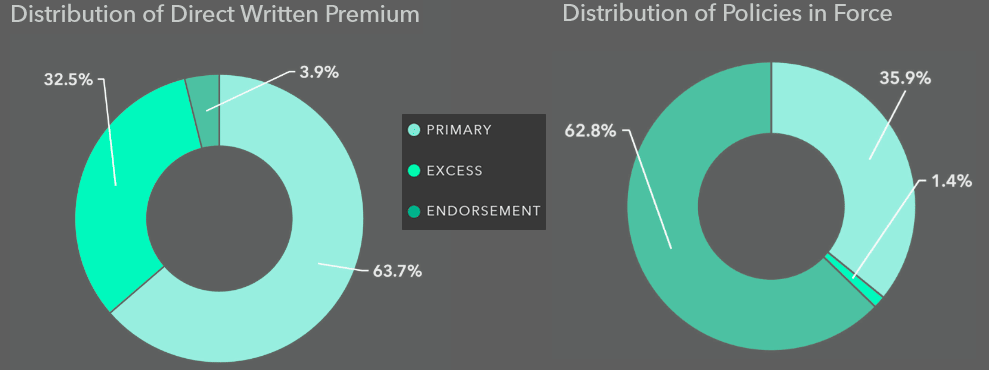
The NAIC reporting framework also provides a breakdown of domestic admitted insurance, domestic surplus lines and alien surplus lines business, alongside domestic direct written premium trends.
Large-business cyber claim severity doubles
Cyber insurance claims data show a marked divergence between large enterprises and smaller policyholders. According to figures from Chubb’s 2026 Cyber Claims Report, cited in the NAIC analysis, average claim severity among businesses generating at least $1 bn in annual revenue reached approximately $4.4 mn in 2025. That compares with roughly $2.2 mn in 2024 and represents a 586% increase since 2021.
Higher business interruption expenses and rising costs associated with data breaches and privacy litigation were the principal drivers of increased severity among large organisations.
Middle-market businesses experienced a smaller increase, with average claim severity rising from approximately $619,000 in 2024 to $759,000 in 2025.
Cyber insurance claims severity and frequency by business size
| Business segment | 2025 average severity | Change |
| Large businesses (revenue ≥$1 bn) | $4.4 mn | 100% |
| Middle-market businesses | $759,000 | +22.6% |
| Small and mid-sized enterprises | $142,000 | -34.0% |
| Source: Chubb 2026 Cyber Claims Report, as cited in the NAIC report. Large-business claim severity increased 586% between 2021 and 2025. | ||
Smaller and mid-sized enterprises recorded an improvement, with average claim severity declining from about $215,000 to $142,000 over the same period.
Claims frequency also declined among larger policyholders. Large businesses reported approximately 10 claims per 100 cyber policies in 2025, compared with 15 in 2024. Middle-market frequency decreased from around six claims to slightly more than five per 100 policies.
The combination of lower frequency and higher severity suggests that improved underwriting selection and cybersecurity controls may be reducing the number of incidents resulting in claims. When major incidents occur at large organisations, however, their financial consequences have become considerably more expensive.
Cyber claims frequency rises globally as smaller losses decline
| Claims frequency indicator | 2025 |
| Large-business claims per 100 policies | 10 |
| Middle-market claims per 100 policies | 5 |
| Global cyber claims frequency | 3% |
| Global average claims severity | $116,000 (-19%) |
A separate global dataset from Coalition’s 2026 Cyber Claims Report presents a different pattern, particularly among smaller businesses.
The analysis covered more than 100,000 policyholders across the US, Canada, UK, Australia and Germany. Overall cyber claims frequency increased 3% in 2025, while average claims severity declined 19% to $116,000.
Smaller policyholders accounted for much of the portfolio, indicating that more cyber incidents generated claims even as the average financial cost of those claims decreased. This contrasts with the sharp increase in severity reported among large enterprises.
Taken together, the Chubb and Coalition datasets suggest that cyber insurance claims-cost pressure is becoming more concentrated among larger organisations, while smaller policyholders are experiencing improved loss containment.
Ransomware remains the costliest cyber insurance claim type
Ransomware continued to generate the highest average claim severity, despite evidence that more businesses are refusing to meet attackers’ payment demands.
According to Coalition, initial ransom demands may have increased 47% year over year to an average exceeding $1 mn.
A record 86% of businesses experiencing ransomware incidents reportedly refused to pay, a development attributed to stronger backup procedures and improved incident-response readiness.
Nevertheless, ransomware remained the most expensive cyber claim category by average severity, with losses reaching $269,000.
Ransomware insurance claims and cyber loss trends
| Ransomware and cyber claims indicator | 2025 result |
| Average initial ransom demand | $1 mn |
| Annual increase in initial ransom demands | 47% |
| Businesses refusing ransom payments | 86% |
| Average ransomware claim severity | $269K |
| Overall global cyber claims severity | $116K |
| Annual change in global claims severity | -19% |
| Annual change in global claims frequency | 3% |
The figures illustrate the differing pressures facing cyber insurers. Improved security controls and incident management appear to be containing some losses, particularly among smaller businesses, while large-account claims, ransomware exposure and systemic cyber risks continue to present significant underwriting challenges.
For the US market, the return to premium growth in 2025 has therefore coincided with a widening difference in claims experience between large enterprises and smaller insured organisations.
………………
by Oleg Parashchak, CEO Finance Media & Editor-in-Chief at Beinsure, Peter Sonner, Lead Tech Editor at Beinsure