- AI, IoT reshape corporate risk and insurance tools
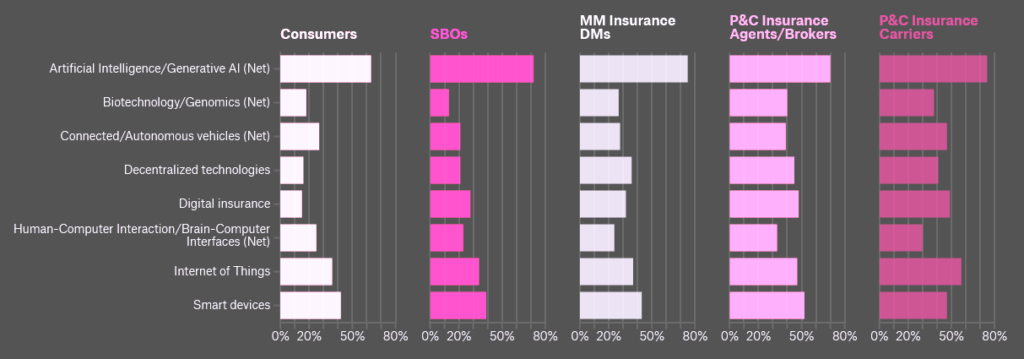
- Global most impactful emerging technologies
- Cyber and climate risks reshape insurance priorities
- Global top insurance risks
- P&C insurance affordability worsens as risks pile up
- Global drivers behind the cost of insurance
- Frequent, regionally relevant natural catastrophes dominate the risk landscape
- Most concerning natural disasters
- Inflation pressure reshapes insurance risk pricing
- Global market dynamics
The global specialty insurance landscape is entering a period defined less by isolated events and more by interconnected risk. Cyber incidents can trigger business interruptions. Natural catastrophes impact affordability while emerging technologies continue to reshape exposure faster than the industry can keep pace, according to Munich Re Specialty’s latest RiskScan survey, designed in partnership with the Insurance Information Institute (Triple-I), a trusted authority on insurance and risk trends.
Unlike traditional risk surveys that focus on a single audience or geography, this research assesses risk across the entire insurance value chain, from carriers and agents and brokers to middle market decision-makers (MM decision-makers), small-business owners (SBOs), and consumers.
The study provides a robust and credible view of how risk is perceived, prioritized, and evolving across the ecosystem. The survey reveals not only what risks matter most today but also how those risks are experienced differently and interconnectedly across the value chain cohorts and regions.
Key Highlights
- AI and generative AI are the most impactful emerging technologies, cited by 70% of respondents.
- Cyber incidents rank as the leading insurance risk, followed by business interruption and emerging technologies.
- Natural catastrophes are expected to become the top risk over the next five years as climate losses increase.
- Inflation, legal pressures and rising catastrophe losses are driving higher P&C insurance costs and affordability challenges.
- Organizations need integrated risk strategies as cyber, climate, operational and liability risks are increasingly interconnected.

It highlights areas of alignment, surfaces meaningful gaps in understanding, and underscores where education, innovation, and partnership are most needed.
As risk becomes increasingly interconnected, understanding how it is perceived and prioritized across the value chain is essential to strengthening resilience. This research provides a data-driven foundation for informed decision-making and highlights the importance of cross-market insight in navigating complex, evolving exposures.
Sean Kevelighan – CEO of Insurance Information Institute
Supported by RTi Research, a foremost expert in quantitative market research, analysts surveyed more than 1,700 insurance professionals, business decision makers, and consumers across the United States and United Kingdom.
AI, IoT reshape corporate risk and insurance tools
- AI and generative AI lead the technology risk agenda, with 70% of RiskScan respondents naming them as the most impactful technologies.
- Smart devices and IoT are turning digital failures into physical, operational and financial risks as companies connect more systems, assets and workflows.
- Risk managers need broader planning across cyber, property, equipment and liability exposures because technology-related disruption no longer stays in one silo.
Technology has moved from a side issue in risk management to a direct driver of how companies operate, assess exposures and deliver value.
The latest Munich Re Specialty’s latest RiskScan report shows technologies, led by artificial intelligence, reshaping both the risks organizations face and the tools they use to manage them.
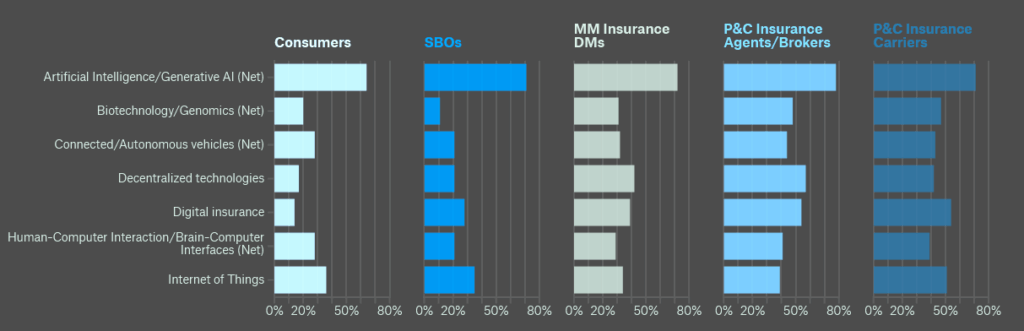
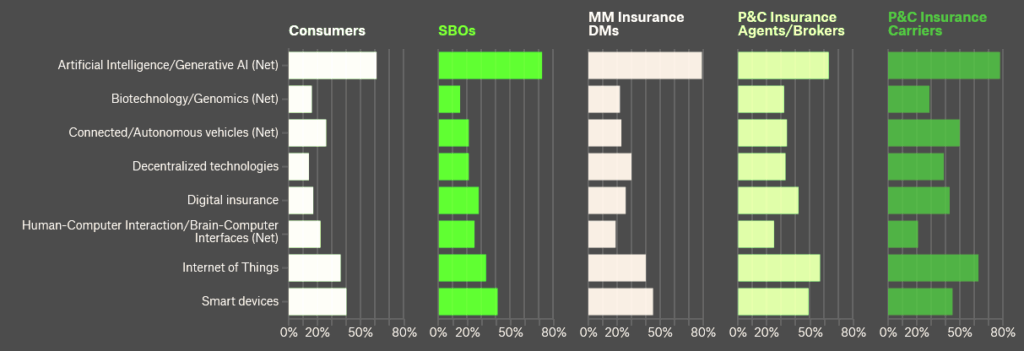
Respondents across the global market ranked artificial intelligence and generative AI as the most influential technologies, with 70% naming them as having the greatest impact.
Smart devices followed at 45%, while the Internet of Things reached 42%. Digital insurance and connected or autonomous vehicles each stood at 32%.
Jeff O’Shaughnessy, president and CEO of HSB, said AI and connected devices now sit across much of the economy. As this happens, the line between digital and physical risk keeps narrowing. One failure might create operational losses, financial damage and safety consequences at the same time, leaving insureds with expensive disruption.
As AI and connected devices become embedded in every part of the economy, the distinction between digital and physical risk is fading. A single failure can trigger operational, financial, and safety consequences that can cause significant and costly disruptions to insureds.
The shift matters because emerging technologies bring better risk insight and new pressure. AI speeds decision-making, yet it also makes models harder to test, explain and control.
Global most impactful emerging technologies
Most impactful emerging technologies in the U.S.
Most impactful emerging technologies in the U.K.
IoT gives organizations more visibility into assets and operations, yet it expands the attack surface. Digital platforms improve efficiency, though they also increase dependence between systems, vendors and customers.
As organizations become more connected, disruption risk rises with them. Risk managers need broader visibility, better scenario planning and insurance structures built for failures that move across technology, operations and physical assets.
According to Beinsure analysts, the next phase of corporate risk management won’t treat cyber, property, equipment and liability exposures as separate silos. The exposures already overlap, the insurance response has to follow.
Cyber and climate risks reshape insurance priorities
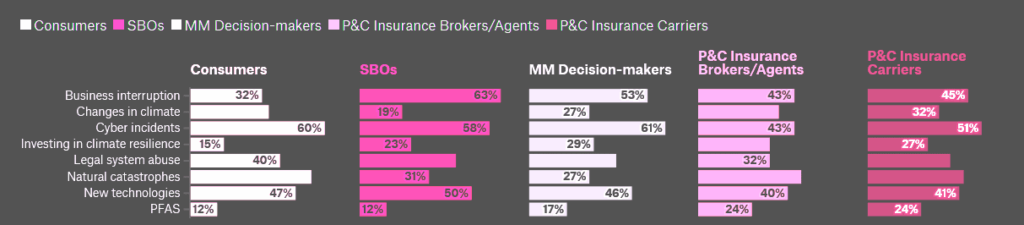
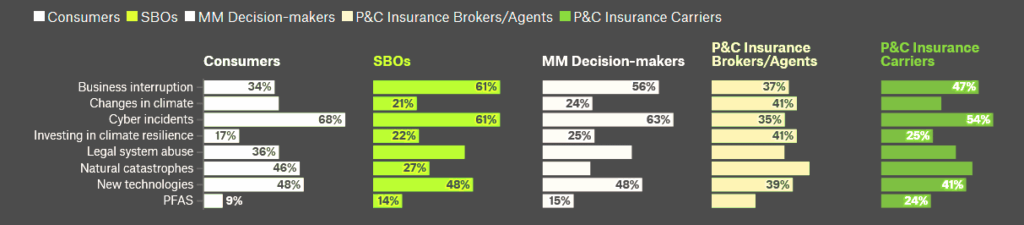
- Cyber incidents lead 2026 risk concerns at 55%, followed by business interruption and new technologies at 45% each.
- Natural catastrophes are expected to become the top risk over the next five years, rising to 52% as climate-related losses increase.
- Risk is becoming more connected: cyber events, climate losses, legal pressure and new technologies can spread across operations, supply chains and insurance claims.
Organizations no longer deal with isolated threats. They manage operational, digital, environmental and liability pressures that move across value chains and turn one event into several losses.
Cyber incidents ranked first, cited by 55% of respondents. Business interruption and new technologies followed at 45% each. Natural catastrophes reached 42%, while legal system abuse and related pressures stood at 39%.
Sabrina Hart, president and CEO of Munich Re Specialty – North America, said the real challenge sits in how these forces connect. A cyber event triggers operational disruption. A climate event moves through supply chains. Legal inflation raises losses beyond the original incident.
She said this environment requires more than traditional insurance placement. Companies need joined-up risk thinking, technical expertise and a forward view that brings more certainty to a less predictable operating environment.
Global top insurance risks
Top insurance risks in the U.S.
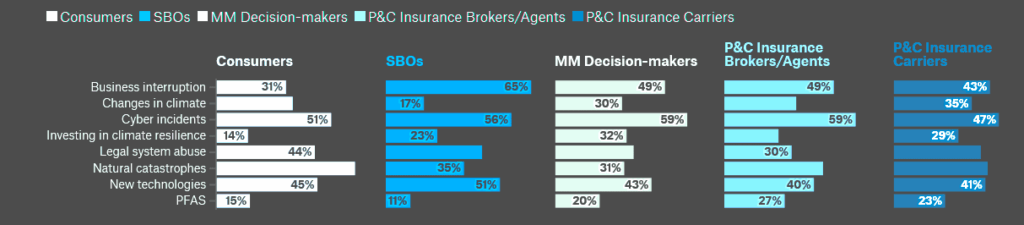
Top insurance risks in the U.K.
The central point is direct: risk no longer moves in a straight line. It compounds, spreads and costs more.
Natural catastrophes rise to the top risk at 52%, reflecting higher climate-related losses. Cyber remains near the top at 47%, driven by broader digital infrastructure and heavier technology dependence.
New technologies, cited by 44%, and business interruption, at 37%, continue to shape operational planning. PFAS liability also moves into view, cited by nearly 20% of all respondents and 37% of US carriers.
These findings match wider research on disaster costs, digital exposure and long-tail environmental claims. The issue isn’t one hazard replacing another. It’s the way each one affects the others.
A cyber incident stops operations. A climate event leads to litigation. A new technology exposes supply chains. Environmental liabilities stay on the balance sheet for decades.
Organizations that understand those links and plan around them will move faster than competitors when losses spread beyond the first event.
P&C insurance affordability worsens as risks pile up
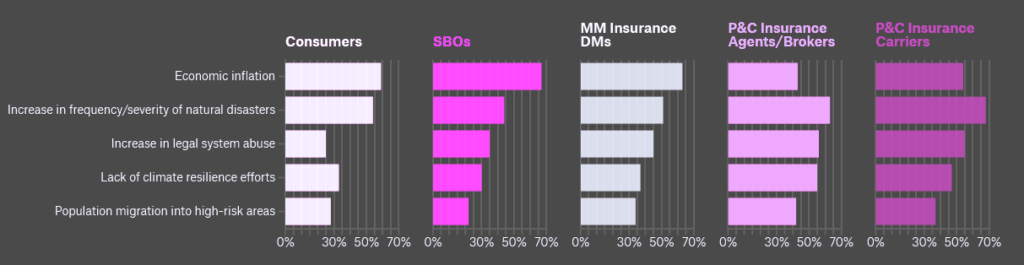
- P&C insurance affordability pressure is driven by accumulated risks, led by economic inflation at 57% and rising natural disaster frequency and severity at 56%.
- Legal system pressure, weak climate adaptation and migration into high-risk areas are adding claims costs and reducing coverage availability.
- Consumers often see higher premiums as a pricing problem, while insurers are responding to higher claims severity, capital costs and volatility.
Affordability pressure in P&C insurance doesn’t come from one source. It reflects the accumulated effect of economic inflation, climate-related catastrophe losses, legal system pressure and long-term changes in risk exposure.
The gap between consumer perception and insurance market reality keeps widening, because policyholders often see higher premiums as a pricing issue, while insurers price the rising cost of claims, capital and volatility.
Across the global market, RiskScan respondents identified several linked cost drivers. Economic inflation ranked first at 57%. Increasing frequency and severity of natural disasters followed closely at 56%, Beinsure noted.
Legal system abuse and related pressure reached 41%. Lack of climate adaptation efforts stood at 40%. Population migration into higher-risk areas came in at 32%.
Global drivers behind the cost of insurance
Global insurance rates declined 6% in the second quarter 2026, extending the market’s run of reductions to eight consecutive quarters and giving buyers better conditions across most regions and major product lines. According to Marsh’s Global Insurance Market Index (GIMI), property pricing recorded the steepest decline.
Property insurance rates fell 12% globally as available capacity and insurer competition gave buyers more room to revisit program cost and structure. For many corporate insureds, property remains the largest single premium class, so the drop matters for budgets.
Insurer financial results helped reset the market. Strong capital levels, lower reinsurance costs and higher investment returns increased competition. Insurers also moved beyond price in many markets, offering broader cover, expanded terms and lower deductibles to win or retain accounts.
The data points to a difficult market problem: the economics of P&C risk have become more complex, while public understanding still lags behind. Inflation raises repair and replacement costs.
Natural disasters increase loss frequency and severity. Legal pressure adds claims expense. Weak climate adaptation leaves exposed assets more vulnerable.
Migration into higher-risk areas adds another layer. More people and property sit in regions exposed to wildfire, flood, storm or heat. That raises insured losses and pushes affordability concerns further into the consumer market.
For insurers, the issue isn’t only premium adequacy. It’s the cost of matching price to risk in a market where losses arrive through several channels at once, Beinsure stated. For customers, the result feels simpler: coverage costs more, and options shrink.
Frequent, regionally relevant natural catastrophes dominate the risk landscape
- Flood is the top natural disaster concern at 47%, followed by winter storms at 39%, thunderstorms at 38% and excess rainfall at 36%.
- Repeated localized events now shape risk perception more than rare high-severity catastrophes, because households and businesses experience them directly.
- Frequent storms and flooding are increasing insured losses, disrupting operations and putting pressure on catastrophe modeling, pricing and preparedness.
Natural disaster risk is becoming more frequent, more local and harder for households and businesses to treat as a distant exposure. Munich Re Specialty’s latest RiskScan shows a shift in how people assess catastrophe risk.
Across the global market, respondents ranked flood as the top natural disaster concern at 47%. Winter storms followed at 39%, with thunderstorms at 38%. Excess rainfall reached 36%, ahead of earthquake at 26%.
Most concerning natural disasters
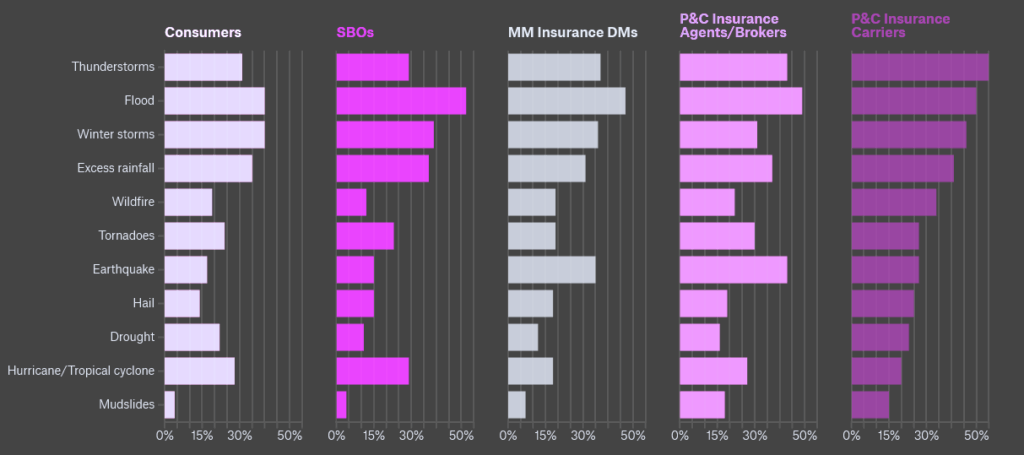
Flood and severe storm events consistently rank near the top across respondent groups. According to RiskScan data, lived experience is shaping risk perception more than distant catastrophe scenarios. Repeated moderate-severity events, especially those tied to local weather, now carry more influence than low-frequency disasters with larger single-event losses.
For the P&C industry, resilience must be built into every stage of the value chain. Our role extends beyond indemnification as we are partners in helping communities anticipate, adapt, and strengthen their defenses against natural disasters.
Kathleen O. Zortman, President & CEO of American Modern
The shift matters because frequent localized disasters change the economics of catastrophe risk. Repeated storms strain household budgets. Local flooding disrupts operations and supply chains. Secondary perils put pressure on traditional modeling and pricing frameworks.
Organizations that understand these patterns will improve preparedness, reduce exposure and manage catastrophe costs with more discipline in a climate environment where volatility has become standard operating reality.
Inflation pressure reshapes insurance risk pricing
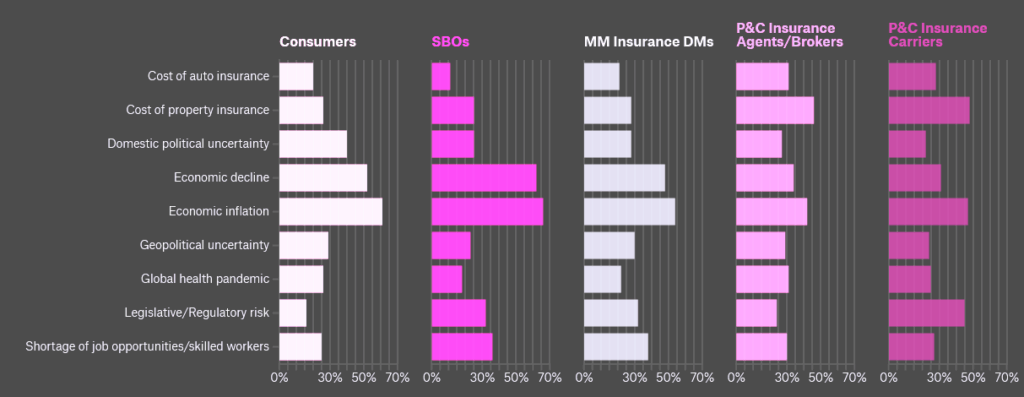
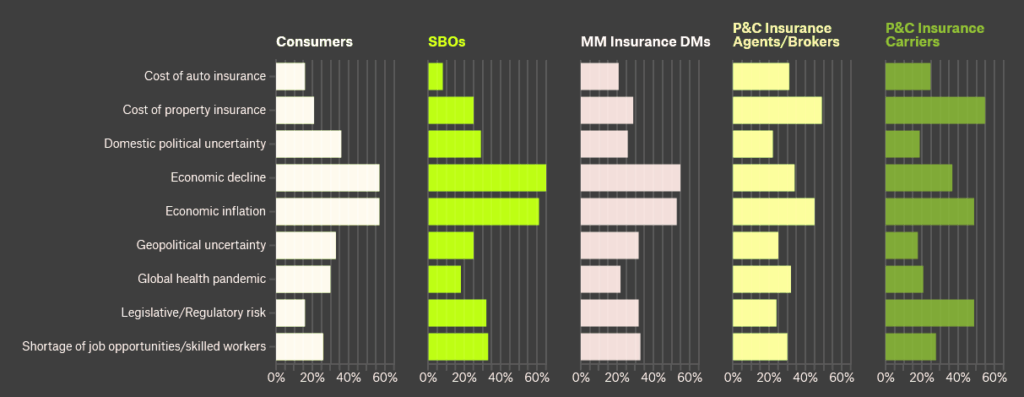
- Economic inflation is the top market concern at 54%, followed by economic decline at 46% and property insurance costs at 34%.
- Inflation, higher replacement costs and capital pressure are forcing insurers to reassess claims severity, pricing and risk appetite across business lines.
- Economic volatility now amplifies other risks, as borrowing costs, geopolitical uncertainty, supply chain stress, cyber events and extreme weather become harder to absorb.
Economic pressure has become the main force shaping market risk. Organizations across the insurance sector now feel financial volatility more directly, as inflation, weaker economic growth and capital constraints influence how risks get priced, financed and transferred.
Global RiskScan respondents identified economic inflation as the leading market concern at 54%. Economic decline followed at 46%. The cost of property insurance ranked at 34%, ahead of skilled labor shortages at 30% and domestic political uncertainty at 29%.
Cathy Smith, chief underwriting officer, said economic volatility affects much more than the price of risk. Inflation, higher replacement costs and pressure on capital are forcing underwriters to reassess severity assumptions and the durability of risk appetite across business lines.
The broader issue is the point where economics and risk meet. As macroeconomic and geopolitical uncertainty rises, insurers are reworking how they model, price and diversify exposures, according to Beinsure. Older approaches, where economic inputs entered underwriting models after the main analysis, no longer meet the market’s needs.
Global market dynamics
U.S. market dynamics
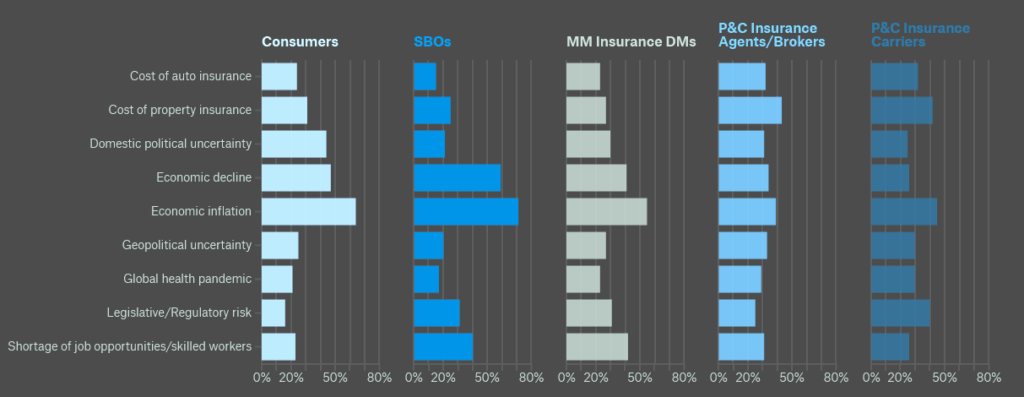
U.K. market dynamics
Michel Léonard, chief economist and data scientist at the Insurance Information Institute, said economic conditions have become a direct amplifier of risk.
Economic conditions are no longer separate from risk, they are a key amplifier. Inflation increases the cost of rebuilding and claims, while higher borrowing costs can delay investments in resilience. The result is a compounding effect where shocks become more costly and harder to absorb across the insurance ecosystem
Economic volatility now affects every part of the risk equation. Inflation increases repair and rebuilding costs. Higher financing costs delay resilience spending. Geopolitical shifts alter supply chains and capital flows. Correlated stress events, including extreme weather and cyber incidents, become harder to carry when balance sheets already face pressure.
Organizations that understand these links will have a stronger position in uncertain markets, Beinsure stated. They will price risk with more discipline, protect capital more carefully and plan for financial stress before losses arrive.
What is the RiskScan 2026 survey?
RiskScan 2026 is a global research study conducted by Munich Re Specialty in partnership with the Insurance Information Institute (Triple-I) and supported by RTi Research. The survey gathered insights from more than 1,700 insurance professionals, brokers, business leaders, small-business owners and consumers across the U.S. and U.K. It examines how different stakeholders perceive today’s most pressing risks, identifies gaps in understanding, and highlights where education, innovation and collaboration are needed to strengthen resilience across the insurance value chain.
Which risk is the highest concern today?
Cyber incidents rank as the leading insurance risk, cited by 55% of respondents. Business interruption and emerging technologies share second place at 45%, while natural catastrophes follow at 42%. The report also emphasizes that these risks rarely occur in isolation, a cyberattack can disrupt operations, trigger supply chain failures and create financial losses, making interconnected risk management increasingly important.
Why is AI important for insurers?
Artificial intelligence and generative AI are considered the world’s most impactful emerging technologies, with 70% of respondents identifying them as major drivers of change. AI helps insurers improve underwriting, claims processing and risk assessment through advanced analytics and automation. However, it also introduces new exposures, including cyber threats, model transparency challenges, governance issues and liability concerns.
How is climate change affecting insurance?
Climate change is increasing both the frequency and severity of natural catastrophes, making them one of the industry’s fastest-growing concerns. Respondents expect natural catastrophes to become the number one insurance risk within the next five years. Flooding, winter storms, severe thunderstorms and excessive rainfall are now among the most significant threats, driving higher claims costs, disrupting businesses and placing additional pressure on catastrophe modeling, pricing and insurance affordability.
What drives rising insurance premiums?
The report identifies several interconnected drivers behind rising property and casualty insurance costs. Economic inflation increases repair and replacement expenses, while more frequent natural disasters generate larger losses. Legal system pressures, insufficient climate adaptation and migration into high-risk areas further increase claims severity and reduce coverage availability.
Why are risks considered interconnected?
Today’s risks are increasingly linked rather than isolated. A cyberattack can interrupt business operations and supply chains, while a climate disaster may trigger litigation, financial losses and long-term operational disruption. Emerging technologies, economic volatility and environmental liabilities can amplify one another, creating multiple losses from a single event. The report concludes that organizations should replace siloed risk management with integrated strategies that address these interconnected exposures.
What should businesses do to improve resilience?
Businesses should adopt a comprehensive risk management approach that integrates cyber, property, operational and liability risks instead of treating them separately. The report recommends strengthening cybersecurity, improving catastrophe preparedness, investing in data-driven risk assessment, enhancing scenario planning and building insurance programs that account for cascading events. Organizations that recognize how different risks interact will be better positioned to protect assets, control losses and adapt to an increasingly volatile business environment.
……………
QUOTES: Sean Kevelighan – CEO of Insurance Information Institute, Michel Léonard – chief economist and data scientist at the Insurance Information Institute, Jeff O’Shaughnessy – President & CEO of HSB, Sabrina Hart – president and CEO of Munich Re Specialty – North America, Cathy Smith – chief underwriting officer of Munich Re Specialty, Kathleen O. Zortman – President & CEO of American Modern
Edited by Yana Keller – Insurance Editor at Beinsure Media, Nataly Kramer – Lead Insurance Editor at Beinsure