The US homeowners insurance industry reported a $16.5 bn net underwriting profit in 2025, its first since 2019, as improved pricing, lower catastrophe losses and favorable reserve development helped insurers recover from several years of substantial losses, according to AM Best.
The result marked a reversal from the $1.3 bn underwriting loss recorded in 2024 and the $15.2 bn loss in 2023. During the five years preceding 2025, cumulative underwriting losses exceeded $35 bn.
The segment’s net combined ratio improved to 87.8% in 2025, compared with 99.2% in 2024 and 110.9% in 2023, reaching its lowest level since 2015. The net loss and loss adjustment expense (LAE) ratio declined to 61.1%, also an 11-year low.
- US homeowners insurers generated a $16.5 bn net underwriting profit in 2025, reversing a $1.3 bn loss in 2024, while the net combined ratio improved to 87.8%.
- Average approved homeowners insurance rate increases slowed from 13.5% in 2024 to 7.6% in 2025 and 4.3% in the first half of 2026, supported by improved underwriting results and softer reinsurance pricing.
- Florida’s insurance reforms and favorable reserve development contributed to stronger profitability, although California’s wildfire losses pushed its direct combined ratio to 205.3% in 2025.
AM Best attributed the improvement to sustained rate increases, more precise underwriting, catastrophe risk modeling and better claims management. Double-digit annual growth in direct and net premiums written from 2022 through 2024 had strengthened insurers’ premium base ahead of the recovery.
The industry also benefited from relatively favorable catastrophe experience in 2025, despite substantial California wildfire losses early in the year and severe convective storms across the Midwest, South and Plains states. No hurricanes made US landfall during the year.
The improvement extended into 2026. The homeowners segment’s direct incurred loss ratio fell to 48.4% in the first half, compared with 78.7% in the corresponding period of 2025, marking its lowest first-half reading in five years.
Alongside homeowners insurance, stronger private passenger auto results contributed to the wider US property and casualty industry’s improved underwriting profitability. US 30-year mortgage rates reached 7.55% as refinancing and purchase applications declined, raising monthly costs and pushing more borrowers toward ARMs.
Homeowners insurance rate increases slow as reinsurance costs ease
Improving underwriting performance has allowed insurers to moderate premium increases following several years of substantial rate adjustments.
The average approved homeowners insurance rate increase across the US declined from 13.5% in 2024 to 7.6% in 2025 and 4.3% during the first half of 2026.
Property catastrophe reinsurance pricing has also softened since reaching its peak in 2023. The trend began with 2024 renewals and continued through midyear 2026, reducing pressure on primary insurers and supporting more moderate pricing and selective coverage expansion.
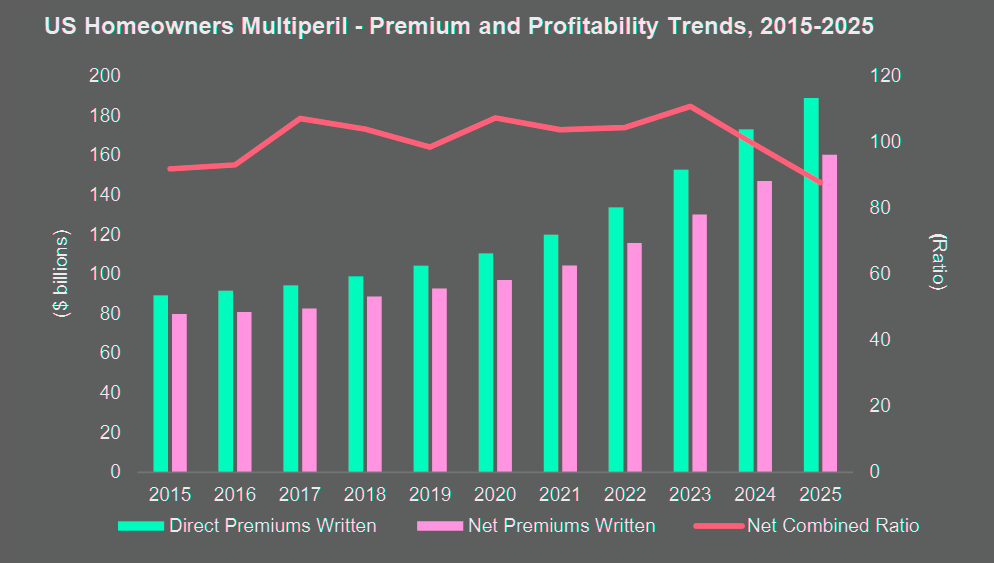
AM Best said insurers have increasingly adopted granular data analytics, inflation adjustments and refined underwriting guidelines to better align premiums with individual property risks.
Performance nevertheless varies considerably by state
- In Florida, the average approved rate increase fell from 5.7% in 2025 to 0.5% in the first half of 2026. Texas recorded a similar slowdown, from 7.5% to 0.3%.
- California continued to experience substantial pricing pressure, with approved increases averaging 12.2% in the first half of 2026 after 16.9% in 2025.
- Other states recorded accelerating increases. Hawaii’s average approved rate change reached 42.9% in the first half of 2026, compared with 16.7% in 2025, while Washington’s rose from 11.2% to 21.8%.
AM Best noted that insurers’ ability to improve profitability depends on geographic exposure, portfolio composition, risk selection and their use of technology in underwriting and loss prevention.
US Homeowners Multiperil – Top 10 States, Direct Underwriting Ratios
| State | Direct premiums written, $ mn | Loss & LAE ratio, % | Underwriting expense ratio, % | Combined ratio, % |
|---|---|---|---|---|
| Texas | 20,475 | 48.6 | 24.4 | 73.4 |
| Florida | 18,831 | 14.3 | 24.9 | 39.4 |
| California | 17,727 | 179.6 | 25.5 | 205.3 |
| New York | 9,029 | 45.2 | 28.1 | 73.5 |
| Illinois | 6,939 | 65.0 | 24.6 | 89.7 |
| Georgia | 6,371 | 50.8 | 26.0 | 77.2 |
| Colorado | 5,760 | 33.0 | 23.5 | 57.0 |
| Pennsylvania | 5,698 | 55.5 | 25.6 | 81.4 |
| North Carolina | 5,499 | 42.8 | 24.9 | 68.2 |
| Ohio | 5,100 | 48.5 | 25.3 | 74.0 |
| Total US | 188,681 | 58.8 | 25.3 | 84.5 |
Florida insurance reforms contribute to national profitability
Changes to Florida’s insurance litigation environment played a significant role in the industry’s improved 2025 results.
Tort reforms enacted in 2022 and 2023 eliminated one-way attorney fees and restricted assignment of benefits to contractors, measures intended to reduce excessive litigation and fraudulent claims activity.
According to the Florida Office of Insurance Regulation, property-related lawsuits subsequently declined.
As insurers reassessed outstanding claims following the reforms, some reduced previously established loss reserves, improving reported underwriting results.
Florida’s homeowners direct combined ratio fell to 39.4% in 2025, compared with 84.0% in 2024 and 68.6% in 2023. Its direct loss and LAE ratio declined to 14.3%, the lowest among the 10 largest state homeowners markets.
Florida generated approximately $18.83 bn in direct homeowners premiums in 2025, making it the second-largest state market after Texas.
Given its substantial premium volume, favorable reserve adjustments in Florida had a significant effect on national underwriting performance.
Across the combined homeowners and farmowners multiperil segment, favorable prior-year reserve development reached nearly $4.1 bn in 2025, compared with more than $1.2 bn in 2024.
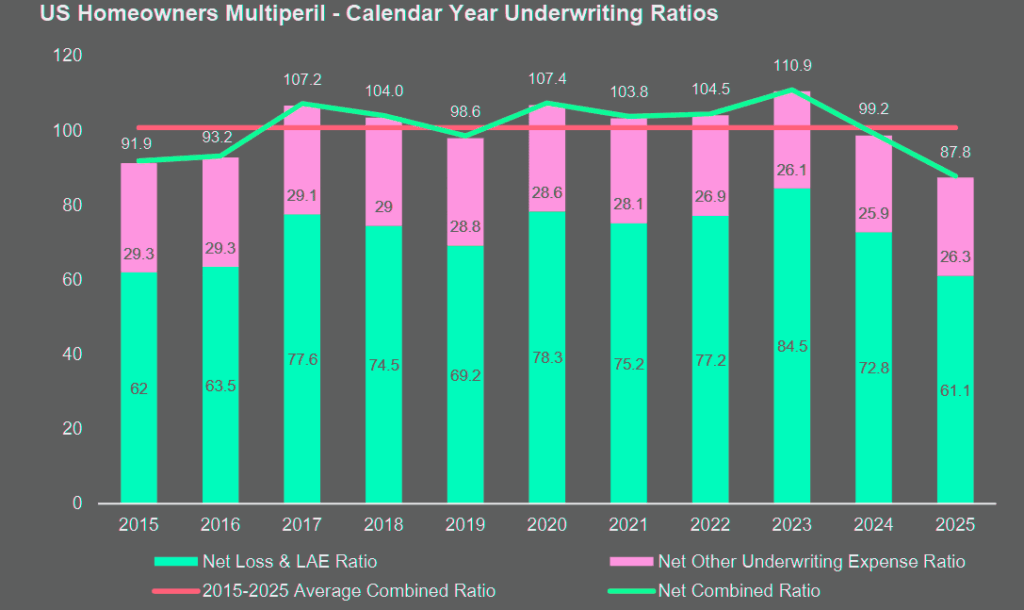
These adjustments improved calendar-year combined ratios by 2.5 percentage points in 2025 and 0.9 percentage points in 2024.
Five insurance groups accounted for approximately 47%, or more than $1.9 bn, of the favorable reserve development in 2025: USAA, American Family Insurance, Liberty Mutual, Chubb INA and RenaissanceRe US.
The contribution was particularly significant because homeowners insurance is generally a short-tail business, where claims settle relatively quickly and prior-year reserve development typically has a smaller effect on annual profitability.
California wildfires remain a major exception to improving results
Most major US homeowners insurance markets reported better underwriting results in 2025, although catastrophe-exposed states continued to experience substantial volatility.
Among the 20 largest state markets, which accounted for more than 75% of US homeowners direct premiums written, 14 recorded lower direct combined ratios than in 2024.
Seven states achieved improvements of at least 20 percentage points.
Texas, the largest homeowners insurance market with $20.48 bn in direct premiums, improved its combined ratio to 73.4% from 93.2%.
Georgia’s ratio declined from 143.5% to 77.2%, Colorado’s from 96.9% to 57.0%, and North Carolina’s from 102.5% to 68.2%.
California moved in the opposite direction
Wildfire losses pushed its direct combined ratio to 205.3% in 2025, compared with 75.9% in 2024. The state reported approximately $17.73 bn in homeowners direct premiums written, ranking third nationally.
Missouri was another major exception, recording a 131.5% combined ratio following severe storms and tornado activity. The state experienced five presidential disaster declarations between May and July, alongside reports of more than 100 tornadoes.
Nationally, the number of states reporting direct combined ratios above 100 fell from 17 in 2023 to 10 in 2024 and five in 2025.
AM Best also identified signs of insurers becoming more willing to re-enter California, although the state’s wildfire exposure continues to complicate underwriting decisions.
Homeowners Multiperil – Average Approved Rate Changes by State
| State | 2025 | 1H 2026 |
|---|---|---|
| Alaska (AK) | 8.0% | 8.7% |
| Alabama (AL) | 7.3% | 1.6% |
| Arkansas (AR) | 12.2% | 6.6% |
| Arizona (AZ) | 7.6% | 3.2% |
| California (CA) | 16.9% | 12.2% |
| Colorado (CO) | 9.4% | 4.8% |
| Connecticut (CT) | 7.7% | 6.0% |
| District of Columbia (DC) | 8.4% | 5.8% |
| Delaware (DE) | 7.0% | 4.1% |
| Florida (FL) | 5.7% | 0.5% |
| Georgia (GA) | 11.0% | 6.2% |
| Hawaii (HI) | 16.7% | 42.9% |
| Iowa (IA) | 7.9% | 3.3% |
| Idaho (ID) | 6.7% | 4.9% |
| Illinois (IL) | 8.1% | 4.6% |
| Indiana (IN) | 6.1% | 4.7% |
| Kansas (KS) | 8.1% | 5.7% |
| Kentucky (KY) | 9.4% | 4.0% |
| Louisiana (LA) | 8.0% | 6.3% |
| Massachusetts (MA) | 7.1% | 3.1% |
| Maryland (MD) | 6.4% | 1.6% |
| Maine (ME) | 2.5% | -0.7% |
| Michigan (MI) | 6.6% | 4.7% |
| Minnesota (MN) | 13.2% | 5.0% |
| Missouri (MO) | 5.7% | 5.8% |
| Mississippi (MS) | 8.4% | 7.8% |
| Montana (MT) | 6.2% | 6.2% |
| North Carolina (NC) | 7.6% | 1.4% |
| North Dakota (ND) | 6.1% | 3.8% |
| Nebraska (NE) | 10.9% | 8.5% |
| New Hampshire (NH) | 3.3% | -2.2% |
| New Jersey (NJ) | 7.8% | 6.3% |
| New York (NY) | 9.5% | 5.4% |
| New Mexico (NM) | 5.8% | 4.5% |
| Nevada (NV) | 13.3% | 3.6% |
| Ohio (OH) | 7.5% | 4.5% |
| Oklahoma (OK) | 10.0% | 5.1% |
| Oregon (OR) | 6.8% | 5.6% |
| Pennsylvania (PA) | 6.2% | 3.8% |
| Rhode Island (RI) | 10.8% | 2.2% |
| South Carolina (SC) | 10.7% | 9.0% |
| South Dakota (SD) | 9.7% | 2.3% |
| Tennessee (TN) | 8.5% | 4.2% |
| Texas (TX) | 7.5% | 0.3% |
| Utah (UT) | 6.3% | 9.3% |
| Virginia (VA) | 7.9% | 1.9% |
| Vermont (VT) | 5.9% | 1.4% |
| Washington (WA) | 11.2% | 21.8% |
| Wisconsin (WI) | 8.7% | 4.2% |
| West Virginia (WV) | 5.1% | 6.0% |
| Wyoming (WY) | n/a | n/a |
| US Average | 7.6% | 4.3% |
State Farm and Allstate retain leadership in US homeowners insurance
The competitive structure of the US homeowners insurance market changed relatively little during 2025.
State Farm remained the largest homeowners insurer, generating approximately $35.27 bn in direct premiums written, up 12.1% year over year. Allstate ranked second with $17.77 bn, an increase of 14.7%, followed by USAA with $13.26 bn, up 11.3%.
Together, the three groups represented more than one-third of the US homeowners insurance market.
Farmers Insurance moved into fourth position after increasing premiums by 8.4% to $10.48 bn, overtaking Liberty Mutual, whose homeowners premiums declined 2% to $10.40 bn.
Liberty Mutual’s decline reflected lower average written premiums per policy and earlier underwriting measures aimed at improving its portfolio mix and profitability.
Six of the 20 largest insurers recorded double-digit premium growth in 2025, while 16 reported improved net loss and LAE ratios.
Florida’s Citizens Property Insurance Corporation experienced one of the most significant changes, falling from 13th to 19th position.
Its direct premiums written declined 44.7% to approximately $1.50 bn as Florida continued transferring policies from the state-backed insurer to private carriers.
Florida Peninsula entered the top 20, replacing Amica Mutual Group, which dropped to 21st.
Population growth in catastrophe-prone states raises future insurance risks
AM Best cautioned that the industry’s improved profitability does not eliminate longer-term exposure to severe weather and demographic changes.
Population growth in states vulnerable to hurricanes, wildfires, hail and severe convective storms is increasing the concentration of insured property values in catastrophe-prone regions.
According to US Census Bureau estimates, the national population increased by approximately 10.2 mn, or 3.1%, between April 2020 and July 2025.
The South accounted for almost 7.4 mn of that increase. Texas added approximately 2.47 mn residents, followed by Florida with 1.87 mn, North Carolina with 748,000, South Carolina with 438,000 and Arizona with 437,000. Together, those five states accounted for 58% of national population growth during the period.
All except Arizona experienced at least one year during the previous decade in which their direct loss and LAE ratios exceeded 100%, indicating underwriting losses before operating expenses.
Migration toward the Gulf Coast and southern inland states could therefore increase aggregate insured losses as more homes and infrastructure become exposed to severe weather.
AM Best expects underwriting discipline, catastrophe risk modeling, geographic concentration management, reinsurance purchasing and capital optimization to remain important determinants of future profitability.
The industry’s 2025 recovery and favorable first-half 2026 results provide insurers with greater pricing flexibility, but the sharp differences between states demonstrate how dependent homeowners underwriting performance remains on catastrophe exposure and the effectiveness of risk management.
……………..
AUTHOR: David Blades – Associate director of industry research at AM Best
Edited by Nataly Kramer – Lead Insurance Editor at Beinsure