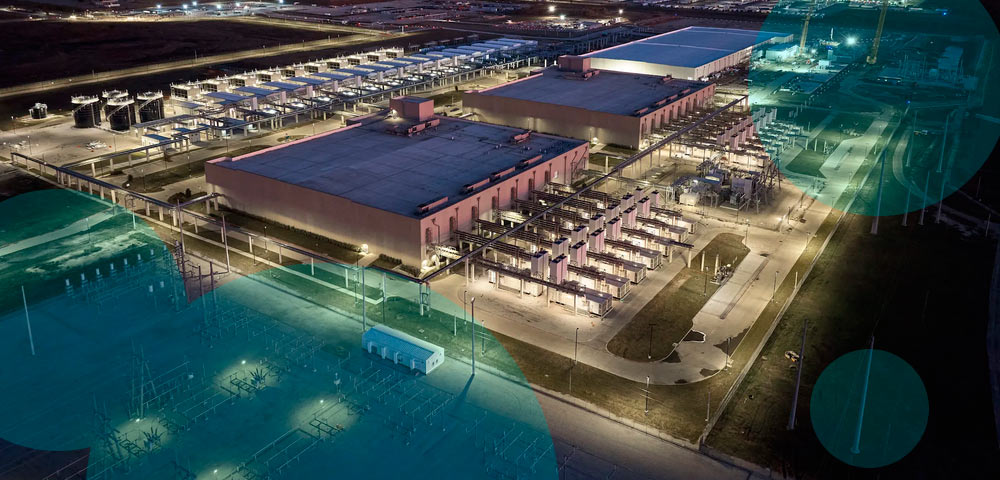
- Global data center investment is projected to reach $6.7 tn by 2030, including approximately $5.2 tn dedicated to AI workloads, according to McKinsey.
- Gallagher Re warns that rapid data center construction and increasingly expensive AI hardware are creating complex underwriting exposures across property, construction, marine cargo and business interruption insurance.
- Insurers and reinsurers face growing challenges in assessing interconnected cyber, environmental and infrastructure risks, particularly where a single event could trigger losses across multiple insurance lines.
The rapid expansion of artificial intelligence is driving unprecedented investment in data centers, creating new underwriting challenges and potential growth opportunities for the global insurance and reinsurance industry, according to Gallagher Re.
As demand for AI computing capacity accelerates, technology companies and infrastructure investors are expanding the physical facilities needed to support increasingly powerful computing systems.
McKinsey estimates that global investment in the data center sector could reach $6.7 tn by 2030, with approximately $5.2 tn allocated to infrastructure supporting AI workloads.
The expansion is also increasing demand for electricity generation and supporting infrastructure, introducing additional operational, environmental and sustainability considerations.
Gallagher Re’s 2026 Global InsurTech Report highlights how these developments are changing the risk profile of data centers and forcing insurers to reconsider traditional underwriting approaches.
Unlike conventional commercial properties, modern AI data centers combine several categories of exposure within a single infrastructure project.
During construction, insurers must assess building and engineering risks associated with the development of large-scale facilities.
Equipment procurement introduces additional exposures involving the transportation of advanced chips, circuit boards and other high-value components, potentially affecting marine cargo and inland transit insurance.
Once operational, data centers face property and technology-related risks, alongside the potential for significant business interruption if essential computing services become unavailable.
Because data centers support interconnected digital services, operational disruptions can also affect businesses and technology platforms that depend on their computing capacity.
This creates the potential for losses extending beyond the physical facility, complicating the assessment of contingent business interruption and insurance accumulation.
AI infrastructure requires a new approach to underwriting
Gallagher Re argues that the speed of data center development, combined with the expense and complexity of AI-specific hardware, is increasing pressure on insurers and reinsurers.
Traditional property risk assessments may not fully capture the financial consequences of an incident affecting a major AI computing facility.
Underwriters must consider how construction, operational and technological exposures interact, rather than evaluating each risk in isolation.
The concentration of expensive equipment and critical digital infrastructure also raises questions about how insurers should price potential losses affecting several coverage categories simultaneously.
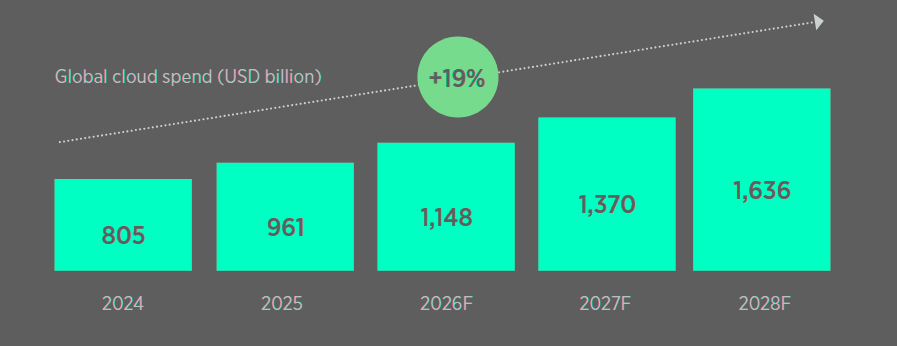
Global cloud-computing spend is projected to rise by almost a fifth by 2028
A particular challenge involves assessing insurance clash, where a single event could generate claims under multiple policies or lines of business.
Gallagher Re identifies systemic contagion as another area requiring attention, particularly when an incident combines exposures that have historically been assessed separately.
Cyber and environmental risks are one example. The interaction between technological failures, infrastructure dependencies and environmental consequences may create loss scenarios that traditional underwriting models have not adequately considered together.
Data center growth creates opportunities for insurers and reinsurers
Despite these challenges, Gallagher Re sees opportunities for insurers willing to develop specialist expertise in AI infrastructure.
As data centers become increasingly important to the global digital economy, businesses investing in these facilities will require insurance solutions capable of addressing their construction, equipment, operational and technology exposures.
That demand could support new underwriting capacity and encourage closer coordination between property, engineering, marine cargo, cyber and business interruption specialists.
The following coverage considerations are now forming the basis for pricing and underwriting data centers
| Property and business interruption coverage | Data centers present unique risks beyond conventional commercial property. Insurance policies frequently provide property damage coverage combined with business interruption protection to minimize downtime and operational losses, taking into account both direct and contingent liabilities. |
| Complex risk engineering and underwriting | The sector’s rapid growth drives the need for specialized underwriting approaches, including: Detailed assessment of operational safeguards, for example, physical segregation of batteries to prevent fire propagation. Integration of digital and physical risk management, recognizing cyber-physical convergence in AI-driven and highly automated facilities. Use of risk engineering expertise to underwrite novel and evolving risks, e.g., data centers powered by modular nuclear reactors, or advanced liquid cooling systems. Continuous monitoring and technical evaluations, over and above traditional annual renewals, to ensure the coverage reflects real-world conditions. |
| Energy and renewables insurance | Data centers require vast amounts of electricity, and yet the companies that build and operate them often aim to meet net-zero commitments. As a result: Insurers play a critical role in supporting renewable energy projects that power these facilities, which includes coverage for construction, operational and transportation risks for wind, solar and nuclear projects. Coverage ensures investors and operators can proceed with large-scale clean energy infrastructure safely and sustainably. |
| Complex claim scenarios | Operational disruptions: Power outages, system failures or cyber-induced shutdowns can trigger multi-layered claims across property, general liability and professional liability lines. Third-party liability: Clients, tenants and contractors may claim losses due to service interruptions or regulatory breaches. Coverage gaps and disputes: Courts have variably interpreted “physical loss or damage” in case law affecting insurance applicability to data and server infrastructure losses. |
| Broader market challenges and opportunities | High-value concentration risks: Many data centers, especially in the UK, are clustered geographically, increasing accumulation risk exposure for insurers. Capacity and expertise shortages: Rapid deployment and adoption of AI-driven and highly automated facilities strain traditional underwriting models. Specialist market development: Insurers investing in technical site visits, advanced modeling and climate-adjusted risk assessments gain a competitive edge, as standard commercial property approaches may be insufficient. Critical infrastructure status: In the UK, data centers are recognized as nationally significant infrastructure, highlighting the need for insurers to adopt enhanced methodologies and engage proactively in long-term risk mitigation. |
Insurers will also need to refine their understanding of infrastructure dependencies and sustainability challenges as power requirements increase.
The central challenge is determining how to price interconnected exposures without overlooking the possibility that a single incident could generate losses across multiple insured businesses.
Gallagher Re’s analysis suggests that the rapid development of AI infrastructure will require insurers and reinsurers to update their risk assessment practices, while creating opportunities for carriers capable of underwriting increasingly complex data center operations.