Sentra, the agentic data security company, has raised $150 mn in a Series C funding round led by Capital One Ventures, as growing corporate adoption of artificial intelligence increases demand for tools that protect sensitive data and control access by autonomous AI agents.
The investment includes participation from existing backers Bessemer Venture Partners, Zeev Ventures, Standard Investments, Munich Re Ventures and Key1 Capital.
- Sentra raised $150 mn in a Series C funding round led by Capital One Ventures, which will also gain representation on the company’s board.
- The investment follows more than 300% year-over-year growth as enterprises increase spending on data security for AI systems and autonomous agents.
- Sentra will use the funding to expand its security platform, strengthen access controls for human and AI identities, and enter new markets.
A representative of Capital One will join Sentra’s board of directors as part of the transaction.
The financing follows a period of rapid expansion for the cybersecurity company, which reported more than 300% year-over-year growth as enterprises seek greater visibility into their data and the identities accessing it.
Sentra plans to use the new capital to accelerate product development, expand sales and distribution operations, and strengthen its presence in existing and new geographic markets.
AI adoption increases demand for enterprise data security
The investment comes as businesses move beyond AI-powered assistants toward autonomous agents capable of accessing information, executing workflows and interacting with enterprise systems.
Unlike traditional employees, AI agents can operate continuously and process information at machine speed, creating additional challenges for security teams responsible for controlling access to sensitive records.
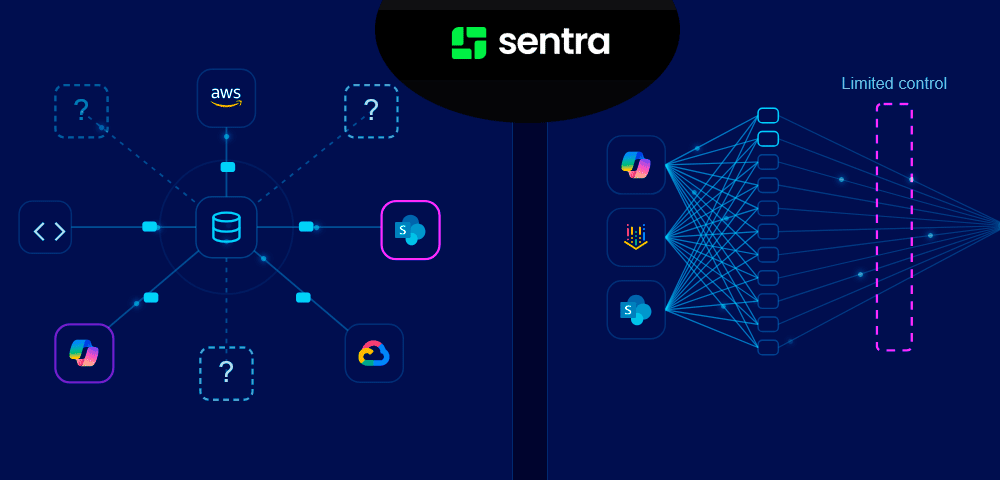
Organizations are also managing growing volumes of data distributed across cloud infrastructure, software-as-a-service platforms, data warehouses and on-premises systems.
This fragmentation makes it more difficult to identify sensitive information, determine which users and applications can access it, and enforce consistent security policies.
Yoav Regev, co-founder and CEO of Sentra, said traditional security controls were not designed for autonomous systems accessing enterprise data at high speed.
AI agents introduce another layer of complexity because they may inherit permissions from existing applications or service accounts, potentially gaining access to information beyond what is required for their assigned tasks.
He argued that companies should focus on securing the underlying data and restricting access before AI agents interact with it, rather than relying exclusively on monitoring individual requests.
The approach is intended to help organizations deploy AI systems while maintaining oversight of confidential information and compliance requirements.
Sentra focuses on protecting data before AI agents access it
Sentra’s platform is designed to identify and classify sensitive information across enterprise environments and map which identities can access particular datasets. Those identities include employees, service accounts, applications and autonomous AI agents.
The company concentrates on protecting data at rest, meaning information stored in databases, cloud services, file systems and other enterprise repositories.
Its security model combines preventive access controls, monitoring and incident response.
Before an AI agent accesses information, Sentra identifies sensitive datasets, evaluates permissions and highlights excessive or unnecessary access rights.
The platform is designed to enforce least-privilege policies, limiting each identity to the information required for its work. It also identifies redundant, outdated and potentially risky data that could increase an organization’s exposure.
During operations, Sentra monitors for unusual access to sensitive information and supports automated remediation, including revoking permissions and restricting inappropriate data sharing.
High-risk incidents can be escalated to designated data owners and handled through existing security workflows.
Following an incident, the platform provides information about the datasets an agent could have accessed, supporting investigations, compliance reviews and assessments of potential exposure.
Sentra says its technology analyzes information within the customer’s existing infrastructure rather than transferring sensitive records into a separate environment.
This approach is intended to reduce additional data residency, retention and compliance risks associated with copying enterprise information into external security platforms.
Funding to support product development and international expansion
Sentra will direct part of the $150 mn investment toward expanding its capabilities for monitoring AI agents, copilots and models, including the sensitive information those systems can access.
Development priorities include continuous assessment of permissions, stronger controls for non-human identities and improved detection of potentially unsafe agent behavior.
The company also plans to expand its ability to identify sensitive data across increasingly complex technology environments and respond when access patterns change.
Commercial expansion will focus on increasing sales capacity, strengthening channel partnerships and entering additional geographic markets.
The funding is intended to support Sentra’s position in the growing market for data security posture management, where companies seek to understand their data exposure and reduce security risks across distributed infrastructure.
The rise of autonomous AI systems is broadening that market by introducing new categories of identities that require access management and security oversight.
Lyft uses Sentra to manage AI data access
Sentra’s customers include Lyft, which has adopted the company’s technology to support data security as it expands its use of AI.
Chaim Sanders, Lyft’s chief information security officer, said the company needs visibility into the information its AI agents can access before deploying them across business operations.
Sentra provides that visibility across Lyft’s technology environment, allowing security teams to support AI initiatives while maintaining appropriate controls.
Chaim Sanders, Lyft’s chief information security officer
The example illustrates a broader challenge facing large enterprises as AI adoption accelerates.
Businesses increasingly need to balance the operational benefits of autonomous systems with requirements to protect customer information, intellectual property and other confidential records.
For Sentra, the investment from Capital One Ventures provides additional funding to develop tools addressing those risks as companies expand the number and capabilities of AI agents operating within their networks.