- Enterprise AI deployment remains concentrated in pilot projects
- AI investment increases, but revenue benefits remain limited
- Agentic AI adoption is advancing faster than governance
- Physical AI adoption could reach 80% within two years
- Workforce skills remain the largest barrier to AI integration
- AI strategy readiness exceeds preparedness in governance and talent
- Sovereign AI becomes a factor in technology procurement
- AI investment returns depend on production deployment and operating changes
Workforce adoption is progressing faster than organizational restructuring. Access to approved AI tools has increased by approximately 50% over the previous year, yet 84% of companies have not redesigned jobs around AI capabilities. The difference is particularly pronounced in autonomous AI. Nearly three-quarters of organizations plan to deploy agentic AI within two years, but only 21% report having mature governance arrangements for autonomous agents.
Deloitte’s 2026 State of AI in the Enterprise report identifies a substantial gap between corporate investment in artificial intelligence and the operational changes required to generate financial returns.
Although 84% of surveyed organizations are increasing AI spending, only 25% have deployed at least 40% of their AI experiments into production. Just 20% report achieving revenue growth from AI, compared with 74% that expect the technology to contribute to revenue expansion.
Key highlights
- Enterprise AI adoption is expanding, but only 25% of organizations have moved at least 40% of their AI experiments into production. Although 84% are increasing AI investment, only 20% report revenue growth from the technology.
- Some 74% of companies plan to deploy agentic AI within two years, compared with 21% that have mature governance frameworks. Meanwhile, 84% have not redesigned jobs to accommodate AI capabilities.
- Deloitte reports that 34% of organizations are pursuing substantial changes to products, processes or business models through AI. Another 30% are redesigning core processes, while 37% have made little or no operational change.
The research covers consumer businesses, energy and industrial companies, financial services, healthcare and life sciences, technology and telecommunications, and government and public services. It also incorporates 15 interviews with senior executives and AI specialists.
Deloitte’s findings are based on a survey of 3,235 business and technology leaders across 24 countries and six industries, conducted between August and September. Respondents held positions ranging from director to C-suite executive and were directly involved in their organizations’ AI initiatives.
Enterprise AI deployment remains concentrated in pilot projects

Employee access to enterprise-approved AI tools increased from below 40% to nearly 60% within a year, according to Deloitte.
Among companies leading adoption, 11% have provided approved AI access to more than 80% of employees. Fewer than 60% of employees with access to AI tools use them in their daily work.
The gap between AI access and usage becomes more significant when deployment moves beyond individual productivity applications.
Only 25% of respondents said their organizations had transferred at least 40% of AI experiments into operational production environments. Another 54% expected to reach that threshold within three to six months of being surveyed. Those expectations indicate planned acceleration, but they do not establish that the deployments have subsequently occurred.
Enterprise AI Adoption and Investment Trends
| Enterprise AI indicator | Share of organizations |
|---|---|
| Increasing AI investment | 84% |
| Reporting greater confidence in AI | 78% |
| Deploying at least 40% of AI experiments into production | 25% |
| Reporting transformative AI impact | 25% |
| Achieving revenue growth from AI | 20% |
| Planning agentic AI deployment within two years | 74% |
| Reporting mature agentic AI governance | 21% |
Deloitte identifies the transition from proof of concept to production as a central constraint on enterprise adoption.
Experimental AI applications typically operate with limited datasets, small teams and controlled technical environments. Production systems require integration with existing enterprise infrastructure, security controls, regulatory compliance processes, continuous monitoring and ongoing maintenance.
A pilot estimated to require three months can take as long as 18 months when integration complications emerge, according to examples discussed in the report.
Models that perform accurately under controlled testing conditions may also prove less reliable when exposed to unusual cases and operational complexity.
Errors tolerated during experimentation can create financial, regulatory or operational liabilities when AI systems process live business transactions. These requirements increase both implementation costs and the resources needed to maintain deployed systems.
AI benefits achieving today vs. hope to achieve (%)
Deloitte also identifies uncertainty over investment returns as a reason organizations continue launching new experiments rather than expanding successful projects.
Without reliable estimates of which applications will generate measurable financial benefits, companies may prefer relatively inexpensive pilots to more demanding production deployments.
A healthcare AI executive interviewed for the report described organizations pursuing numerous experiments without establishing how successful applications would be implemented at scale (see about Agentic AI in Insurance: From Use Cases to a Core Operating System).
The distinction matters for capital allocation. Expenditure on a pilot demonstrates experimentation, but does not necessarily produce recurring operating benefits or a commercially viable system.
AI investment increases, but revenue benefits remain limited
Deloitte reports that 25% of business leaders now describe AI as having a transformative effect on their companies, compared with 12% a year earlier.
Investment and management confidence have also increased. 84% of organizations are raising AI investment, while 78% of leaders report greater confidence in the technology.
The financial benefits achieved so far are concentrated in operational efficiency rather than revenue generation.
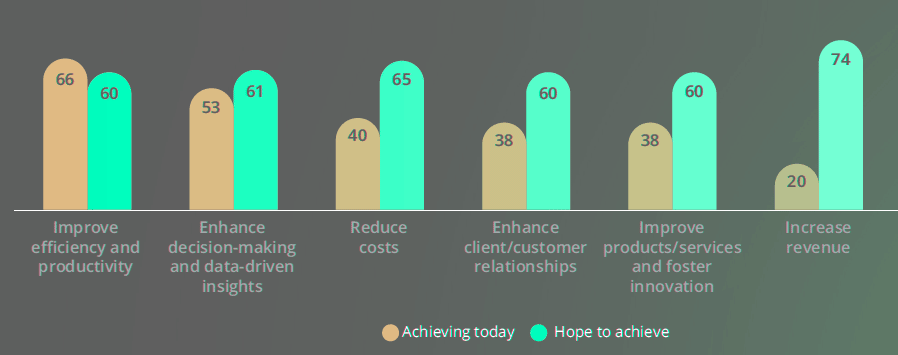
According to the survey, 66% of organizations are already improving efficiency and productivity through AI, while 60% identify those benefits as an objective they hope to achieve (see Why Insurers Are Still Struggling to Turn AI into Real Transformation).
Another 53% report improvements in decision-making and data-driven insights, compared with 61% seeking further gains in that area. Cost reduction has been achieved by 40% of respondents, although 65% identify it as an intended benefit.
Enterprise AI Business Benefits: Achieved vs Expected
| Business benefit | Already achieved | Targeted |
|---|---|---|
| Efficiency and productivity | 66% | 60% |
| Data-driven decision-making | 53% | 61% |
| Cost reduction | 40% | 65% |
| Customer relationships | 38% | 60% |
| Product and service innovation | 38% | 60% |
| Revenue growth | 20% | 74% |
Customer relationships and product development show similar gaps between current results and expectations.
Some 38% report improvements in client and customer relationships, compared with 60% that hope to achieve those benefits. The same 38% report improvements in products, services and innovation, again compared with 60% expecting such results.
Only 20% of organizations report increased revenue from AI initiatives, while 74% expect AI to contribute to revenue growth. That represents a 54-percentage-point gap between companies currently achieving the benefit and those identifying it as an objective (AI Agents Push Cyber Insurers to Rethink Policy Language).
The figures do not measure the size of revenue increases, cost savings or returns on invested capital. They establish the proportion of surveyed organizations reporting particular benefits.
Consequently, the findings support a narrower conclusion than the level of investment alone might suggest: efficiency gains are relatively widespread, but revenue expansion remains less commonly realized.
Only 34% of companies are changing business models through AI
Deloitte divides organizations into three categories based on how extensively AI is changing their operations.
The largest group reporting substantial change, 34%, is using AI to develop new products and services, restructure core processes or alter business models.
Another 30% are redesigning important business processes around AI while maintaining their existing business models. The remaining 37% are using AI with little or no change to established processes. The reported percentages exceed 100% slightly because of rounding.
Level of preparedness for AI adoption (%)
The distinction separates organizations using AI to improve existing activities from those changing how their businesses operate or generate revenue.
A company using AI to accelerate an existing administrative process may reduce processing time without changing the underlying service.
A business integrating AI into its core products may create an additional source of revenue or change the economics of its existing offering.
Enterprise AI Organizational Readiness
| Readiness category | Highly prepared | Year-over-year change |
|---|---|---|
| AI strategy | 42% | +3 pp |
| Technology infrastructure | 43% | −4 pp |
| Data management | 40% | −3 pp |
| Risk and governance | 30% | +6 pp |
| Workforce talent | 20% | −2 pp |
Deloitte describes an example from the mining industry, where traditional industrial equipment was adapted into connected systems incorporating sensors and predictive analytics. That approach changes the functionality of the product sold to customers, rather than confining AI investment to internal productivity.
Investment performance will depend on whether those changes produce measurable revenue, cost reductions or other commercial results.
Agentic AI adoption is advancing faster than governance
Autonomous AI agents are moving toward enterprise deployment, but Deloitte identifies a substantial difference between adoption plans and governance maturity.
Some 74% of surveyed companies plan to deploy agentic AI within two years of the survey. Only 21% report mature governance models for autonomous agents.
The figures represent a 53-percentage-point difference between planned deployment and reported governance maturity, although the two measures assess different aspects of organizational readiness.
The concern is distinct from the use of conventional AI systems that generate recommendations or assist employees.
Autonomous agents may carry out multiple connected tasks, access enterprise systems and make decisions within delegated operating parameters. Deloitte’s findings indicate that governance arrangements have not developed at the same rate as deployment plans.
Governance becomes particularly relevant where AI agents participate in financial transactions, customer interactions, procurement or other activities involving sensitive information and business commitments.
The survey establishes that relatively few organizations consider their oversight arrangements mature, despite widespread intentions to introduce autonomous agents.
Physical AI adoption could reach 80% within two years
Deloitte reports that 58% of surveyed organizations already use physical AI to some extent. Respondents expected adoption to reach 80% within two years.
Physical AI covers technologies that interact with the physical environment, including robotics, autonomous vehicles and drones. Manufacturing, logistics and defense are identified as leading sectors, with Asia Pacific markets ahead in adoption.
Unlike applications confined to software environments, physical AI systems operate through equipment and infrastructure that can directly affect industrial processes.
Adoption therefore involves different technical requirements, including equipment integration, operational safety and coordination with existing production systems.
Deloitte’s findings indicate that physical AI was already present in a majority of surveyed organizations, although the report’s headline adoption measure includes companies using the technology only to a limited extent.
The projected increase to 80% reflects respondents’ expectations, not verified future deployment.
The figures also do not establish how much industrial activity has been automated or what proportion of production is controlled by AI.
Companies forecast substantial job automation without redesigning roles

Expectations for workforce automation are considerably higher than the level of organizational restructuring completed.
Some 36% of surveyed companies expected at least 10% of their jobs to be fully automated within one year. Looking three years ahead, 82% expected at least 10% of jobs to be fully automated.
These are forecasts made by business leaders during the survey, not recorded employment reductions.
Deloitte separately found that 84% of organizations had not redesigned jobs around AI capabilities. The mismatch creates organizational questions that extend beyond the replacement of individual tasks.
Entry-level positions involving data entry, reconciliation and first-level customer support are among those being prioritized for automation.
If routine responsibilities are automated, companies may need different methods of developing employees’ technical knowledge and operational judgment.
Supervisors may increasingly coordinate work performed by employees and autonomous systems rather than manage larger teams completing conventional administrative processes.
Deloitte found that 53% of respondents had considered pod-based or non-hierarchical organizational models, but only 16% had adopted such arrangements to a great or maximum extent.
The gap indicates greater interest in organizational restructuring than implementation. A lending employee who previously relied on experience and judgment may begin receiving AI-generated credit recommendations.
The responsibilities require explicit operating policies and staff training.
Workforce skills remain the largest barrier to AI integration
Insufficient employee skills are identified as the leading obstacle to integrating AI into existing business processes. Despite that finding, fewer than half of surveyed companies are making substantial adjustments to their talent strategies.
Some 53% are educating employees to improve AI knowledge and familiarity, while 48% are designing or implementing upskilling and reskilling programs.
Only 36% are assessing recruitment requirements and hiring specialized talent to support AI initiatives. Another 33% are redesigning career paths and internal mobility arrangements.
AI Workforce and Business Transformation
| Workforce and transformation indicator | Share |
|---|---|
| Companies making substantial business changes through AI | 34% |
| Companies redesigning core processes | 30% |
| Companies making little or no operational change | 37% |
| Organizations that have not redesigned jobs around AI | 84% |
| Companies educating employees about AI | 53% |
| Companies implementing upskilling and reskilling | 48% |
| Companies expecting at least 10% of jobs to be fully automated within three years | 82% |
Three categories each register 30%: assessing changes in future skills demand, introducing performance-based incentives for AI use, and restructuring organizations around new working patterns.
The same proportion, 30%, is measuring employee trust and engagement with AI. Only 19% are changing the balance between full-time employees, contractors and gig workers.
The results indicate that companies have generally prioritized training employees to use new technology over redesigning workforce structures.
Among nontechnical workers, 13% are highly enthusiastic and proactively seek opportunities to use the technology. Another 55% are at least open to exploring it. By contrast, 21% would prefer not to use AI but would do so if required, while 4% actively distrust and avoid it.
An executive from a logistics company interviewed for the research described efforts to move employees from existing analytical positions toward more strategic responsibilities.
Deloitte’s survey indicates that relatively few organizations have completed such changes, even as expectations for automation increase.
AI strategy readiness exceeds preparedness in governance and talent
Business leaders report different levels of readiness across the organizational capabilities required for AI deployment.
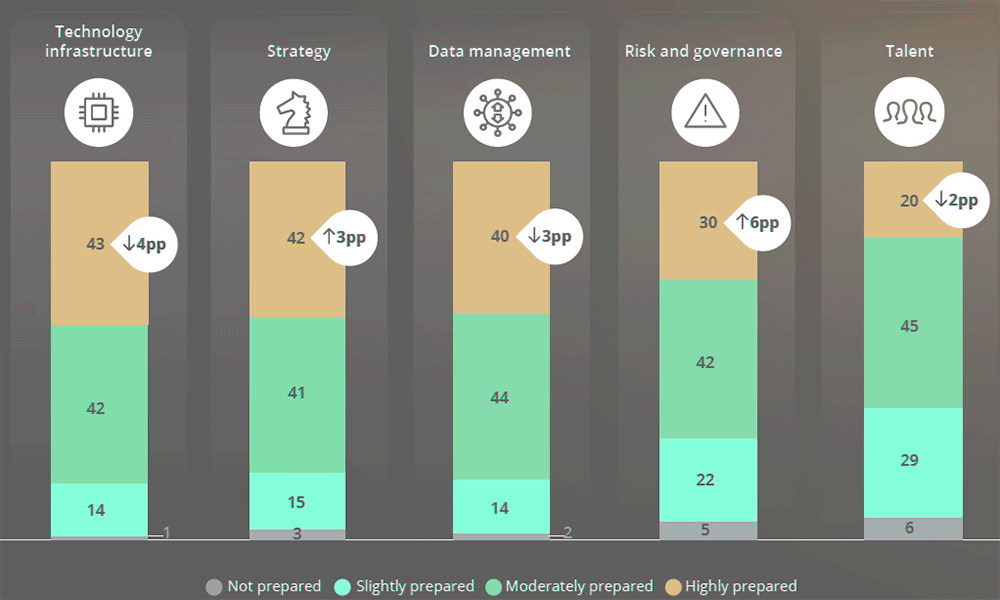
Some 42% of respondents consider their AI strategies highly prepared, an increase of three percentage points from the previous survey.
- For technology infrastructure, 43% report high preparedness, down four percentage points.
- Data management readiness stands at 40%, a decline of three percentage points.
- Risk and governance preparedness increased six percentage points to 30%.
- Talent readiness is the lowest among the five categories, at 20%, down two percentage points.
The changes indicate improving confidence in strategy and governance, but weaker assessments of the infrastructure, data and workforce capabilities needed for deployment.
Governance readiness has improved from a lower base, and only 30% of companies currently regard it as highly prepared. The findings also show that strategic planning is more advanced than workforce preparation.
An organization may have approved an AI strategy without completing the technical integration, data management procedures, governance controls or workforce changes necessary to operate the technology consistently.
The survey measures executives’ assessments of preparedness rather than independently testing the effectiveness of those capabilities.
Sovereign AI becomes a factor in technology procurement
Deloitte identifies the geographic location of AI development as an increasingly important consideration in enterprise technology decisions.
Some 77% of surveyed organizations say where AI is developed is a key factor when selecting new technologies. The finding relates to sovereign AI, which Deloitte frames in terms of technological ownership and strategic independence.
The concern extends beyond model performance to questions about where systems are developed and the degree of control organizations retain over technology they depend on.
For multinational businesses and public institutions, procurement decisions may therefore involve geographic and jurisdictional considerations alongside commercial and technical requirements.
AI investment returns depend on production deployment and operating changes
Deloitte’s research identifies three measurable differences between corporate AI expectations and current implementation.
- The first concerns deployment. Although 54% of respondents expected to move at least 40% of their experiments into production within three to six months, only 25% had reached that threshold when surveyed.
- The second concerns financial returns. Revenue growth was an objective for 74% of organizations, but only 20% reported achieving it.
- The third concerns workforce organization. Some 82% expected at least 10% of jobs to become fully automated within three years, yet 84% had not redesigned jobs around AI.
These findings describe separate stages of adoption. Technology availability does not establish production readiness, deployment does not guarantee revenue growth, and automation plans do not establish that workforce restructuring has occurred.
The report also identifies additional constraints that may affect implementation, including immature autonomous-agent governance, shortages of suitable employee skills and weaker confidence in technical infrastructure.
The strongest reported results remain in efficiency and productivity, achieved by 66% of respondents, and improved decision-making, achieved by 53%.
Deloitte’s 2026 findings therefore distinguish between companies experimenting with AI, those incorporating it into established processes and the smaller group using it to change products, services and business models.
The proportion reporting a transformative impact has increased from 12% to 25% in one year. The share that has redesigned jobs, however, remains at just 16%, and only 21% report mature governance of autonomous AI agents.
The difference between those measures defines the operational constraints facing organizations seeking to convert AI spending into sustained financial performance.
…………….
Report authors: Jim Rowan – US Head of AI of Deloitte Consulting, Nitin Mittal – Principal, Global AI Leader of Deloitte Consulting, Beena Ammanath – Executive Director of Global Deloitte AI Institute, Costi Perricos – Global GenAI Business Leader of Deloitte.
by Peter Sonner, Lead Tech Editor at Beinsure / Reviewed by Oleg Parashchak, CEO Finance Media & Editor-in-Chief at Beinsure