Palantir Technologies (NASDAQ: PLTR) enters the final quarter of 2026 with strong revenue growth and improving analyst sentiment, although its elevated valuation has made the shares vulnerable to renewed selling across the artificial intelligence sector.
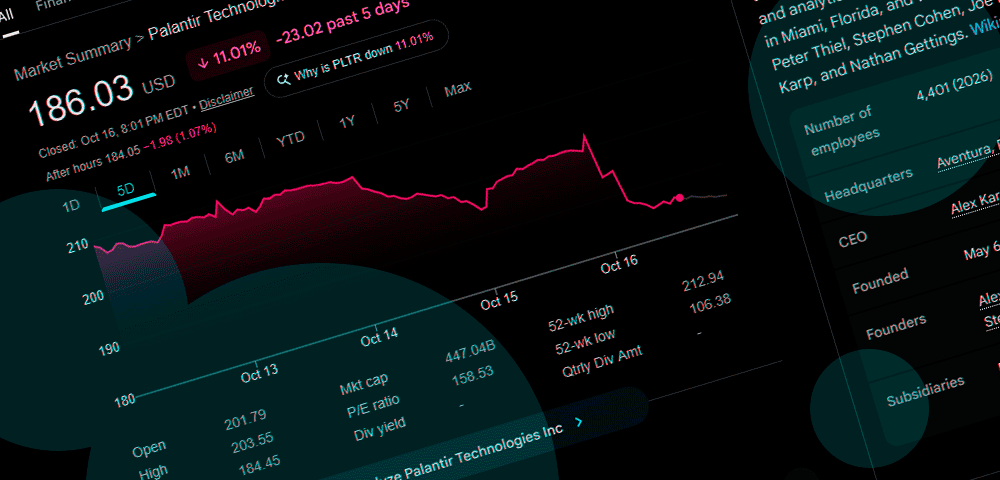
The stock closed at $186.03 on October 16, down 7.22% for the session and approximately 12.6% below its recent 52-week high of $212.94.
- Palantir shares fell 7.22% to $186.03 on October 16, while the average 12-month analyst target of $206.43 implies approximately 11% upside.
- Goldman Sachs, Baird and Mizuho maintain bullish forecasts, with targets of $230, $250 and $245, respectively, as commercial AI adoption accelerates.
- Palantir’s Q2 revenue surged 93% to $1.94 bn, driven by 149% growth in US commercial revenue, but its premium valuation leaves the stock exposed to higher interest rates and earnings disappointments.
The decline came during a broader technology selloff as investors reassessed AI-related valuations, infrastructure spending and the possibility of persistently high interest rates.
Despite the correction, the Wall Street consensus remains positive. According to forecasts compiled from 32 analysts by S&P Global, Palantir carries a Buy consensus rating and an average 12-month price target of $206.43, implying 10.97% upside from the latest closing price.
The median target is $217.50, while individual projections range from $80 to $265, reflecting substantial disagreement over how much investors should pay for Palantir’s expected growth.
Palantir stock forecast: Goldman Sachs, Baird and Mizuho
Several investment banks have recently raised their expectations for Palantir. Goldman Sachs upgraded the shares from Neutral to Buy on October 8, setting a $230 price target. The bank cited expanding demand for enterprise AI systems that allow organizations to retain greater control over their data and technology infrastructure.
Baird increased its target from $200 to $250, pointing to Palantir’s ability to reduce AI processing costs and support deployment of different AI models within enterprise environments.
Mizuho analyst Gregg Moskowitz raised his target from $215 to $245 on October 15 while maintaining an Outperform rating.
Barclays also initiated coverage with an Overweight recommendation in October, adding to positive sentiment among institutional analysts.
The bullish forecasts contrast with more cautious assessments. RBC Capital Markets maintains an Underperform rating with a $90 target, reflecting concerns about valuation relative to the company’s longer-term financial outlook.
Analyst expectations therefore remain widely dispersed, even as Palantir’s operating performance improves.
Palantir Q2 earnings support growth expectations
Palantir’s second-quarter results provide the main financial support for higher price targets. Revenue increased 93% year over year to $1.935 bn, while diluted earnings per share reached $0.41.
US commercial revenue grew 149% to $764 mn, supported by increased adoption of the company’s Artificial Intelligence Platform (AIP). US government revenue rose 90% to $809 mn.
The company also reported $1.062 bn in GAAP net income and $1.22 bn in adjusted free cash flow, representing a 63% adjusted free cash flow margin.
Customer demand remained strong. Palantir closed 73 contracts worth at least $10 mn during the quarter, while total contract value reached $3.37 bn, an increase of 49% year over year.
Net dollar retention reached 157%, indicating substantial expansion in spending among existing customers.
Following the results, management raised its full-year 2026 revenue guidance to $8.150 bn-$8.158 bn and projected US commercial revenue growth of at least 134%.
Palantir’s platforms, including Gotham, Foundry and AIP, integrate organizational data with AI models to support operational decisions across government agencies and commercial enterprises.
Its Ontology framework connects underlying data with business processes, allowing customers to deploy AI applications without replacing existing information systems.
Valuation remains Palantir’s principal investment risk
Palantir’s growth rates support its premium valuation, but the stock remains expensive relative to conventional software companies.
At the latest share price, its trailing price-to-earnings ratio is approximately 159. The company is valued at roughly $447 bn, equivalent to nearly 55 times its projected full-year 2026 revenue.
These multiples leave considerable sensitivity to changes in earnings expectations, discount rates and investor appetite for high-growth technology stocks.
Stock-based compensation remains another consideration. Palantir recorded $265 mn in stock compensation expenses during Q2, although profitability and cash generation have strengthened.
Competition from Snowflake, Databricks and other enterprise data platforms could also affect future contract growth, particularly among customers seeking alternatives to Palantir’s integrated software architecture.
The company faces additional regulatory and reputational exposure through its involvement in defense, surveillance and immigration-related government programs.
Against these risks, Palantir reported $9.2 bn in cash, cash equivalents and short-term US Treasury securities at the end of June, providing substantial financial resources to support product development and expansion.
Palantir stock outlook for 2026 and 2027
Palantir’s next earnings report, scheduled for November 2, 2026, will provide an important test of whether rapid commercial AI adoption can support current valuations. Management expects third-quarter revenue of $2.160 bn-$2.164 bn and adjusted operating income of $1.292 bn-$1.296 bn.
Investors will focus on US commercial growth, government contract activity, customer retention and the conversion of new agreements into recognized revenue.
The average analyst target of $206.43 suggests moderate upside over the next 12 months, considerably below the returns implied by the most optimistic investment bank forecasts.
Palantir’s operating momentum remains strong, supported by accelerating enterprise AI adoption and expanding government demand. The principal uncertainty is valuation: further share price appreciation will depend on earnings growth remaining sufficiently strong to justify a premium multiple in a less accommodating interest-rate environment.