Property catastrophe reinsurance renewals at June 1 and July 1 delivered double-digit pricing reductions and broader terms across most placements, according to Aon. Capacity remained plentiful and was sufficient to absorb higher demand, particularly from US insurers.
Global reinsurance demand at the mid-year renewals increased by more than 10%. Aon attributed the increase to a wider range of products from reinsurers and greater demand for coverage at the upper layers of US programs.
Demand outside the US was broadly stable as most insurers maintained existing net retentions. Reinsurer appetite continued to increase across regions, with Florida recording what Aon described as one of its most favorable renewal periods in a decade.
Insurers in Latin America and Australia/New Zealand also faced fewer capacity constraints. Reinsurers offered sufficient capacity across most placements as competition for business increased.
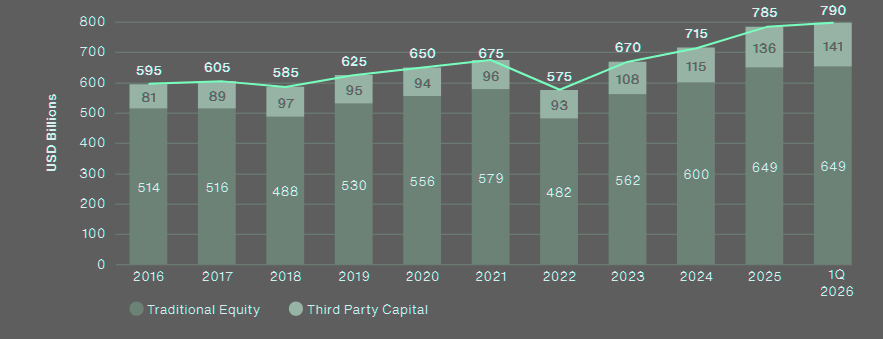
Global reinsurer capital rose by $5 bn to a record $790 bn at March 31, 2026. Continued expansion of third-party capital accounted for most of the increase, according to Aon.
The mid-year renewals also brought greater use of customized reinsurance structures. Reinsurers showed more willingness to offer aggregate covers and products designed to protect insurers against earnings volatility.
Global Reinsurer Capital
Insurers continued investing in exposure data and analytics, including AI-based tools used in underwriting and portfolio analysis. Aon said better information is helping reinsurers assess individual portfolios more precisely and offer capacity under more tailored structures.
The broker also reported growing interest in catastrophe products focused on frequent losses. These included Aon’s high-efficiency frequency catastrophe covers, designed to address repeated events rather than only severe tail losses.
Marine, war and political violence reinsurance faced a different environment following conflict in the Middle East. Damage notifications involving vessels, energy assets and property from missile and drone attacks had begun reaching the market, but Aon said the conflict had no direct effect on June and July renewals.
Aon expected any material response in pricing or contract terms to become more visible at January renewals, when a larger share of affected treaties renew. The report identified war, terrorism and political violence as areas where capacity and pricing remained sensitive to further geopolitical developments.
The report referred to a June US-Iran ceasefire framework as reducing the immediate threat of broader escalation at the time it was prepared. Subsequent events changed that assessment: hostilities resumed and the June agreement later broke down amid implementation disputes.
Aon also noted that higher energy costs associated with Middle East disruption could feed into insured claims through inflation and supply-chain costs. Those effects would emerge separately from direct insured losses on marine, energy or property policies.
Reinsurance Sector Return on Equity
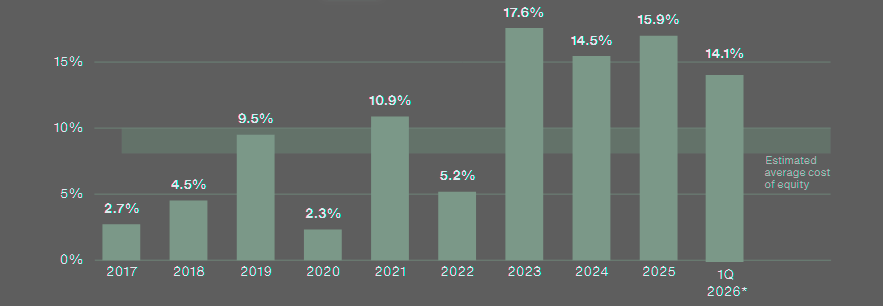
Reinsurer financial performance remained strong entering the second half of 2026. Aon reported an average first-quarter return on equity of 14.1% across the reinsurers it tracked, above the sector’s estimated cost of equity.
The metric represents annualized profitability relative to shareholders’ equity rather than an underwriting margin. Aon expected most reinsurers to earn returns above their cost of equity in 2026, assuming no unusually severe catastrophe losses during the remainder of the year.
Aon also expected an El Niño weather pattern to suppress Atlantic hurricane activity during 2026. That assumption supported its favorable earnings expectations for property catastrophe reinsurers, although actual results remain dependent on catastrophe experience.
Mid-year renewal outcomes showed that reinsurers retained substantial risk appetite despite softer pricing. Aon expects further flexibility in structures, coverage and retentions heading into 2027 if the second half of 2026 avoids extreme insured losses.
Insurers are also examining a wider range of capital sources as insurance pricing cycles change. Facultative facilities and proportional reinsurance are receiving greater interest, alongside multi-year structures and legacy transactions.
These structures address different balance-sheet objectives. Some transfer earnings volatility, while others release capital or provide additional capacity for new underwriting.
Aon said insurers increasingly face a trade-off between maintaining pricing discipline and pursuing premium growth as primary insurance markets soften.
Reinsurance and third-party capital provide additional options for adjusting retained exposure without relying solely on changes to primary underwriting.
The combination of record reinsurer capital and strong profitability has increased competition among providers. For insurers, the result at the 2026 mid-year renewals was lower property catastrophe pricing and broader access to customized risk-transfer structures.