Follow Beinsure

Social Security’s approaching funding shortfall is putting payroll taxes back into the congressional debate, with workers facing higher contributions under proposals that rely heavily on additional revenue.
The 2026 Social Security trustees report projects that the Old-Age and Survivors Insurance Trust Fund will exhaust its reserves in the fourth quarter of 2032. Continuing program income would then cover 78% of scheduled retirement and survivor benefits, leaving a funding gap of about 22%.
Trust fund depletion wouldn’t end Social Security payments because payroll tax revenue would continue arriving. The problem is simpler and expensive: incoming revenue wouldn’t cover benefits scheduled under current law unless Congress changes the program’s finances.
Social Security’s costs exceed total income in 2026, continuing a pattern that began in 2021. The trustees expect annual costs to remain above income through the rest of their 75-year projection period.
The numbers involve a huge share of the US population. Social Security paid benefits to 71.34 mn people in July 2026, including 57.61 mn retirement beneficiaries and 5.76 mn survivor beneficiaries. Another 7.97 mn received Disability Insurance payments.
Closing the gap therefore leaves lawmakers with choices involving additional revenue, slower future benefit growth or some combination of the two.
A broad payroll tax increase represents one of the most direct revenue options, though its cost would reach workers and employers across the income distribution.
How much workers would pay
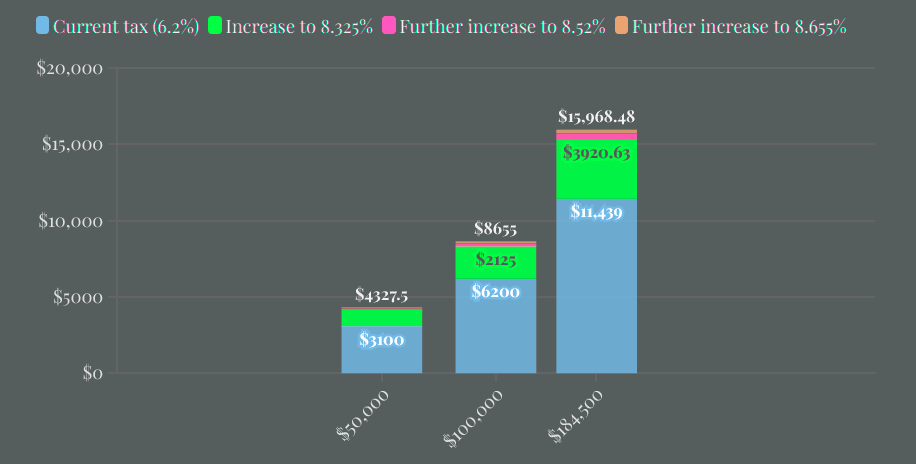
Employees currently contribute 6.2% of covered wages to Social Security, with employers paying another 6.2%. The combined payroll tax stands at 12.4%, while self-employed workers generally pay the entire amount themselves.
For 2026, Social Security taxes apply to the first $184,500 of annual earnings. Earnings above the taxable maximum aren’t subject to the 12.4% Social Security levy under existing law.
Estimates of the payroll rate required for a tax-only solution differ because analysts use separate demographic and economic assumptions. The 2026 trustees calculate that an immediate permanent increase in the combined rate to 16.65% would address the projected 75-year actuarial shortfall.
Cato Institute estimates place the necessary combined rate at 17.04%, while a CBO-based estimate used by Cato reaches 17.31%. If employers and employees continued splitting the tax evenly, the worker contribution would rise from 6.2% to roughly 8.3%–8.7%.
For an employee earning $50,000, the direct worker share would increase by about $1,060-$1,230 annually, depending on the assumed rate. At $100,000 in wages, the increase reaches roughly $2,130-$2,460.
A worker earning the 2026 taxable maximum of $184,500 would pay roughly $3,920-$4,530 more annually. An employer would face an equal increase under the existing 50-50 contribution structure, while a self-employed worker would directly absorb both portions.
Cato estimates that a median full-time US worker earning about $61,600 would generate between $2,600 and $3,000 in additional combined payroll taxes each year. Part would appear directly on the employee’s paycheck and part would come through the employer contribution.
Economists differ over how much of an employer payroll tax falls on workers through wages and other compensation over time. The statutory payment is split evenly, but the economic burden isn’t necessarily divided in the same way.
How much could higher Social Security Tax rates cost workers?
Taxing more earnings above the cap
Raising the payroll rate for every covered worker isn’t the only revenue proposal under discussion. Another approach increases the amount of higher earnings subject to Social Security taxes while leaving the existing rate unchanged for income below the taxable ceiling.
Sens. Elizabeth Warren, a Massachusetts Democrat, and Bernie Moreno, an Ohio Republican, said in June 2026 that they were developing legislation to remove the Social Security payroll tax cap.
Under current rules, a worker earning $184,500 and another earning $1 mn both pay Social Security payroll tax on no more than $184,500 in 2026 wages. Removing the ceiling would expose additional earnings from the second worker to the tax.
Warren and Moreno argue this structure would raise Social Security revenue without increasing the rate paid on earnings below the current threshold. Details of their legislation will determine how newly taxed earnings affect future benefits and how much of the long-term financing gap the measure addresses.
Other lawmakers have proposed a second tax tier rather than removing the ceiling outright. The Social Security Expansion Act introduced in 2025 by Sen. Bernie Sanders, Warren and House Democrats would apply Social Security payroll taxes to earnings above $250,000.
Under that design, earnings below the normal taxable maximum would remain taxed, followed by an untaxed gap, then the 12.4% levy would resume above $250,000. The legislation also proposes a $2,400 annual benefit increase and several other benefit changes.
Sponsors say the full package would finance scheduled Social Security benefits for 75 years. That estimate applies to the legislation as a whole, rather than the payroll-tax provision in isolation.
CBO has separately examined a policy applying the 12.4% payroll tax to earnings above $250,000 while retaining the existing taxable maximum. Its December 2024 analysis estimated the option would reduce federal deficits by about $1.43 tn between 2025 and 2034.
CBO didn’t recommend the policy. Its budget-options work estimates the fiscal effects of proposals lawmakers might consider, without endorsing or rejecting them.
Under CBO’s design, scheduled benefits wouldn’t increase for earnings taxed above $250,000. The agency estimated the additional revenue would extend the life of the combined Social Security trust funds by 17 years relative to its baseline at the time, moving projected exhaustion to 2051.
The taxable maximum itself rises with average wages, while a fixed $250,000 threshold doesn’t. CBO therefore projected that the regular taxable ceiling would eventually reach the $250,000 threshold, after which all covered earnings would fall under the payroll tax.
The debate isn’t limited to taxes. Some lawmakers have also discussed changes to the retirement age or scheduled benefit growth, while others favor solutions weighted toward additional revenue.
Each approach distributes the financial adjustment differently. A broad payroll rate increase reaches nearly every covered worker and employer, whereas a higher earnings cap concentrates more of the tax increase among workers earning above the current ceiling.
The 2032 depletion date leaves less time for gradual changes than Congress had several years ago. Under the trustees’ assumptions, an immediate tax-only solution requires a 16.65% combined payroll rate, and delaying action raises the size of the adjustment needed later.
For workers, the scale is already measurable. Depending on the assumptions used, closing Social Security’s long-term gap entirely through payroll taxes puts the combined rate near 17%, with annual direct employee costs rising by more than $4,000 for some workers earning at or near today’s taxable maximum.