- The Dow Jones Industrial Average fell 0.35%, the S&P 500 declined 0.02% and the Nasdaq Composite slipped 0.15%, with healthcare, financials and consumer goods leading losses.
- Johnson & Johnson dropped 5.73%, Citigroup lost 5.60% and Applied Materials fell 6.69%, while Visa and Valero Energy reached record highs.
- The CBOE Volatility Index rose to 15.27, while gold futures traded at $4,181.67 per ounce and US crude oil futures advanced to $94.89 per barrel.
US stocks closed lower as declines in healthcare, financial and consumer goods shares weighed on Wall Street’s major benchmarks, although gains in selected technology, energy and communications stocks limited the broader market’s losses.
The Dow Jones Industrial Average declined 0.35% at the New York Stock Exchange close, while the S&P 500 slipped 0.02% to 7,805.45, a decrease of 1.79 points. The Nasdaq Composite ended the session 0.15% lower.
Johnson & Johnson, Citigroup and Applied Materials were among the session’s largest decliners, while Salesforce, Verizon Communications and Visa provided support to the Dow.
Salesforce (NYSE: CRM) led the Dow’s gainers, advancing 1.75%, or $4.09, to close at $238.01. Verizon Communications (NYSE: VZ) increased 1.74%, or $0.75, to $43.53, while Visa (NYSE: V) gained 1.74%, or $6.79, to finish at $396.06.
Visa’s advance took its shares to an all-time high, making it one of the strongest performers among the Dow’s components during an otherwise negative session.
Healthcare stocks recorded some of the largest losses. Johnson & Johnson (NYSE: JNJ) fell 5.73%, or $15.12, to $248.61, making it the Dow’s weakest performer.
Industrial equipment manufacturer Caterpillar (NYSE: CAT) declined 3.33%, or $26.59, to close at $772.78. Pharmaceutical company Merck & Co. (NYSE: MRK) lost 2.39%, or $3.47, ending the session at $141.98.
Among S&P 500 constituents, technology solutions provider CDW (NASDAQ: CDW) led gains with a 5.71% increase to $151.97.
Valero Energy (NYSE: VLO) advanced 4.67%, or $20.37, to $456.37, reaching an all-time high. Charter Communications (NASDAQ: CHTR) added 4.36% to close at $106.95.
The index’s largest losses included semiconductor equipment manufacturer Applied Materials (NASDAQ: AMAT), which dropped 6.69% to $464.24.
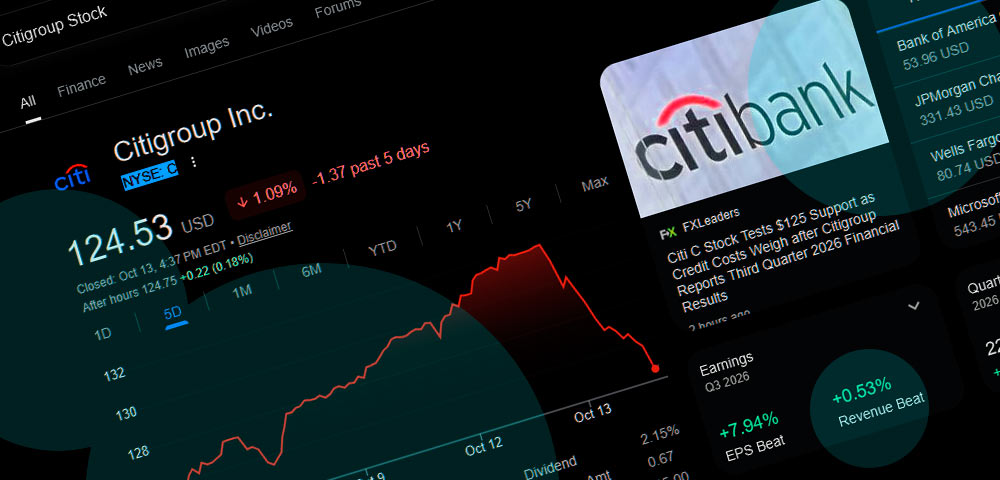
Johnson & Johnson’s 5.73% decline also placed it among the S&P 500’s weakest performers, alongside Citigroup (NYSE: C), which fell 5.60% to close at $124.53.
Trading on the Nasdaq Composite was marked by substantial price movements among several smaller companies, even as the broader technology-heavy index finished modestly lower.
JBDI Holdings (NASDAQ: JBDI) recorded the session’s largest percentage gain among the reported Nasdaq performers, surging 251.79% to $3.43.
Alaunos Therapeutics (NASDAQ: TCRT) rose 187.14% to $3.02, while Pinnacle Food Group (NASDAQ: PFAI) advanced 80.08% to finish at $4.70.
The largest reported Nasdaq declines were similarly pronounced. WF Holding (NASDAQ: WFF) lost 87.27% to close at $2.20, while Treasure Global (NASDAQ: TGL) plunged 66.90%, or $0.56, to $0.28.
Treasure Global’s decline pushed its shares to an all-time low. Linkers Industries (NASDAQ: LNKS) also recorded a substantial loss, falling 57.10% to $0.97.
Market breadth showed different patterns across the two major US exchanges.
On the New York Stock Exchange, advancing stocks narrowly outnumbered declining issues by 1,374 to 1,325, with another 89 securities finishing unchanged.
The Nasdaq Stock Exchange recorded weaker breadth, with 2,201 stocks declining against 1,222 advancing. Another 184 securities ended the session without a change in price.
The figures indicated that selling pressure was more widespread among Nasdaq-listed companies, despite the relatively small decline in the Nasdaq Composite itself.
Measures of expected market volatility edged higher. The CBOE Volatility Index, which tracks implied volatility in S&P 500 options, increased 0.39% to 15.27.
Commodities markets recorded gains in gold and crude oil futures. Gold futures for December delivery advanced 0.10%, or $4.37, to $4,181.67 per troy ounce.
In energy trading, November US crude oil futures gained 0.80%, or $0.75, to reach $94.89 per barrel. December Brent crude futures increased 0.73%, or $0.77, to $106.46 per barrel.
Foreign exchange trading was comparatively subdued. EUR/USD was quoted at 1.12, with a reported change of 0.38%, while USD/JPY declined 0.18% to 158.33.
The session ended with losses across all three major US stock indexes, although the S&P 500’s marginal decline contrasted with sharper weakness in individual healthcare, financial and semiconductor stocks. Record closing levels for Visa and Valero Energy, alongside positive NYSE market breadth, showed that gains remained concentrated in selected parts of the market despite the negative index performance.