Follow Beinsure

Global reinsurance capital has reached a record $800 bn, giving property and casualty insurers greater negotiating power ahead of January renewals. Increased capacity, stronger competition and a broader range of risk transfer solutions are creating opportunities to reduce earnings volatility, improve coverage and release capital for underwriting growth.
Property reinsurance conditions became increasingly favorable to buyers throughout 2026, with double-digit pricing reductions and more flexible terms and conditions across most placements.
According to Aon, the shift has been particularly pronounced for US exposures, although insurers in nearly all regions are benefiting from fewer capacity constraints.
- Global reinsurance capital has reached a record $800 bn, creating favorable conditions for property insurers, with double-digit pricing reductions and greater flexibility in coverage terms.
- Casualty reinsurance capacity is expanding as traditional reinsurers and third-party investors increase participation, including through casualty sidecars and insurance-linked securities.
- Aon expects insurers to benefit from broader coverage options, earnings protection and capital-efficient structures, although litigation trends, reserve adequacy and emerging risks remain important considerations.
The casualty market is also showing gradual improvement, supported by renewed reinsurer appetite, greater participation from third-party capital and the development of alternative structures for managing long-tail liabilities.
Property reinsurance pricing declines
Record global reinsurance capacity is providing property insurers with more options to manage catastrophe exposure and protect earnings.
Aon reported that buyer-friendly conditions accelerated during 2026, with insurers gaining access to additional limits and greater flexibility in programme design.
The expansion extends beyond traditional reinsurance capital. Institutional investors are increasing their participation through catastrophe bonds and reinsurance sidecars, diversifying the sources of capacity available to insurers.
These developments are also encouraging new trading relationships between insurers, reinsurers and capital market investors. A broader capital base can provide additional flexibility and help insurers maintain access to risk transfer capacity across market cycles.
Multi-year reinsurance arrangements and automatic capacity facilities offer opportunities to secure current pricing conditions for longer periods.
Insurers can also use improved market terms to widen coverage, purchase additional limits and optimise reinsurance programme structures. Reinsurance capital released through these adjustments can be redeployed to support underwriting growth.
Aon identified increased opportunities to purchase frequency protection, aggregate covers and low-attaching occurrence reinsurance. Such structures can help protect earnings against repeated losses, rather than concentrating protection exclusively on larger individual catastrophe events.
Global reinsurer capital trend
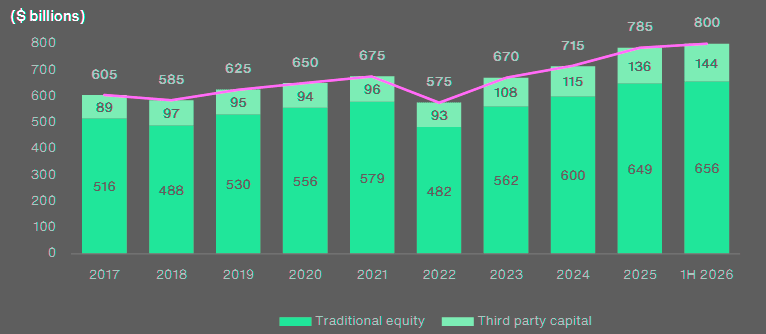
The broker is expanding its range of reinsurance and capital market solutions, including sidecars, enhanced earnings protection arrangements and automated capacity. It is also connecting institutional investors with insurance risks through established markets such as Lloyd’s and Bermuda, seeking to broaden the available capital base and support market stability.
Climate volatility increases demand for property catastrophe protection
The current strong El Niño phase reinforces the need for insurers to assess both immediate catastrophe exposure and longer-term climate risks.
Through its Impact Forecasting capabilities, Aon models current and future climate scenarios to help insurers evaluate how changes in climate conditions could affect their portfolios and corresponding reinsurance requirements.
With the 2026 Atlantic hurricane season still underway, insurers are being encouraged to continue testing portfolio resilience and evaluating how reinsurance programmes could respond to potential losses.
Aon’s approach combines hazard analytics, exposure management, accumulation modelling and portfolio assessment tools with scenario analysis and stress testing. These capabilities are intended to help insurers understand loss frequency and volatility, assess concentrations of catastrophe exposure and determine how available reinsurance capital can be matched to their risk appetite.
Casualty reinsurance capacity expands
Casualty reinsurance conditions are improving ahead of January renewals, supported by stronger reinsurer appetite and greater availability of structured risk transfer solutions.
Aon described the market as broadly stable, with gradual improvements in pricing terms and contract conditions during 2026.
Capacity has returned to the US casualty market, while competition for international casualty business continues to increase. This expansion is occurring despite higher exposure levels and pressure on underlying insurance pricing.
Reinsurers remain cautious about nuclear verdicts, reserve deterioration and uncertainty surrounding emerging exposures, including artificial intelligence.
Traditional reinsurers are nevertheless selectively allocating more capital to casualty business. Some are seeking to maintain broader relationships with clients as conditions in the property reinsurance market become more competitive.
Third-party capital is also becoming a larger source of casualty reinsurance capacity.
Investors are developing purpose-built casualty sidecars and insurance-linked securities structures that provide additional capacity for long-tail exposures.
These arrangements allow insurers to diversify their reinsurance counterparties and access alternative capital structures, potentially improving programme resilience across underwriting cycles.
Casualty insurers gain options for aggregate and catastrophe coverage
Greater competition is creating opportunities for casualty insurers to negotiate improved renewal terms and establish relationships with reinsurers seeking to expand their portfolios.
More favorable conditions may allow insurers to secure attractive structures, use savings to purchase protection at lower attachment points and obtain additional reinsurance limits.
Aon also identified growing opportunities for aggregate protection and casualty catastrophe coverage. These products address exposures that may be difficult to accommodate within conventional casualty treaty arrangements.
Adverse litigation developments and emerging risks are producing potentially systemic losses and catastrophe-like concentrations of liability across insured portfolios.
Aon has initiated work to develop a dedicated casualty catastrophe market, using multiple modelling tools to identify, aggregate and price emerging exposures.
The objective is to develop tailored reinsurance arrangements for risks that do not fit traditional treaty structures.
Demand for adverse reserve development protection and legacy transactions also remains strong, reflecting increased loss volatility and changes in underlying market conditions.
Such transactions can help insurers manage uncertainty associated with prior-year liabilities, protect earnings and release capital for new business growth.
The global ILS market reached a record $145 bn in capital as strong investor demand, favorable catastrophe loss experience and expanding risk transfer opportunities supported another year of growth.
Reserve adequacy and portfolio performance remain decisive
Although the casualty outlook for January renewals is positive, Aon cautioned that reinsurer appetite continues to vary by business class, geography and underlying exposure.
Renewal outcomes will depend on individual portfolio performance, the quality of underwriting and exposure data, and insurers’ management of market cycles.
Claims handling and reserve adequacy will also influence the capacity and terms reinsurers are prepared to offer.
Insurers seeking improved conditions will need credible analytical evidence supporting their assessment of exposures, emerging perils and reserve positions.
Aon identified strong portfolio analytics and clearly supported explanations of underwriting risk as essential to securing favorable casualty reinsurance arrangements, even as competition and available capacity continue to increase.