Follow Beinsure
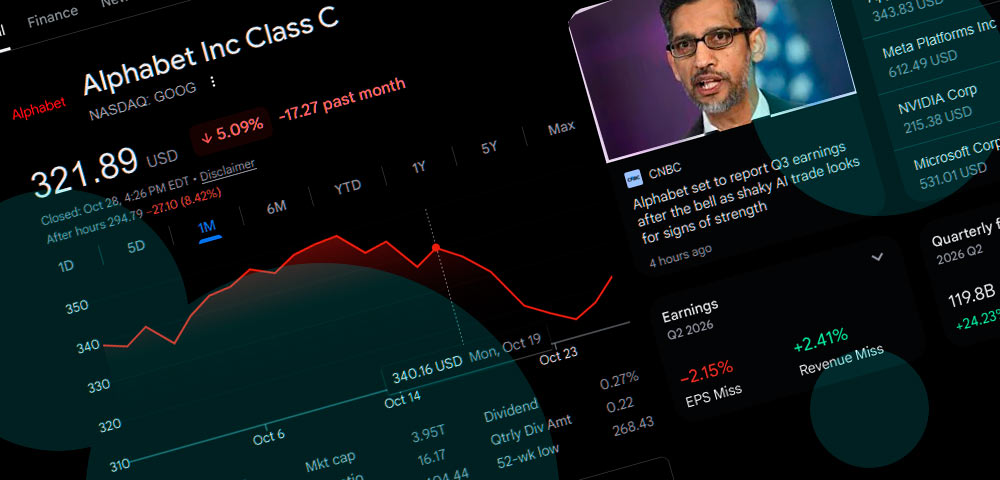
Alphabet (NASDAQ: GOOGL, GOOG) shares fell more than 7% in after-hours trading on Wednesday after Google’s parent company reported third-quarter revenue below Wall Street expectations, weaker advertising sales and a decline in free cash flow, despite rapid growth in its cloud computing business.
Alphabet reported earnings per share of $2.12 on revenue of $127.58 bn, representing a 25% increase from the previous year. Analysts surveyed by LSEG had expected revenue of $128.22 bn and earnings of $3.02 per share, although it was not immediately clear whether the reported earnings figure was directly comparable with that estimate.
- Alphabet reported Q3 revenue of $127.58 bn, up 25% year over year, but below Wall Street estimates as advertising and search sales disappointed.
- Google Cloud revenue surged 103% to $30.71 bn, exceeding analyst forecasts, while the Gemini app surpassed 1 bn users.
- Alphabet shares dropped more than 7% after hours as investors weighed weaker free cash flow, operating income and AI investment returns.
A separate analyst consensus put expected earnings at $3.01 per share and revenue at $127.93 bn. Revenue excluding traffic acquisition costs reached $111.21 bn, slightly below Wall Street’s $111.29 bn forecast.
Alphabet’s Class C shares (GOOG) closed regular trading at $321.89, up 1.60%, before falling to $295.70 at 4:24 p.m. EDT, an after-hours decline of 8.14%.
Alphabet’s Q3 earnings miss advertising and search revenue estimates
Google’s advertising business generated $82.01 bn in third-quarter sales, missing analyst expectations of $83.5 bn. Search revenue reached $63.35 bn, compared with the $64.96 bn projected by analysts. Operating income totaled $40.58 bn, below the $43.19 bn forecast compiled by FactSet.
Free cash flow declined again during the quarter, reaching $9.07 bn. One analyst expectation cited in the earnings coverage was $2.70 bn, although that figure was below the reported free cash flow total.
Alphabet also recorded a substantial change in the contribution from its equity investments.
In the second quarter, the company benefited from a $99.03 bn gain associated with its equity holdings, including stakes in SpaceX and Anthropic. That contribution reversed in the third quarter, when the category produced an $8.66 bn loss.
The results renewed investor attention on Alphabet’s profitability and cash generation as the company continues spending heavily on artificial intelligence infrastructure, computing capacity and model development.
Google Cloud revenue jumps 103% as AI demand accelerates
Google Cloud remained the strongest part of Alphabet’s quarterly performance, generating revenue of $30.71 bn, an increase of 103% from a year earlier.
The result exceeded analyst forecasts of $28.7 bn to $29.1 bn. One consensus projection had anticipated growth of approximately 90%.
The cloud division, which houses Google’s enterprise AI products and infrastructure services, continues to gain market share against larger competitors Amazon Web Services and Microsoft Azure.
Growth in cloud revenue has provided evidence of commercial demand for Google’s AI services, even as investors question how quickly the company’s substantial technology investments will translate into sustained profitability.
Google’s AI expansion received another commercial endorsement on Tuesday when Oracle announced that it would become the first company to purchase Google’s AI processors for deployment in its own data centers.
The agreement forms part of Oracle’s effort to broaden its AI hardware suppliers beyond Nvidia, with the company also adding processors from Cerebras and SambaNova.
Gemini reaches 1 bn users as Google introduces its latest AI model
Alphabet’s earnings announcement followed the introduction of Gemini 4 Carbon, Google’s latest frontier AI model, earlier on Wednesday.
Google said Carbon outperformed Gemini 4 Argon, a model released just two weeks earlier. The company also claimed that Carbon surpassed competing systems, including OpenAI’s GPT-6 Astra and Anthropic’s Claude Opus 5.5.
CEO Sundar Pichai said the Gemini app had exceeded 1 bn users, making it the fastest-growing app in Google’s history.
The milestone reflects the rapid expansion of Google’s consumer AI products, which the company is developing alongside its enterprise cloud offerings and search services.
The growing adoption of Gemini comes as competition intensifies among major technology companies seeking to establish their AI assistants as primary interfaces for online information, commerce and digital services.
Google is also facing competition from Meta, whose newly introduced Muse AI agent has attracted 10 mn users, according to CEO Mark Zuckerberg.
Most Muse users have been accessing the application for shopping, a development that could threaten Google’s position in online search and commercial discovery if Meta continues expanding its user base.
“Search usage [and] growth is back in focus given Muse launch and challenges Google could face in migrating users to agentic while maintaining strong monetization,” Post wrote.
The concern centers on Google’s ability to move consumers toward AI agents without weakening the advertising business that generates much of its revenue.
Alphabet stock faces pressure over AI spending and profitability
Alphabet’s share-price decline comes amid increasingly divided investor expectations for artificial intelligence.
Major cloud providers and technology companies are committing substantial capital to AI infrastructure, but Wall Street remains uncertain about the timing and scale of returns.
Those concerns affected CoreWeave shares the previous week, when investors sold the AI infrastructure company’s stock amid questions about its substantial debt burden. The decline also contributed to broader weakness across technology-related shares.
For Alphabet, the third-quarter results presented contrasting evidence about its AI strategy.
Google Cloud’s 103% revenue growth and Gemini’s expansion beyond 1 bn users demonstrated the scale of demand for its products. Advertising revenue, search sales and operating income nevertheless missed expectations, while free cash flow declined.
The $8.66 bn loss from equity holdings also contrasted sharply with the $99.03 bn gain reported in the preceding quarter, adding volatility to Alphabet’s financial performance.
Investors are consequently assessing whether growth in cloud services and AI adoption can support Alphabet’s infrastructure spending without placing further pressure on cash generation and profitability.