- ANZ Group Holdings (ASX: ANZ) has an average 12-month analyst price target of A$36.56, approximately 6% below its latest closing price of A$38.89.
- Citi and JPMorgan maintain Buy ratings with targets of A$41 and A$40, respectively, while Macquarie’s A$33.50 forecast suggests substantially greater downside.
- ANZ reported A$1.90 bn in third-quarter cash profit and a CET1 capital ratio of 12.51%. Its full-year results on November 9 will provide the next test of earnings growth and operating efficiency.
ANZ Group Holdings (ASX: ANZ), the parent of Australia and New Zealand Banking Group Limited, enters the final quarter of 2026 with improving operating performance but a more cautious valuation outlook among equity analysts.
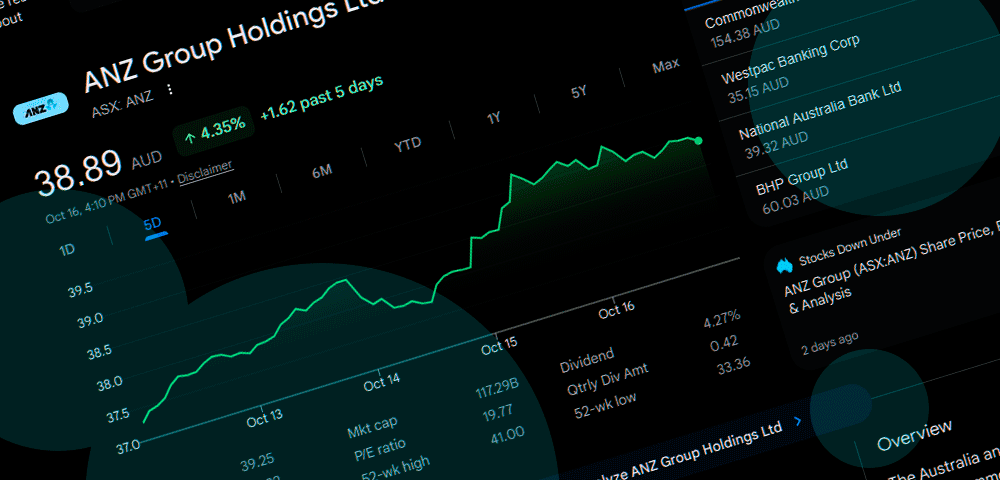
Shares closed at A$38.89 on October 16, down 0.31% for the session. The stock has recovered from its recent lows, trading within a 52-week range of A$33.36 to A$41.00.
According to Investing`s consensus of 14 analysts, ANZ has an average 12-month price target of A$36.56, implying approximately 6% downside from the latest closing price. Six analysts recommend Buy, six Hold and two Sell, producing an overall Neutral consensus.
The individual forecasts range from A$32 to A$41, reflecting disagreement over how much further ANZ can improve profitability under its restructuring strategy.
Citi remains among the more optimistic banks covering ANZ. Analyst Thomas Strong maintains a Buy recommendation and A$41 target, reaffirmed in October. The forecast suggests approximately 5.4% upside from the October 16 close, excluding dividends.
Citi favors ANZ’s exposure to business lending and its valuation relative to other major Australian banks, particularly Commonwealth Bank.
JPMorgan also maintains a Buy rating, with a A$40 price target, implying potential appreciation of 2.9%.
UBS is more reserved, retaining a Hold recommendation and A$39 target, broadly in line with the current share price.
Morgan Stanley analyst Richard Wiles maintains a Buy rating with a A$35.50 target, below the latest market price. The difference indicates that the broker’s relative investment preference does not necessarily translate into expectations of an absolute share price increase.
Macquarie analyst Carlos Cacho maintains a Hold rating and A$33.50 target, implying approximately 13.9% downside.
The divergence suggests that ANZ’s earnings recovery is increasingly reflected in its valuation, leaving further gains dependent on stronger returns rather than a reassessment of its existing business.
ANZ’s financial performance provides some support for the more positive forecasts. The bank reported unaudited third-quarter fiscal 2026 cash profit of A$1.90 bn, up 1% against the quarterly average for the first half. Excluding a New Zealand class-action provision, cash profit reached A$1.98 bn, representing 5% growth on the same comparison basis.
Net interest income excluding Markets increased 2%, supported by lending growth and improved margins. Business and Private Banking lending advanced 4% during the quarter, while total net loans and advances increased A$24 bn.
The group’s net interest margin improved by one basis point to 1.54%. Excluding Markets, the margin increased four basis points.
Operating expenses declined 3% after excluding the New Zealand provision, indicating progress under CEO Nuno Matos’s ANZ 2030 restructuring program.
Capital strength also improved. ANZ’s Common Equity Tier 1 ratio reached 12.51% at June 30, compared with 12.39% at the end of March.
Cash return on tangible equity stood at 11.54%, with management targeting approximately 12% by fiscal 2028 and 13% by 2030.
The bank reported a statutory profit of A$3.65 bn and cash profit of A$3.78 bn for the six months ended March 31, 2026. These are half-year figures, rather than quarterly results.
ANZ shares currently trade at approximately 19.8 times trailing earnings and 15.3 times forward earnings, with a dividend yield of roughly 4.3%.
The valuation offers less scope for disappointment if loan growth slows, funding costs increase or the expected restructuring benefits take longer to materialize.
Legal exposure is another consideration. On October 9, Australia’s Federal Court ruled that ANZ could not recover approximately A$117 mn in previously agreed class-action settlements, or associated defense costs, under its excess insurance policies. The judgment concerned insurance reimbursement rather than a new regulatory penalty.
ANZ’s US-traded sponsored ADR (ANZGY) has also attracted positive earnings-revision signals. Zacks assigned the security a Buy rating after its full-year earnings consensus increased 2.3% over 90 days. That rating uses a different methodology from the Australian-listed shares’ 12-month price target consensus.
The next major catalyst will be ANZ’s full-year earnings announcement on November 9, 2026.
Investors will focus on net interest margins, business lending growth, productivity savings, Suncorp Bank integration and progress toward management’s profitability targets.
Citi’s A$41 forecast supports modest upside, but the broader A$36.56 analyst consensus suggests that the current market valuation already incorporates much of the anticipated recovery.
The investment case therefore rests on whether ANZ can deliver sustained earnings growth and higher returns on equity without sacrificing margins or credit quality.
ANZ Group Holdings (ASX: ANZ) has lost a Federal Court dispute over A$117 mn in class action settlements after an Australian court ruled that the payments and associated legal defence costs were not covered under the bank’s excess insurance policies.
In a judgment delivered on October 9, Insurance Business stated, the court sided with insurers that had refused to reimburse ANZ for settlements arising from alleged misconduct involving consumer credit insurance and undisclosed commissions on vehicle loans.
The ruling centred on whether repayments of amounts improperly charged to customers could constitute an insured loss under the bank’s liability insurance arrangements.
Australia and New Zealand Banking Group maintained three layers of excess insurance arranged by broker Aon, providing up to A$200 mn in additional protection above a A$50 mn primary layer.
The policies covered the period beginning in September 2017 and were underwritten by Zurich, Lloyd’s syndicates, XL, AIG, Liberty Mutual, AXIS and other insurers.
The bank sought indemnification for two class action settlements involving separate consumer financial products.
The first, the Reilly proceeding, resulted in a A$31.92 mn settlement over consumer credit insurance sold to credit card and personal loan customers.
Claimants alleged that they had been sold insurance without requesting it, had not understood they were insured or had been incorrectly informed that purchasing coverage was compulsory.
ANZ collected the premiums, retained a 20% commission and transferred the balance to its insurance subsidiaries, OnePath Life and OnePath General.
The second dispute, the O’Brien proceeding, involved A$85 mn in settlements relating to flex commissions on automobile loans distributed through ANZ’s Esanda business.
Under the arrangements, car dealers could charge borrowers interest rates above those initially approved by the bank, receiving larger commissions as the difference increased.
In one example, a customer in western Sydney was charged 12.38% interest despite ANZ approving the loan at 8.35%. The dealer’s ability to set a higher rate and receive additional commission was not disclosed to the borrower.