Follow Beinsure
US fintech company Coast has raised $35 mn in growth equity financing to expand its financial management platform for construction, transportation, utilities and other businesses operating physical assets and field services.
The round was led by Thomvest Ventures, with new investors Intuit Ventures, Small World Capital and Alpha Square Group joining the financing. Existing backers ICONIQ Growth, Accel, Insight Partners, Better Tomorrow Ventures, Avid Ventures, Vintage Investment Partners, Colle Capital, Synchrony, RXR and The Fintech Fund also participated.
- Coast secured $35 mn in growth equity funding led by Thomvest Ventures, with new investments from Intuit Ventures, Small World Capital and Alpha Square Group.
- The company will expand AI-powered expense automation, bill pay and accounts payable services for construction, transportation, utilities and other field-based businesses.
- Coast is strengthening integrations with fleet management and telematics platforms, including Samsara and Fleetio, to automate payment controls, fuel spending and financial reconciliation.
Coast plans to use the capital to expand customer acquisition and develop AI-powered expense management, automated bill payments and accounts payable products. The investment will also support deeper integrations with fleet management, telematics and field service software providers.
The millions of field businesses that keep the physical economy running still lack a financial platform built around the way they work.
Daniel Simon, founder and CEO of Coast
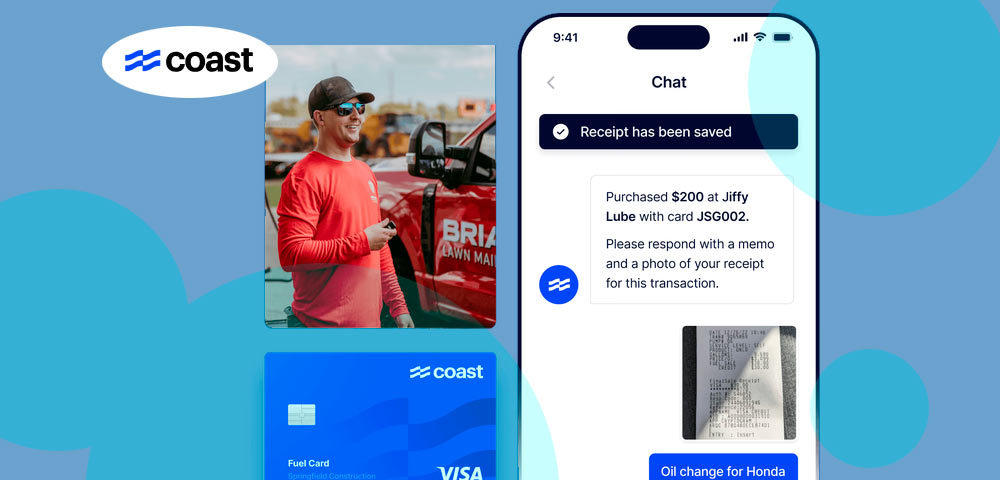
The company is developing a financial platform for businesses whose operations involve vehicles, equipment, field employees and purchases across multiple locations. Its services combine fuel cards, corporate payments, expense tracking and accounting automation.
“Coast is that platform. We’re excited to deepen our partnership with Thomvest, who first backed Coast in 2024, and to welcome Intuit Ventures, a deep integration partner that’s a critical part of so many of our customers’ businesses as they grow,” said Daniel Simon.
Coast targets financial services for construction, transportation and field businesses
Coast serves companies in construction, HVAC, plumbing, landscaping, electrical services, pest control, solar energy, transportation, oil and gas, and utilities.
The company initially focused on fuel cards before expanding into corporate cards, expense management and bill payment services.
Its products are designed to address the financial requirements of businesses operating vehicle fleets and distributed workforces, where spending needs to be tracked across individual drivers, vehicles, job sites and suppliers.
Demand for skilled trades has increased alongside investment in AI data centers and supporting infrastructure.
According to figures cited by Coast from Randstad, US job postings for HVAC engineers have increased nearly 78% since 2022. Openings for electricians, welders and construction specialists have risen 30%.
The expansion of data center construction is increasing activity across electrical installation, HVAC, utilities and transportation, adding to the operational requirements of businesses serving these sectors.
Coast argues that conventional corporate cards, banking products and fleet management systems often require companies to operate several disconnected platforms to manage spending, approvals and financial reporting.
Its platform combines payment controls with operational information, allowing businesses to monitor transactions using vehicle and driver identities, fuel consumption, purchasing activity and individual job costs.
Customers can access fuel grade and gallon-level transaction details, apply vehicle-specific spending restrictions and manage payments for fuel, supplies, field operations and office expenses.
Accounting integrations also automate transaction coding and reconciliation, reducing the manual work required by finance teams.
Coast claims its platform can save individual customers tens of thousands of dollars and several weeks of administrative work, although the company did not provide an independently verified savings benchmark.
Coast invests in AI-powered expense automation and accounts payable
A central part of Coast’s expansion involves applying artificial intelligence to expense management and purchasing decisions.
The company is developing tools that guide drivers toward fueling locations and purchasing options that offer better value to their employers.
Payment approvals and transaction reconciliation can be handled automatically through integrations with the software systems customers already use.
Coast also plans to expand its payment services through new Bill Pay and Accounts Payable (AP) products.
The products will allow businesses to manage supplier invoices alongside corporate card transactions, creating a consolidated record of outgoing payments.
Bringing vendor invoices and card spending into one system is intended to simplify financial oversight and reduce the need to move information between separate accounting and payment platforms.
The company said these capabilities are part of a longer-term plan to develop a broader financial services suite for businesses in the physical economy.
That expansion will extend Coast’s existing focus on fuel and corporate card spending into additional payment and financial management functions.
Coast expands embedded payments through Samsara and Fleetio
Coast is also investing in partnerships with fleet management, telematics and field service software providers to integrate payment controls directly into operational systems. Its existing integrations include Samsara and Fleetio, allowing customers to manage Coast card settings without switching between separate applications.
The integrations use telematics information such as vehicle location, driver identity and odometer readings to help businesses verify purchases and identify potentially inappropriate transactions.
For example, fleet operators can detect fuel purchases made outside an authorised route, flag suspected card misuse or disable a payment card directly within their fleet management software. These controls give businesses a way to connect financial transactions with real-time operational data.
They also allow payment approvals and spending restrictions to operate within the platforms employees already use to manage fleets and field activities.
Coast intends to expand these embedded capabilities through additional partnerships, positioning its payment infrastructure within existing industry-specific software rather than requiring customers to adopt separate financial tools.
Thomvest Ventures and Intuit back Coast’s fintech expansion
The new financing strengthens Coast’s relationship with Thomvest Ventures, which first invested in the company in 2024.
Don Butler, managing director at Thomvest Ventures, said the investment reflects the firm’s interest in financial technology designed for industries with specialised operating requirements.
The physical economy has been underserved by financial software for decades, and Coast is changing that with a platform that brings payments and credit controls into the workflows that businesses already use.
Don Butler, managing director at Thomvest Ventures
“We believe that software that acts as a control plane for payments and credit, embedded in the workflows of vertical industries, is one of the most important shifts happening in financial services. Coast is a clear leader on both fronts,” Butler said.
The participation of Intuit Ventures also builds on Coast’s existing relationship with Intuit, whose accounting and financial software is used by many of Coast’s customers.
Simon identified the relationship as an important part of the company’s plans to improve financial management integrations as customers expand their operations.
Coast said the $35 mn investment will support its next phase of product development and commercial expansion, with a focus on AI-assisted expense controls, automated vendor payments and deeper connections between financial services and fleet operations.