- CoreWeave founders Michael Intrator, Brian Venturo and Brannin McBee have sold approximately $3.3 bn in company shares since the March 2025 IPO, including $2.4 bn during 2026.
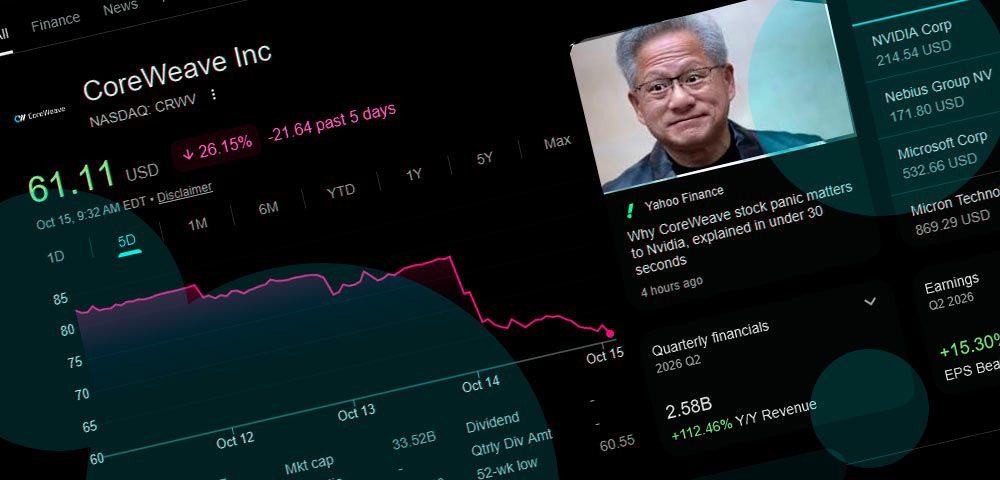
- CoreWeave shares closed at $61.39 on October 16, down 11.91% for the session and 25.21% from October 9, amid concerns about AI infrastructure debt and financing costs.
- The founders retain approximately 20% combined ownership and remain among CoreWeave’s six largest shareholders. The company says the stock sales were prearranged and fully disclosed.
CoreWeave (NASDAQ: CRWV) co-founders have sold approximately $3.3 bn in company shares since its March 28, 2025 initial public offering, including $2.4 bn in 2026, according to regulatory filings.
The transactions involve CEO Michael Intrator, Chief Strategy Officer Brian Venturo and co-founder Brannin McBee. The disclosures have attracted attention as the AI infrastructure provider faces growing investor concerns over debt, borrowing costs and the financial sustainability of its data center expansion.
CoreWeave shares fell 11.91% to $61.39 on October 16, closing near their 52-week low of $59.51. The stock has declined 25.21% since October 9, when it closed at $82.08, and more than 60% from its June 2025 peak.
CoreWeave insider stock sales accelerate in 2026
Venturo has sold more than $1.2 bn in CoreWeave shares since the IPO, including $734 mn during the second quarter of 2026. That made him the second-largest insider seller among US public companies during the period.
McBee has sold approximately $1.06 bn, equivalent to 40.4% of his undiluted shareholding at the IPO. Intrator has sold more than $907 mn since January 2026, compared with less than $70 mn throughout 2025.
Before CoreWeave went public, the three founders also received $488 mn from private share sales conducted in 2023 and 2024. All reported transaction values represent gross proceeds before taxes.
A CoreWeave spokesperson described the transactions as “pre-scheduled, fully disclosed, and entirely standard.”
Most sales were conducted under Rule 10b5-1 trading arrangements, which allow corporate insiders to establish predetermined share disposal plans. Such arrangements can provide protection against insider trading allegations when applicable regulatory conditions are satisfied.
The founders continue to hold approximately 20% of CoreWeave collectively, maintaining substantial exposure to the company’s future share price performance.
CoreWeave stock faces pressure from rising credit risk
The accelerating insider sales coincide with a sharp reassessment of CoreWeave’s debt-funded expansion strategy. On October 14, shares declined 15.46% as credit market concerns intensified. Investors have increasingly questioned whether revenue generated from AI computing contracts will support the company’s infrastructure investments and financing obligations.
CoreWeave’s borrowing costs have attracted particular scrutiny, with investors demanding higher yields on its unsecured debt. The company continues to emphasize its contracted revenue backlog and demand for AI computing infrastructure.
During an August 11 earnings discussion, Intrator told analysts that “our conviction in our strategy has never been stronger.”
The insider transactions do not establish that management expects the company’s financial performance to deteriorate. Prearranged sales can reflect personal financial planning and portfolio diversification, particularly where founders retain large equity positions.
Nevertheless, the scale of the disposals is relevant to shareholders assessing management ownership and market selling pressure.
CoreWeave’s founders retain significant financial exposure to the company, but the stock’s recent decline has placed greater emphasis on its ability to manage debt, finance new data centers and convert contracted revenue into cash flow.