CoreWeave (NASDAQ: CRWV) faces growing pressure from equity and credit investors as concerns over its debt-funded artificial intelligence infrastructure expansion intensify, despite strong revenue growth and a substantial pipeline of customer contracts.
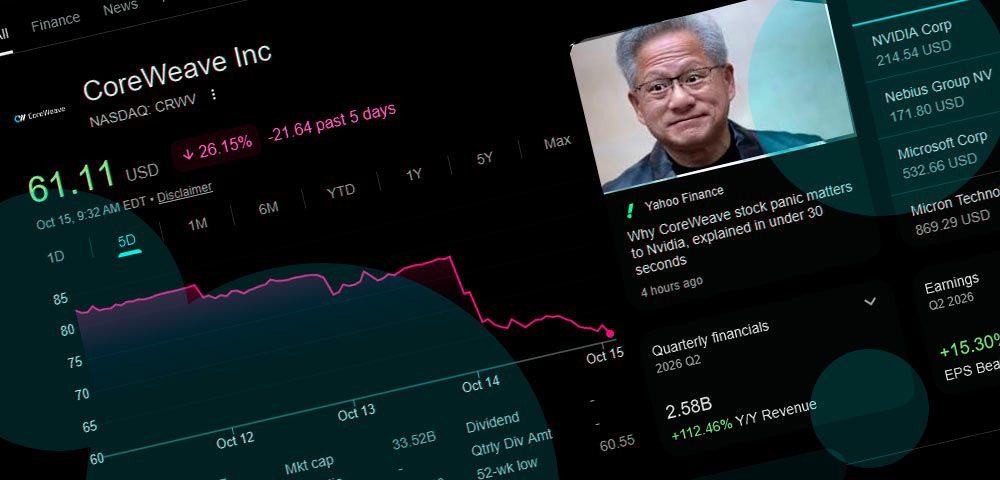
Shares declined 15.46% to $65.78 on October 14, 2026, and came under further pressure in early trading on October 15. The selloff followed a sharp increase in borrowing yields and renewed concerns about whether AI infrastructure providers can generate sufficient cash flow to support their investments.
- CoreWeave shares closed at $65.78 on October 14, 2026, down 15.46%, as its bond yields surged and investor concerns over AI infrastructure financing intensified.
- The average 12-month analyst price target stands at $141.47, implying approximately 115% upside from the October 14 closing price, although Mizuho and Bernstein maintain more cautious forecasts.
- CoreWeave reported a $104.2 bn revenue backlog in Q2 2026, but rising interest expenses, substantial lease obligations and planned capital spending of up to $39 bn remain significant financial risks.
CoreWeave’s unsecured bonds due in 2032 yielded approximately 14.8% on October 14, compared with their original 9.625% coupon. By October 15, yields had exceeded 16%, while credit default swap spreads moved above 1,000 basis points, indicating a substantial increase in perceived credit risk.
The deterioration reflects concerns about future refinancing costs rather than an immediate increase in interest payments on existing fixed-rate obligations.
CoreWeave stock forecast: What Wall Street analysts expect
Despite the recent decline, Wall Street’s consensus remains positive. As of October 15, forecasts compiled from 42 analysts indicate an average 12-month price target of $141.47, approximately 115% above the October 14 closing price.
The consensus rating is Buy, although individual forecasts vary considerably and some targets predate the latest deterioration in credit markets.
Deutsche Bank analyst Brad Zelnick maintained a Buy rating and a $150 price target, arguing that much of CoreWeave’s backlog consists of long-term take-or-pay contracts designed to cover associated capital and operating costs while generating a return.
Jefferies analyst Brent Thill also reiterated Buy with a $150 target on October 14, while Bank of America analyst Tal Liani maintained a Buy recommendation and a $140 target on October 15.
Other analysts have adopted more conservative assumptions.
- Mizuho’s Gregg Moskowitz lowered his target from $115 to $88 on October 15 while maintaining a Neutral rating.
- Bernstein analyst Madison Rezaei retained an Underperform rating and a $74 target, warning that unsecured bond yields approaching distressed levels reflect increasing concern about CoreWeave’s financial position.
- Paul Meeks, head of technology research at Freedom Capital Markets, described CoreWeave’s balance sheet as relatively weak compared with other specialized AI cloud providers because of its extensive borrowing and infrastructure construction commitments. He nevertheless questioned fears that the company would be unable to service its interest obligations.
Strong revenue growth meets rising financing costs
CoreWeave’s second-quarter revenue increased 112% year over year to $2.58 bn, supported by demand for Nvidia-powered AI computing infrastructure.
Adjusted EBITDA doubled to $1.51 bn, representing a 59% margin. However, the company’s net loss widened to $626 mn from $290 mn a year earlier.
Net interest expense increased from $267 mn to $640 mn, equivalent to approximately one-quarter of quarterly revenue.
As of June 30, CoreWeave had approximately $35.6 bn in debt and $16.3 bn in operating lease obligations, bringing the combined total to nearly $52 bn.
Its revenue backlog reached $104.2 bn, excluding more than $25 bn in additional customer commitments announced early in the third quarter.
Although these agreements provide visibility into future demand, backlog represents revenue expected from services delivered over time, not cash currently available for debt repayment.
Customer concentration adds another consideration. Three customers accounted for approximately 72% of second-quarter revenue, leaving CoreWeave heavily dependent on a relatively small group of major technology companies.
The company has maintained substantial commercial relationships with Microsoft, Meta and OpenAI, while its computing infrastructure depends on Nvidia GPUs.
Gartner warns of risks across AI infrastructure
Concerns about CoreWeave coincide with a more cautious outlook for the broader AI infrastructure industry. Gartner estimates that more than $3.5 trillion in AI infrastructure investment could be exposed to impairment by 2030 if current spending trends continue.
The research firm expects AI infrastructure investment of nearly $1 trillion in 2026, followed by another $6 tn between 2027 and 2030.
According to Gartner, data center owners would need cumulative revenue of approximately $8.5 tn to recover announced capital expenditure, financing costs and a 12% return on invested capital. Revenue attributable to AI data centers is projected to reach no more than $3.6 tn over the same period.
Gartner also forecasts that more than 80% of specialized AI cloud providers could cease operating independently by 2030 because of financing pressures, rapid hardware depreciation and insufficient returns. The projection is an industry-wide scenario rather than a company-specific forecast for CoreWeave.
CoreWeave stock outlook for late 2026
CoreWeave expects full-year 2026 revenue of $12.4 bn to $13.2 bn, with capital expenditure projected at $35 bn to $39 bn. For the third quarter, management forecast revenue of $3.45 bn to $3.60 bn and interest expense of $860 mn to $940 mn.
The next earnings report will be an important test of the company’s ability to translate contracted demand into revenue and cash flow while managing financing costs.
Investors will be watching capital spending, borrowing terms, liquidity and progress toward improved operating margins.
CoreWeave’s longer-term equity valuation remains highly sensitive to those factors. Strong AI demand supports analysts’ growth expectations, but high financing costs and continued infrastructure investment create substantial uncertainty around future shareholder returns.
The gap between Wall Street’s positive stock forecasts and the increasingly cautious credit market makes debt servicing, funding conditions and cash generation the principal measures to watch in CoreWeave’s next quarterly results.