Follow Beinsure

Delaware Life Insurance Company’s recent reclassification of affiliated investments points to a larger issue in the U.S. life insurance sector.
Fitch Ratings says rising exposure to private credit, affiliated asset managers and complex reinsurance or investment structures adds governance pressure and makes risk analysis less transparent.
The issue goes beyond one balance sheet. As life insurers expand into private assets and related-party structures, investors and rating agencies face a harder task in judging valuation, oversight and capital strength. Weak governance damages confidence in financial reporting, investment controls and capital adequacy, even when reported earnings and solvency metrics still look stable.
Fitch expects governance, disclosure quality and board supervision of affiliated exposures to carry more weight as credit factors over the near to medium term. The difference between strong and weak oversight will matter more.
Fitch placed Delaware Life on Rating Watch Negative after the company reclassified a material amount of private credit investments as affiliated investments. The move raised questions around governance, financial reporting and investment oversight.
After the reclassification, Delaware Life’s affiliated investment exposure rose almost 20 times, from 2% of invested assets to 40% as of year-end 2025. Fitch said the restated exposure ranks as the highest in its rated universe of North American life insurers for that period.
Fitch recognizes that affiliated investments differ widely by structure and purpose. Still, it reviews them more closely than other asset holdings because they carry higher risks tied to conflicts of interest, illiquidity and limited transparency.
The agency views the convergence between insurers and alternative asset managers as credit neutral for companies with strong governance. It turns credit negative when transparency and control systems fall behind the complexity of the business model.
More insurers now have ties with alternative investment managers. They also hold more opaque assets, larger private credit allocations, derivatives and asset-intensive reinsurance structures. That adds complexity across the sector, and sometimes a bit of fog.
The credit effect will differ by insurer group. Large life insurers with affiliated asset managers, significant private credit exposure or asset-intensive reinsurance programs face more governance and disclosure pressure. Public information often gives limited visibility into valuation, concentration and related-party exposure.
Top 20 U.S. Life Insurers Affiliated Investment Exposure
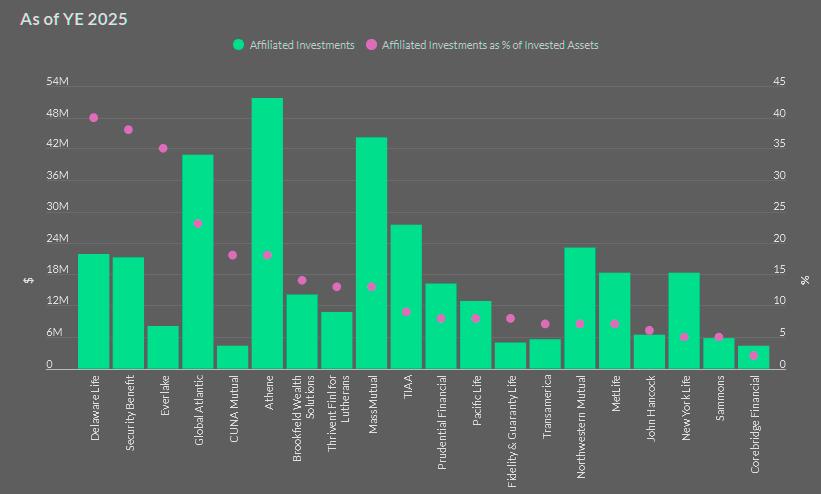
Insurers with simpler general account portfolios, clearer legal entity structures and stronger independent risk controls sit in a better position to contain governance pressure. Fitch looks at investment transparency, board oversight, independent committees and the quality of disclosures when assessing governance.
Disclosures that match regulatory requirements or go beyond them remain neutral for ratings. Poor disclosure works the other way and hurts rating outcomes.
Fitch expects governance to become more rating-sensitive as life insurers build more interconnected, data-heavy models and rely more on external or affiliated partners.
Regulators are tightening expectations as well. The Prudential Regulation Authority has increased scrutiny of funded reinsurance through changes to governance, risk limits, collateral standards and recapture planning. Its latest proposal would also tighten capital treatment.
Bermuda has added stronger reporting requirements, prior approval for certain block reinsurance transactions and more attention to senior management accountability and model risk management.
In the U.S., NAIC corporate governance standards require clear board oversight of risk appetite, capital planning and risk transfer. Fitch expects regulators to keep pressing for more transparency as private-credit exposure and affiliated structures grow inside life insurance.