Insurtech Sixfold has launched AI Underwriter for Life & Health, a system designed to generate case-level underwriting recommendations across life, disability, long-term care and critical illness insurance. The platform also provides rationale and suggested next actions for each case.
The system reviews evidence submitted with an application and applies the insurer’s underwriting manual. It assesses mortality and morbidity risk, then presents its reasoning with citations to source documents and relevant manual provisions.
Sixfold said the product goes beyond summarizing case files. It converts medical and financial evidence into underwriting recommendations that carriers can review and manage within their own governance processes.
Insurtech has launched AI Underwriter, a technology platform designed to support insurers with underwriting analysis, risk assessment, and decision support throughout the submission process.
The launch follows Sixfold’s $30 mn Series B funding round announced earlier this year. The company said that capital would help accelerate development of the AI Underwriter and deepen its use across insurance workflows.
Brewer Lane led the round, with strategic backing from Guidewire and continued participation from Bessemer Venture Partners and Salesforce Ventures.
The company has worked with life and health insurers for more than three years, including Guardian, New York Life and ClearView. Its earlier product focused on converting applications into underwriting-ready case overviews.
The new AI Underwriter adds recommendation capabilities to that process. It is designed to move from organizing information toward applying carrier rules and identifying potential underwriting actions.
The platform begins analyzing a case as new evidence arrives. It reads prescription histories and laboratory results, alongside driving records and financial information.
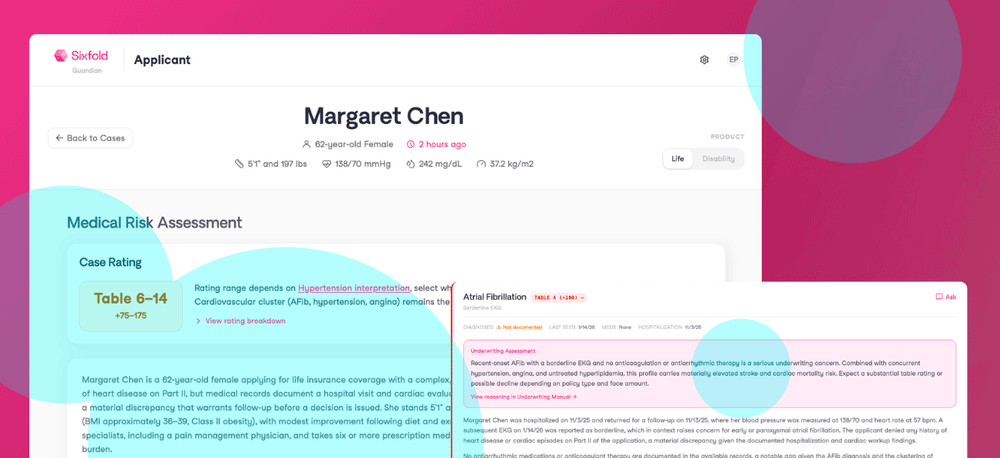
Those records are evaluated against the carrier’s own underwriting manual or a manual supplied by a reinsurer. The system identifies relevant impairments, flags missing information and produces rating recommendations with supporting explanations.
For example, in a hypertension case, the system reviews the diagnosis and historical control of the condition. It also examines recent changes before consulting applicable underwriting rules.
The AI Underwriter then determines whether the available evidence supports a debit, credit, exclusion or postponement under the relevant manual. Underwriters can review the recommendation, inspect citations and apply their own judgment before taking action.
Individual impairment findings are combined into an overall case assessment. The system then produces one of four suggested actions: rate, refer, decline or postpone.
Insurers determine how much human review is required before a decision is finalized. Sixfold positions the system as an underwriting support tool rather than a replacement for carrier oversight.
Sixfold said customers using its technology have recorded a 55% reduction in case evaluation time. The company also reports 30% more premium written per underwriter, based on customer results.
ClearView Head of Underwriting Peter Tilocca said the platform reduced time spent finding page references and missing information in medical reports. ClearView has recorded a 55% reduction in case evaluation time, according to Tilocca.
Sixfold also maintains an AI governance program covering its insurance products. The company engages with the National Association of Insurance Commissioners and other regulators and published its third annual Responsible AI Report in August 2026.
Founder and CEO Alex Schmelkin said life and health underwriting involves applying manuals and product rules to medical impairments and other evidence rather than simply summarizing documents. He said the company designed the platform to preserve detailed reasoning and auditability for underwriters.
Sixfold also published research involving more than 250 life and health underwriting professionals. According to the survey, 86% said AI made them more positive about the future of the sector.
The company said the AI Underwriter is intended to reduce time spent on document review and case preparation. Human underwriters remain responsible for judgment involving complex risks, policy terms and interactions with brokers or agents.