Follow Beinsure
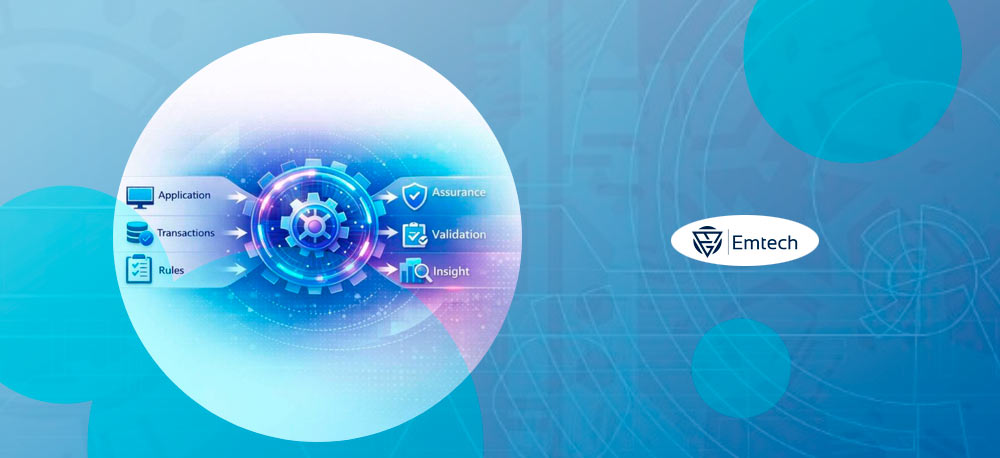
Emtech, a provider of software technology for insurance carriers and Insurtechs, has launched QMT Oracle, a new System Intelligence capability within its QMT platform. The company announced the product at ITC Vegas 2026 on Sept. 29.
QMT Oracle gives business and technology teams a conversational way to explore Emtech’s Digital Blueprint, which maps how enterprise systems operate.
Users can query relationships between workflows, business rules, data, integrations, dependencies, execution results and business outcomes.
The product is aimed at a problem many insurers face as they expand their use of AI. Information about how internal systems work is often spread across source code, process diagrams, spreadsheets, testing assets, documentation and employee knowledge, making it harder for AI tools to return dependable answers.
Emtech said QMT Oracle brings those sources into a connected system model rather than asking generative AI to infer relationships from fragmented information.
The conversational layer then lets employees ask questions against that model using natural language.
QMT Oracle uses Emtech’s Digital Blueprint
QMT is built on Emtech’s patented Deterministic Knowledge Graph technology. It creates what the company calls a Digital Blueprint, a machine-readable representation of an enterprise system and the relationships between its components.
QMT Oracle uses this Blueprint as the source for conversations about system behaviour. Instead of relying only on probabilistic AI outputs, responses are grounded in structured information already mapped across the underlying enterprise environment.
Enterprise AI is only as useful as the knowledge it can reliably access. Insurers often ask AI to explain systems whose rules, dependencies and processes remain distributed across separate sources.
Toni Jardini, chief innovation officer at Emtech
The Digital Blueprint was initially developed for software quality engineering and testing. Emtech is now extending its use into application modernization, change impact analysis, compliance validation, onboarding, business analysis, customer support and integration planning.
Insurance systems create complex dependencies
For insurers, those use cases often involve systems built over many years. Products, underwriting rules, regulatory requirements, customer processes, APIs, databases and legacy platforms frequently depend on one another.
QMT Oracle is designed to show how those dependencies connect before teams make changes.
A user might ask which workflows would be affected by a business rule change, which integrations depend on a particular field or which tests validate a specific process.
The system also supports questions about information required to complete a customer journey or failures recorded during the latest execution. It then connects those failures with the business functions affected by them.
Carriers have spent decades accumulating applications and data, but much of the knowledge about how those systems operate remains distributed across people, artifacts, and technologies.
Alex Rodov, founder of Emtech
Rodov said the Digital Blueprint gives enterprises a connected representation of those systems, while QMT Oracle makes the information accessible through a conversational interface.
QMT Oracle targets modernization and AI projects
The product is intended to support insurance carriers and Insurtechs working on modernization, software quality and enterprise AI projects. Teams can use the same system model to examine dependencies before changing applications, testing integrations or replacing older technology.
That also gives business and technical teams access to the same underlying information rather than relying on separate documentation.
For insurers with large legacy environments, the approach is intended to reduce the amount of manual work required to understand how a proposed change might affect other systems.
Emtech develops Deterministic Knowledge Graph technology used to create Digital Blueprints of complex enterprise systems. Through its QMT platform, the company applies those Blueprints to autonomous testing, continuous validation, modernization and System Intelligence for insurance carriers and Insurtechs.