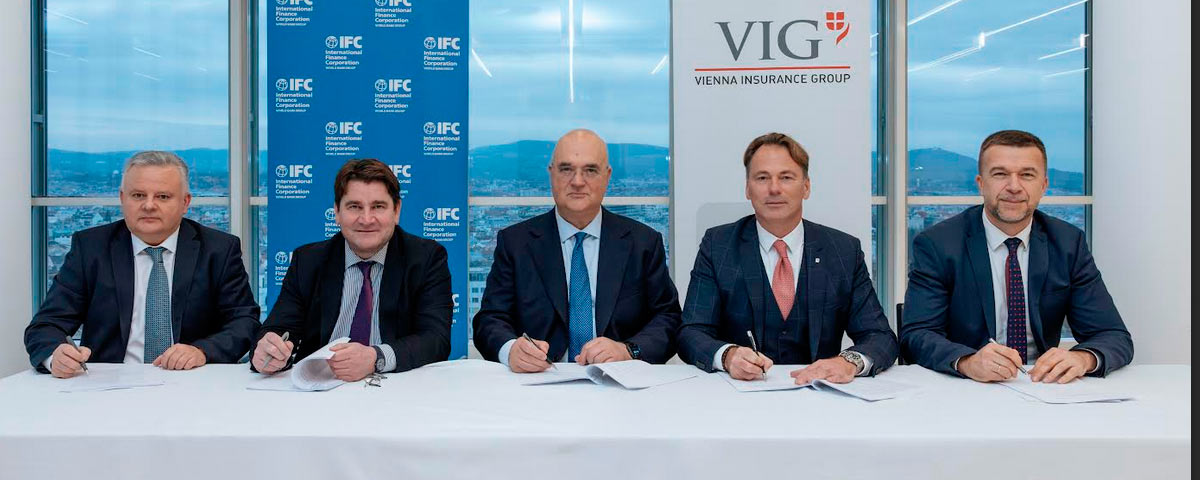
The International Finance Corporation, part of the World Bank Group, plans to acquire stakes of about 20% in each of Vienna Insurance Group’s Ukrainian non-life insurers, USG and Kniazha. The investment will come through a capital increase and still needs regulatory approval.
Vienna Insurance Group said IFC’s entry should help both companies expand product ranges and speed up digital projects.
The insurer sees technology and distribution upgrades as necessary steps in a market operating under strain.
The deal builds on VIG’s existing relationships with Aon and Lloyd’s. Alongside those partnerships, the group said it intends to take an active role in Ukraine’s reconstruction once the war ends.
IFC, VIG Holding, and the two local insurers have signed a related agreement.
With IFC as a shareholder, VIG said it aims to support the development of Ukraine’s insurance market and reinforce its position in the country. Ukraine remains a central part of the group’s Central and Eastern Europe footprint.
Peter Höfinger, deputy chief executive of Vienna Insurance Group, said the group has worked with IFC since late 2022, when the institution invested in its Bulgarian pension fund Doverie.
He said the Bulgarian focus sits on pension provision, while in Ukraine the priority lies in expanding insurance protection to support future rebuilding.
We have been working with the IFC since the end of 2022, when it acquired a stake in our Bulgarian pension fund Doverie. While the focus in Bulgaria is on expanding the pension fund business to strengthen capital-funded pension provision and combat poverty in old age, extending insurance cover in Ukraine is essential for the future reconstruction of the country.
Peter Höfinger, Deputy CEO of the Vienna Insurance Group
“With IFC and our existing partnerships with AON and Lloyd’s, we are preparing to take an active role in the renewal process of this country,” Peter Höfinger says
Harald Riener, board member at Vienna Insurance Group with responsibility for Ukraine, said IFC’s investment reflects confidence in both the local teams and the market. He said Ukraine continues to matter strategically for the group and remains within its core CEE markets.
We see IFC’s investment in our Ukrainian companies not only as a sign of confidence and recognition of our expertise in the Ukrainian market. It is also a commitment to the country and its great potential, which both IFC and we continue to see. Ukraine is and will remain part of our core market CEE.
Harald Riener, member of the Managing Board of VIG
“We are very proud of the immense resilience of our Ukrainian colleagues, whose unwavering commitment ensures the stability and profitability of the companies despite the difficult war conditions,” Harald Riener sayd.
“Together with the IFC, we are leveraging the expertise of our teams and partners in the country to provide high demanded insurance solutions for the country’s reconstruction once the war hopefully comes to an end soon.”
Riener pointed to the resilience of VIG’s Ukrainian staff, saying their commitment has helped maintain stability and profitability despite wartime conditions. He added that cooperation with IFC and other partners is intended to support insurance solutions needed once reconstruction accelerates.
Vittorio Di Bello, IFC’s director for financial institutions across Europe, Latin America, and the Caribbean, said insurance plays a role in protecting assets and managing risk across sectors such as transport, energy, agriculture, housing, and healthcare.
By safeguarding critical sectors the insurance industry can help protect assets, manage risks, and enable growth.
Vittorio Di Bello, IFC’s Director of the Financial Institutions Group for Europe, Latin America and the Caribbean
He said IFC’s equity investment brings long-term capital into Ukraine’s insurance sector and signals confidence in its ability to operate through difficult conditions while supporting recovery driven by private enterprise.
“IFC’s equity investment in the Ukrainian insurance companies injects scarce long-term capital into the sector, sending a strong signal of confidence in its resilience and giving the private sector the stability needed to weather challenging conditions and drive recovery,” Vittorio Di Bello said.