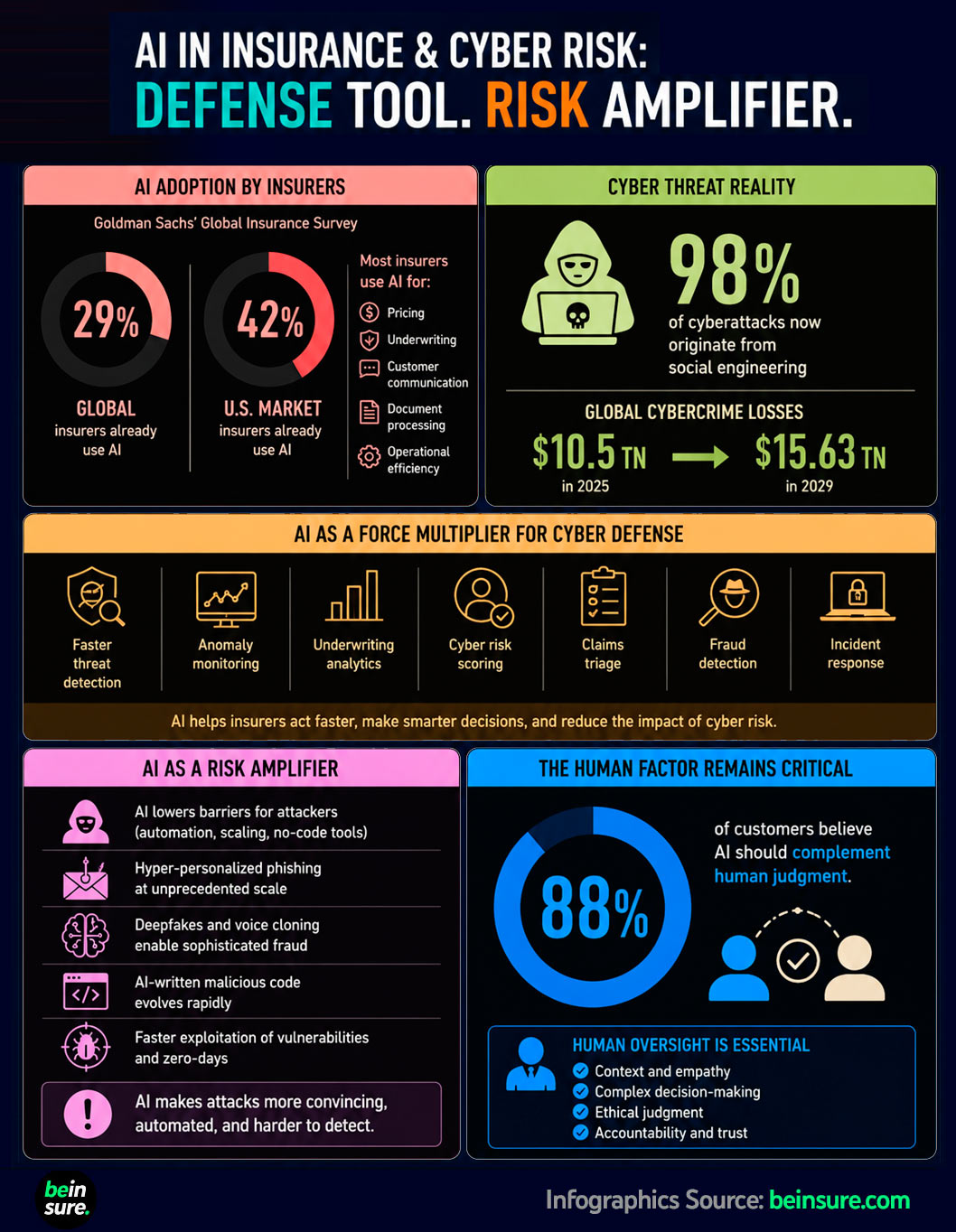
Artificial intelligence is rapidly becoming one of the defining forces shaping the future of insurance and cyber risk. But the market is still underestimating one critical reality: AI is both a defense tool and a risk amplifier at the same time.
According to Goldman Sachs’ Global Insurance Survey, 29% of insurers globally already use AI, while in the U.S. market the adoption level has already reached 42%.
Most insurers are now using AI for pricing, underwriting, customer communication, document processing, and operational efficiency.
AI is already embedded into insurance operations. At the same time, cybercriminals are scaling with the same technologies.
98% of cyberattacks now originate from social engineering. Global cybercrime losses are projected to reach $10.5 tn in 2025 and may grow to $15.63 tn by 2029, according Beinsure.
Generative AI is accelerating this threat environment dramatically.
10 years ago, phishing emails were often easy to detect. AI generates grammatically flawless, psychologically convincing, and highly personalized attacks at industrial scale. Deepfakes can imitate executives, family members, and trusted contacts. AI systems can identify vulnerabilities, automate exploitation, and launch malware with minimal human involvement.
AI is fundamentally changing the economics of cyber risk. The cyber threat landscape is becoming increasingly automated.
Historically, cyberattacks required time, skill, and human coordination. AI lowers barriers to entry, expands attack surfaces, and increases the scalability of fraud, phishing, and ransomware operations.
Insurers are also using AI to strengthen defense:
- faster threat detection
- anomaly monitoring
- underwriting analytics
- cyber risk scoring
- claims triage
- fraud detection
- incident response
This creates a new dynamic where insurers, businesses, and cybercriminals are effectively operating on the same technological battlefield.
One of the most important conclusions for the insurance industry is that cyber insurance can no longer remain purely reactive.
The future of cyber insurance will increasingly depend on prevention, monitoring, risk intelligence, and active resilience support.
Companies will buy cyber insurance for balance-sheet protection after an event, and will expect insurers to help reduce the probability of attacks before losses occur.
At the same time, human oversight becomes even more important. Research already shows that while customers value AI speed and efficiency, 88% believe AI should complement human judgment.
……………….
AUTHOR: Oleg Parashchak – CEO & Founder of Finance Media Holding