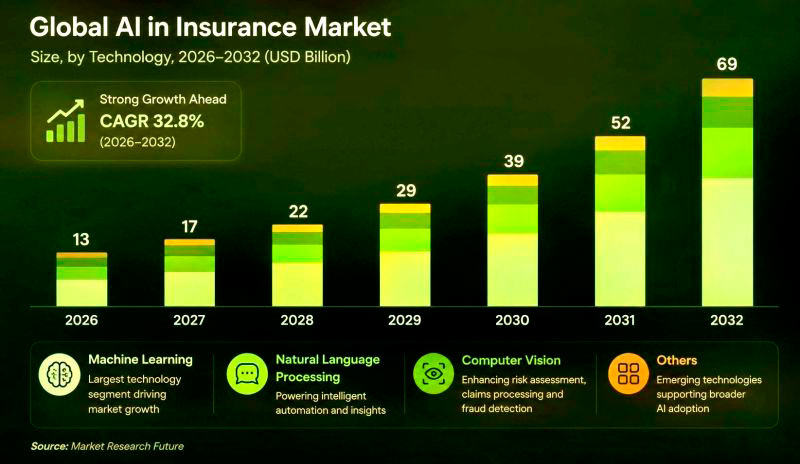
Most AI discussions in insurance still centre on global carriers, large technology budgets and Silicon Valley-style product development. That misses a more interesting shift. Emerging insurance markets might gain more from AI because they carry less legacy architecture, fewer fixed workflows and less internal attachment to older operating models.
According to Beinsure analysts, late adopters in insurance often avoid the expensive mistakes made by early movers and skip failed pilots, outdated vendor choices and overbuilt systems. Instead, they move straight to use cases with clearer economics.
AI has already moved past lab work in insurance
- Underwriting teams use automated scoring to improve speed and pricing discipline.
- Claims departments use image recognition to assess damage and shorten settlement cycles.
- Fraud teams use machine learning to spot suspicious patterns earlier.
- Health insurers use diagnostic algorithms to support pricing, risk selection and claims review.
The same shift now reaches routine analytical work. Tasks that once took analysts hours, from document review to portfolio checks, now move faster with AI support. That changes where the specialist spends time.
The larger barriers aren’t always technical. In many insurers, the harder issues sit inside the organisation: regulatory uncertainty, data privacy rules, internal resistance, skills gaps and weak governance frameworks. 65% of insurers still report problems in these areas.
This is where emerging markets have an opening. Some insurers in these markets work with lighter legacy systems and younger digital distribution models. Others face the opposite problem – fragmented data, uneven regulation and thin technical talent.
Underwriters, claims handlers, actuaries and risk teams need systems that improve judgement, not black boxes that create new control problems.
Insurance has seen this pattern before. Digital banking faced years of scepticism, then moved quickly once customers accepted mobile service and regulators adjusted. AI in insurance is likely to follow a similar route, though with higher model-risk exposure.
Munich Re and other industry leaders have already warned about AI accumulation risk. If many insurers rely on similar models, datasets or vendors across underwriting, claims and fraud detection, a single model weakness spreads across the market. That risk looks technical at first, then becomes financial.
According to Beinsure, emerging markets might move faster because they have less to unwind. Developed markets still hold more capital, deeper actuarial teams and stronger regulatory infrastructure, but those advantages slow adoption when old systems, committees and compliance layers turn every AI use case into a two-year project.
The future of insurance is underwriters, claims experts, actuaries and risk managers working with AI under clear governance. Firms that connect people, process, governance and technology will capture the larger gain.
……………….
AUTHOR: Oleg Parashchak – CEO & Founder of Finance Media Holding