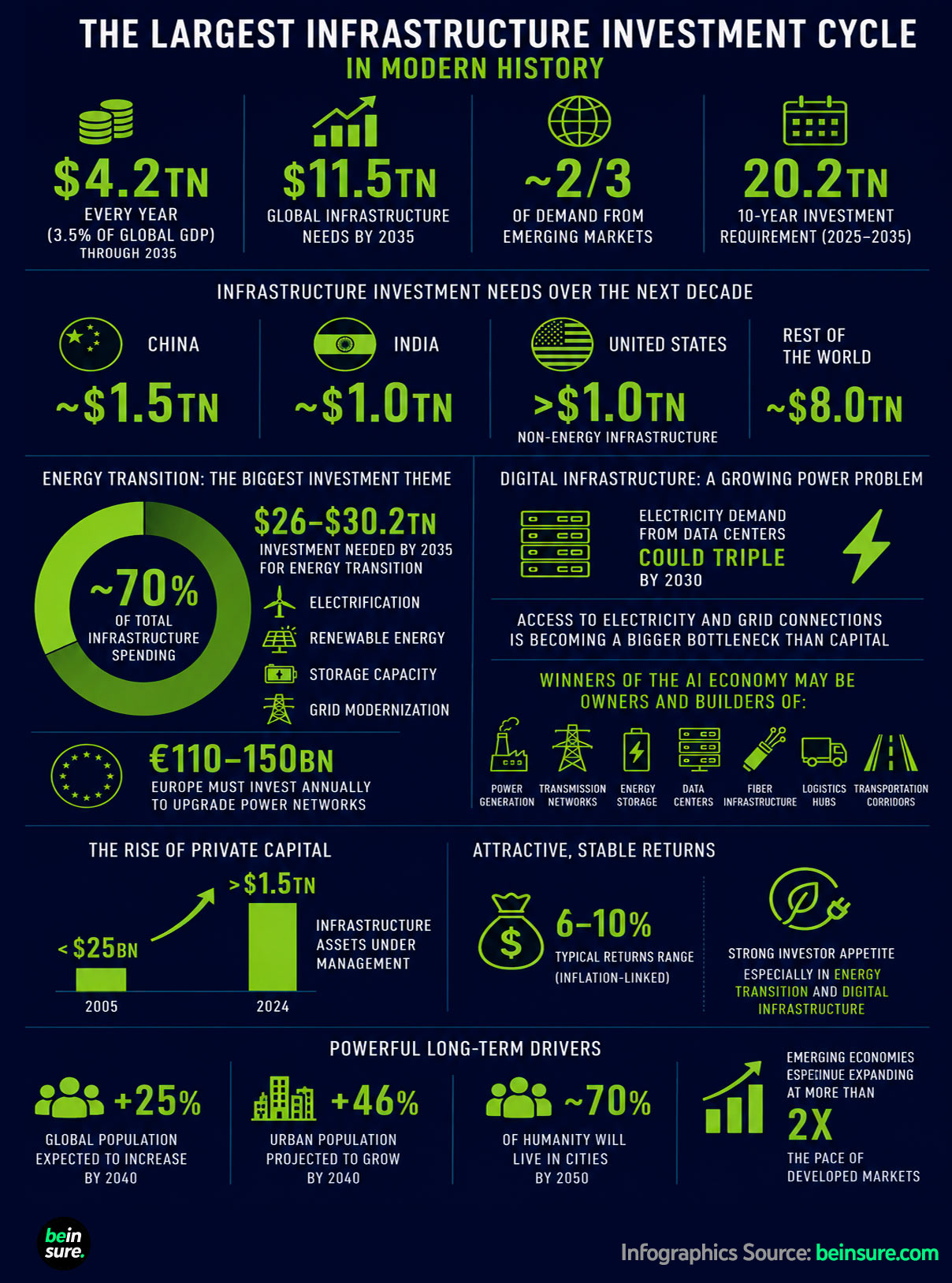
The global economy is entering the largest infrastructure investment cycle in modern history, according to Beinsure. Allianz estimates that annual spending must reach about $4.2tn through 2035, equal to 3.5% of global GDP.
The target addresses gaps in transport, energy, social infrastructure and digital systems. These aren’t marginal upgrades. They define whether economies keep pace with urbanisation, electrification and data demand.
Allianz estimates total global infrastructure needs at $11.5tn by 2035. Emerging markets account for nearly two-thirds of expected demand.
China requires about $1.5tn. India needs close to $1tn. The US faces more than $1tn in non-energy infrastructure investment over the next decade.
The spending pattern matters as much as the size of the bill. Energy transition now dominates infrastructure allocation.
Between $26tn and $30.2tn will be needed by 2035 for electrification, renewable energy, storage capacity and grid modernisation. That equals almost 70% of global infrastructure spending.
Europe faces its own grid bill. Transmission, distribution and interconnection networks require about €110bn to €150bn a year.
AI has changed the equation. Cloud computing, hyperscale data centres and machine-learning workloads are turning electricity supply into a business constraint.
Allianz describes this as a digital power problem. It’s blunt, but accurate.
McKinsey estimates that electricity demand from data centres might triple by 2030. In several regions, grid access and power connections already matter more than available capital.
This shift changes which assets matter in the AI economy. The biggest beneficiaries aren’t limited to software firms.
The capital is moving toward power generation, transmission networks, energy storage, data centres, fibre systems, logistics hubs and transport corridors. That list says a lot about where the next economic bottlenecks sit.
Private capital now plays a larger role. Infrastructure assets under management grew from less than $25bn in 2005 to more than $1.5tn in 2024.
Investors are drawn to stable, inflation-linked returns, often in the 6% to 10% range. Energy transition and digital infrastructure projects attract the most attention.
The long-term demand signals remain strong. Allianz expects the global population to rise by 25% by 2040, with the urban population up 46%.
By 2050, around 70% of humanity will live in cities. Emerging economies continue to grow at more than twice the pace of developed markets.
According to Beinsure, the investment challenge has moved beyond identifying infrastructure gaps. The harder question is whether governments, insurers, investors and developers move fast enough to finance, insure and deliver the assets the global economy now requires.
……………….
AUTHOR: Oleg Parashchak – CEO & Founder of Finance Media Holding