Many insurers still talk about AI as an experiment, even as the performance gap in the sector keeps widening. McKinsey’s latest insurance AI report shows a sharp split between companies that use AI across full business domains and those still running isolated pilots.
According to Beinsure, the strongest insurers treat AI as a set of tools for underwriting, claims or customer service, and redesign entire operating areas around data, automation, staff adoption and reusable technology, then measure the financial result.
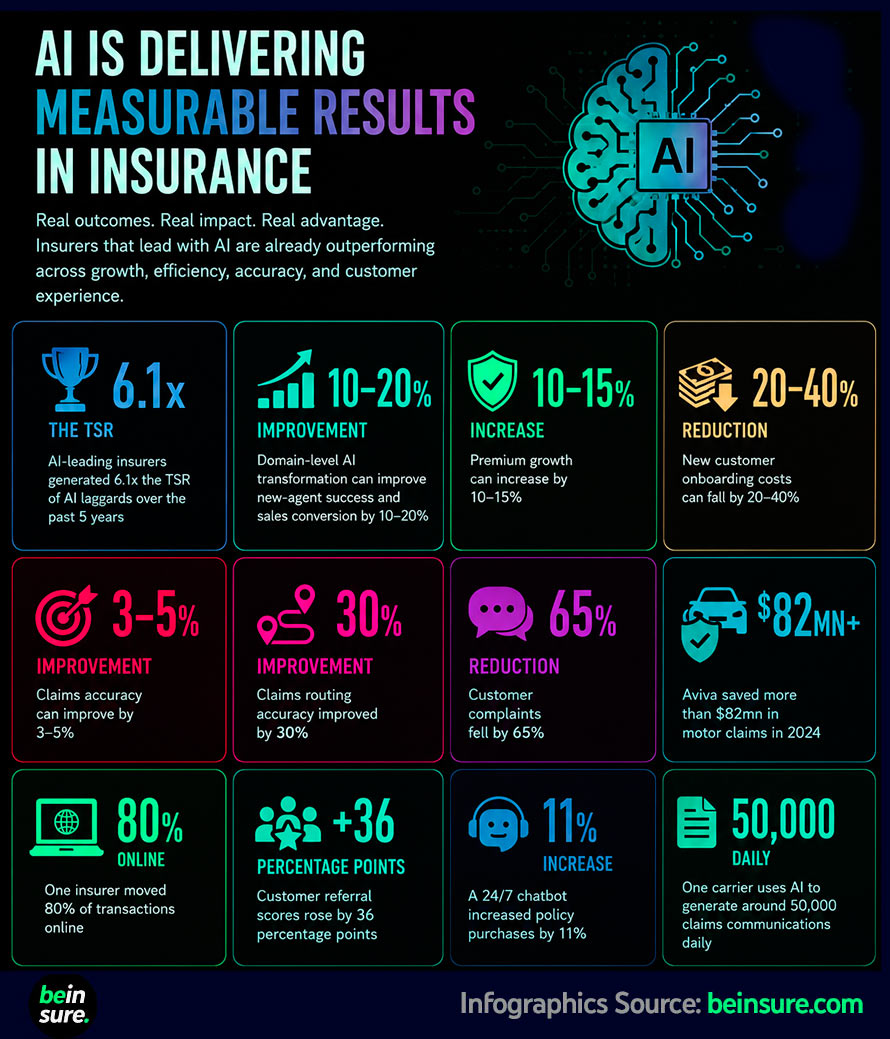
The difference shows up in shareholder returns. AI-leading insurers generated 6.1 times the total shareholder return of AI laggards over the past five years. That gap is hard to dismiss as a technology trend or a budget issue.
Domain-level AI transformation also changes day-to-day performance. New-agent success and sales conversion rise by 10-20%, while premium growth increases by 10-15%. New customer onboarding costs fall by 20-40%, which matters in distribution models where acquisition expenses still eat into margins.
Claims results look more practical, and in some cases more immediate. Claims accuracy improves by 3-5%, while claims routing accuracy rises by 30%.
Customer complaints fell by 65% in one example, showing that AI works best when it removes friction rather than adding another system for staff to manage.
AI leaders have C-suite agreement on the roadmap, stronger internal digital talent and an operating model built for scale. They use reusable AI components, embed data capabilities inside business teams and manage adoption as a business change, not a side project.
They fund pilots, test tools, publish internal demos and then stall when the work hits legacy systems, unclear governance, weak data ownership or staff resistance. The model works in a lab, then gets trapped before production.
According to Beinsure analysts, the adoption budget matters as much as the development budget.
For every $1 spent on AI development, insurers should plan at least another $1 for adoption and scaling. Training, workflow redesign, compliance controls and management attention decide whether the model reaches daily use.
Building an AI model is easier than changing the way claims handlers, agents, underwriters and service teams work every day.
……………….
AUTHOR: Oleg Parashchak – CEO & Founder of Finance Media Holding