Follow Beinsure
AMC Entertainment Holdings (NYSE: AMC) has received a consensus “Moderate Buy” rating from 10 research firms covering the movie theater operator, according to MarketBeat. The average 12-month AMC stock price target stands at $2.67, reflecting mixed expectations following a sharp recovery in the company’s share price during 2026.
Two analysts recommend selling AMC shares, three maintain hold ratings, three recommend buying and two assign strong-buy ratings. The differences reflect uncertainty over whether improving theater attendance and box office revenue can generate sustainable profits for a company carrying substantial debt.
- AMC Entertainment (NYSE: AMC) holds a consensus Moderate Buy rating from 10 analysts, with an average 12-month price target of $2.67.
- AMC stock has climbed 86% in 2026, supported by a 21% increase in domestic box office receipts, although shares remain down more than 99% over five years.
- Institutional investors have increased their exposure, but AMC’s debt, negative shareholders’ equity and continued losses remain major concerns for its profitability outlook.
AMC stock has gained approximately 86% in 2026, significantly outperforming the broader market after losing more than 99% of its value over the preceding five years. The recovery has coincided with stronger theatrical attendance, higher box office receipts and expectations that AMC could achieve its first annual adjusted profit since 2018.
The company’s financial position remains a concern. AMC has reported a loss of $554.1 mn on revenue of $5.23 bn, alongside negative shareholders’ equity. Its market capitalization of approximately $2.6 bn compares with an enterprise value of $9.5 bn, reflecting the scale of its debt and other obligations.
AMC stock price forecast and Wall Street analyst ratings
Recent analyst reports show considerable differences in expectations for AMC Entertainment’s valuation and earnings recovery.
Benchmark reaffirmed its “buy” recommendation on July 21, raising its AMC stock price target to $3.00 from $2.50. Needham & Company also issued a report on July 21, setting a target of $3.50 per share.
Texas Capital upgraded AMC from “hold” to “strong buy” on July 15, indicating a more favorable assessment of the company’s prospects.
Weiss Ratings revised its assessment on August 31, improving AMC’s rating from “sell (e+)” to “sell (d-)”. The recommendation remained negative despite the upgrade. B. Riley Financial maintained a “neutral” rating in its October 19 research report.
The average analyst price target of $2.67 sits below the stock’s recently reported trading levels, suggesting limited upside under the prevailing consensus forecast. Individual targets nevertheless vary, with Needham’s $3.50 estimate offering a more optimistic assessment than the consensus.
Some bearish analysts remain concerned about AMC’s operating margins and financial commitments. Before the latest earnings surprise, a cautious group of forecasts projected approximately $6.0 bn in revenue and $704.2 mn in earnings by 2029, yet assigned a stock price target of just $2.20.
The difference between those earnings projections and the valuation illustrates the importance analysts place on AMC’s balance sheet, financing costs and ability to convert operating improvements into returns for shareholders.
AMC stock performance: Shares rise 86% in 2026
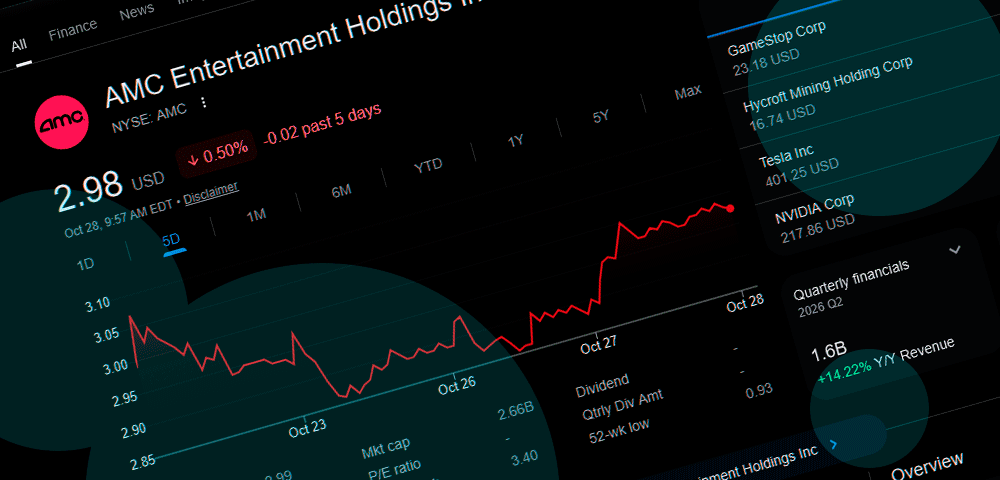
AMC shares opened at $2.90 in a recent Tuesday trading session, with one market report recording a 0.2% increase. The stock’s 12-month trading range extended from $0.93 to $3.40.
Its 50-day simple moving average stood at $2.76, compared with a 200-day moving average of $1.95, reflecting the recovery in the share price.
At that valuation, AMC had a market capitalization of approximately $2.59 bn, a price-to-earnings ratio of -2.71 and a beta of 1.97.
A separate market snapshot showed AMC trading at $2.98, down $0.01, or 0.41%, during the session. The company’s market capitalization was approximately $2.67 bn, with shares trading between $2.96 and $3.00.
The same snapshot recorded trading volume of 556,400 shares against average volume of 25.6 mn shares, with a reported gross margin of 26.71%.
AMC’s rally represents a substantial recovery from its earlier share price declines, although the stock remains far below its levels five years ago.
Box office recovery supports AMC Entertainment’s outlook
Improving cinema attendance has been a central factor behind AMC’s stock performance.
Domestic box office receipts were running 21% above the corresponding period in 2025, indicating stronger demand for theatrical releases.
Global box office revenue was also expected to exceed $10 bn for the first time since before the COVID-19 pandemic. Industry commentary projected that 2026 would become only the second year in cinema history in which more than five films each generated over $1 bn in box office revenue.
The improvement reflects audiences returning to movie theaters rather than waiting for films to become available through streaming services.
AMC operates one of the world’s largest theatrical exhibition businesses through its AMC Theatres and ODEON Cinemas Group brands. Its locations offer standard and premium large-format screenings, including IMAX and Dolby Cinema, alongside reserved seating, online ticketing and food and beverage services.
The company has also developed additional revenue opportunities through its AMC Stubs loyalty program and A-List monthly movie subscription service.
Premium concession products and movie-related collectibles have expanded its food, beverage and merchandise offerings, providing potential support for higher-margin revenue.
Analysts now expect AMC to deliver its first annual adjusted profit since 2018. That would represent an improvement after years of losses following the pandemic.
AMC has not yet returned to annual profitability, even though some smaller theater operators have reported profits for several years.
The company’s outlook remains closely tied to Hollywood’s release schedule. Weaker film content in 2027 and subsequent years could reduce attendance, while an economic downturn could weaken consumers’ spending on entertainment.
Higher interest rates would create additional pressure for a business with significant financing requirements.
Institutional investors increase AMC stock holdings
Several institutional investors established new positions in AMC Entertainment during the second quarter, according to recent ownership disclosures.
Readystate Asset Management LP purchased shares valued at approximately $8.34 mn, while Fund 1 Investments LLC acquired a new position worth $4.19 mn.
Headlands Technologies LLC bought AMC shares worth approximately $1.64 mn, and WINTON GROUP Ltd established a position valued at $969,000.
Bank of America Corp DE increased its AMC holdings by 34.3% during the first quarter, acquiring an additional 138,853 shares.
The bank subsequently held 543,857 shares valued at approximately $533,000. Hedge funds and other institutional investors collectively owned 28.80% of AMC Entertainment’s outstanding stock.
These investments occurred during a period of improving market performance, although institutional ownership alone does not establish expectations for future returns.
AMC stock outlook: Earnings recovery versus debt and dilution risks
AMC’s investment outlook depends on whether higher ticket sales, improved pricing and concession revenue can support sustainable cash generation across its large theater network.
Recent revenue and earnings-per-share results exceeded analyst expectations, prompting higher earnings estimates and strengthening the near-term case for improving operating performance.
The earnings surprises indicate that demand and pricing have performed better than analysts previously anticipated. They do not, however, resolve the company’s financial constraints.
AMC’s reported loss of $554.1 mn against $5.23 bn in revenue demonstrates that stronger operating activity has yet to produce consistent bottom-line profitability.
Negative shareholders’ equity and substantial debt obligations add to the financial risks facing shareholders.
A central question is whether AMC can manage theater occupancy, fluctuations in film releases and concession profitability sufficiently to achieve the earnings recovery expected over the next three years.
Financing presents another challenge. The company must meet its obligations without relying heavily on further equity issuance, particularly after existing shareholders experienced substantial dilution during the previous year.
Additional share issuance could dilute existing investors even if operating performance continues to improve.
Corporate governance also remains part of the investment debate, including concerns about chief executive compensation exceeding peer levels despite AMC’s continued losses.
For shareholders assessing AMC’s valuation, the difference between its approximately $2.6 bn equity market capitalization and $9.5 bn enterprise value is particularly significant.
That gap reflects financial obligations that must be considered alongside any improvement in ticket sales or adjusted earnings.
The available forecasts therefore present competing outcomes. More optimistic analysts, including Needham, have assigned AMC a $3.50 price target, whereas cautious projections place its value near $2.20 despite assumptions of substantially higher revenue and earnings by 2029.
With the consensus 12-month target at $2.67, AMC’s 86% rally in 2026 has already taken its share price above the average analyst valuation. Further gains will depend on whether improving box office revenue translates into profitability and stronger financial performance without additional pressure on existing shareholders.