Follow Beinsure
- AMD stock price targets from leading Wall Street analysts
- Citi raises AMD stock price forecast to $800
- Aletheia Capital lifts AMD price target to $800
- Bank of America forecasts AMD shares at $720
- Other investment banks expect AMD stock to reach $600-$725
- AMD data center revenue growth supports higher price targets
- AMD valuation remains the principal risk to the bullish forecast
- AMD stock price prediction ahead of November earnings
Advanced Micro Devices (NASDAQ: AMD) is attracting increasingly ambitious stock price forecasts from Wall Street analysts ahead of its third-quarter earnings report on November 3, 2026. Citi and Aletheia Capital have established $800 targets, while Bank of America, KeyBanc, Mizuho and Wells Fargo also see substantial upside as AMD expands its position in artificial intelligence infrastructure.
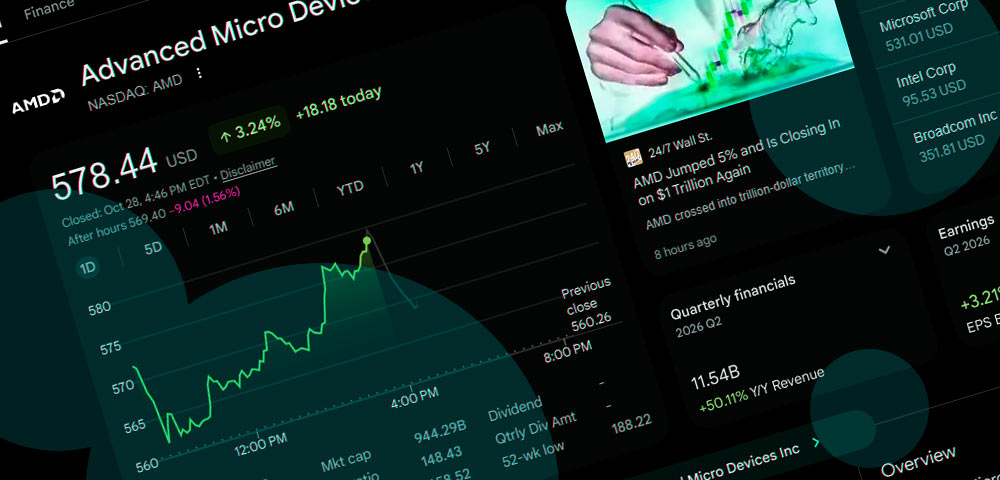
The semiconductor company’s shares closed at $560.26 on October 27, gaining 5.45% during the session, and continued trading higher on October 28. AMD remains below its 52-week high of $658.52, reached earlier this month, following a rally that has lifted the stock more than 160% in 2026.
- Citi and Aletheia Capital have set $800 price targets for AMD, implying nearly 43% upside from the October 27 closing price of $560.26. Bank of America targets $720, while KeyBanc expects $725.
- Aletheia forecasts AMD’s data center revenue will triple in 2027, supported by accelerating server CPU sales and a fourfold increase in GPU revenue. Its earnings projections exceed market consensus.
- AMD’s upcoming November 3 earnings report will test expectations for AI chip demand, MI450 shipments and the profitability of its Helios infrastructure business.
The divergence between AMD’s current valuation and analysts’ earnings forecasts is becoming more pronounced. The most optimistic investment firms expect data center sales to accelerate sharply through 2027, driven by EPYC server processors and Instinct AI accelerators. More cautious valuations leave considerably less room for further share price gains.
AMD stock price targets from leading Wall Street analysts
AMD closed October 28 at $578.44, up 3.24%. At that price, Citi’s and Aletheia Capital’s $800 forecasts imply approximately 38% upside. The broader Wall Street consensus is considerably more conservative, with an average 12-month target near $640, equivalent to roughly 11% appreciation.
The latest forecasts show a substantial difference in how analysts value AMD’s future earnings.
| Investment firm | AMD price target | Upside from $578.44 |
|---|---|---|
| Citi | $800 | +38.3% |
| Aletheia Capital | $800 | +38.3% |
| KeyBanc | $725 | +25.3% |
| Bank of America | $720 | +24.5% |
| Mizuho Securities | $705 | +21.9% |
| Wells Fargo | $700 | +21.0% |
| Stifel | $700 | +21.0% |
| TD Cowen | $675 | +16.7% |
| Susquehanna | $650 | +12.4% |
| Bernstein | $650 | +12.4% |
| Wedbush | $600 | +3.7% |
These are analyst price objectives rather than guaranteed trading levels. Most are intended to represent expectations over approximately 12 months.
Citi raises AMD stock price forecast to $800
Citi analyst Atif Malik raised his AMD price target from $575 to $800 on October 6, maintaining a Buy rating. The substantial revision followed the launch of Meta’s Muse AI agent and an upward reassessment of demand for server CPUs.
Citi estimates that the CPU market could expand from $29 bn in 2025 to $300 bn by 2030, representing approximately 60% compound annual growth.
Malik expects agentic AI applications to require substantially more computing resources than conventional chatbots. Autonomous agents generate repeated workloads involving code execution, database queries, information retrieval and external tools, creating additional demand for general-purpose processors.
Citi sees AMD as a major beneficiary because of its EPYC server CPU portfolio and commercial exposure to Meta, one of the company’s large data center customers.
The bank’s $800 target places greater value on AMD’s server processor business rather than relying exclusively on the company’s ability to compete with Nvidia in AI accelerators.
The distinction matters for AMD’s earnings outlook. Sustained growth in server CPU shipments could strengthen revenue even as the company increases investment in its more complex Instinct GPU and Helios systems.
Citi’s forecast nevertheless depends on its assumption that agentic AI will expand CPU demand substantially beyond the levels associated with conventional cloud computing.
Aletheia Capital lifts AMD price target to $800
Aletheia Capital analyst Warren Lau raised his AMD price target from $700 to $800 on October 28, maintaining a Buy rating and adding the semiconductor company to the firm’s Alpha Portfolio.
The revised valuation follows substantial upward adjustments to Aletheia’s earnings forecasts, supported by stronger demand for server CPUs and AI computing, improved supply chain conditions and AMD’s expanding product portfolio.
Aletheia expects AMD’s data center revenue to more than double year over year in the fourth quarter of 2026 before tripling in 2027.
The bank’s 2027 forecasts assume server CPU revenue will more than double and GPU revenue will increase fourfold.
Lau also projects fully diluted earnings per share will triple year over year in fiscal 2027 and rise by approximately another 80% in fiscal 2028. Taken together, those projections imply earnings growth exceeding fivefold over the three-year period described in the firm’s analysis.
Aletheia’s $800 target uses a sum-of-the-parts valuation, equivalent to approximately 24 times its estimated fiscal 2027-2028 earnings.
This differs from assigning a high multiple to AMD’s current profitability. The valuation instead assumes that a substantial increase in future earnings will make today’s share price considerably less expensive relative to the company’s projected financial performance.
Aletheia acknowledges that its earnings estimates are well above consensus. Consequently, the $800 forecast is particularly sensitive to AMD’s ability to deliver the expected growth in data center revenue and operating profit.
The firm describes AMD as potentially the fastest-growing AI compute provider, although that assessment depends on the scale of the anticipated GPU and server CPU expansion.
Bank of America forecasts AMD shares at $720
Bank of America analyst Vivek Arya raised his AMD price target from $620 to $720 on September 25 and maintained a Buy rating.
The bank’s investment thesis centers on the expanding role of CPUs in agentic AI infrastructure.
BofA estimates the total addressable market for server CPUs will rise from approximately $61 bn in 2026 to $211 bn in 2030, with AI-related demand accounting for about $180 bn of the projected market.
The bank sees a growing relationship between GPUs and CPUs as AI workloads become more complex. GPUs perform computationally intensive model operations, while CPUs handle supporting tasks such as application execution, tool calls, database interactions and retrieval processes.
That means an increase in AI inference activity can also create demand for processors handling the surrounding workloads.
BofA cited Anthropic’s $11.6 bn, seven-year cloud infrastructure agreement with Akamai as evidence of growing requirements for CPU capacity.
The bank increased its AMD earnings estimates for 2027 and 2028 by 2% and 3%, respectively. Its $720 price objective represents approximately 24.5% upside from the October 28 closing price.
Unlike Aletheia’s more aggressive forecast, BofA’s investment case places considerable weight on the expansion of AMD’s established server processor business alongside AI accelerators.
Other investment banks expect AMD stock to reach $600-$725
KeyBanc analyst John Vinh maintained a $725 target in October, placing the firm among the more optimistic institutions covering AMD.
Mizuho Securities analyst Vijay Rakesh raised his target from $580 to $705 on October 6, retaining an Outperform rating. Stifel analyst Ruben Roy increased his target from $635 to $700, while Wells Fargo’s Joseph Quatrochi also has a $700 objective.
The more restrained forecasts suggest that analysts are broadly constructive on AMD’s business prospects but differ over how much future growth should already be reflected in the stock.
Susquehanna analyst Christopher Rolland raised his target from $620 to $650 on October 28, maintaining a Positive rating. Bernstein analyst Stacy Rasgon also has a $650 target.
Wedbush analyst Matt Bryson maintains a $600 target and an Outperform rating. At AMD’s latest closing price, that target implies less than 4% upside.
The distinction between these forecasts is significant. A $600 target indicates relatively limited potential appreciation from the current price, whereas $800 assumes a substantially stronger earnings trajectory or a more favorable market valuation.
AMD data center revenue growth supports higher price targets
AMD’s second-quarter results provide the strongest operating evidence behind the bullish analyst forecasts.
Revenue increased 50% year over year to $11.54 bn, with data center revenue rising 107% to $6.72 bn. The segment accounted for approximately 58% of total company revenue, supported by demand for EPYC server processors and Instinct AI GPUs.
The company reported a non-GAAP gross margin of 56% and free cash flow of approximately $1.56 bn. Gaming revenue declined 31%, illustrating the difference in growth rates across AMD’s businesses.
For the third quarter, management forecast revenue of approximately $13 bn, plus or minus $300 mn, representing roughly 41% year-over-year growth.
The more important question for investors is how much of AMD’s expanding AI infrastructure pipeline can be converted into revenue during 2027.
Management has outlined the possibility of data center revenue reaching approximately $70 bn next year, including around $40 bn from AI GPUs. These figures represent prospective business opportunities rather than guaranteed results.
The MI450 accelerator and Helios rack-scale platform are central to those expectations.
AMD plans to expand MI450 shipments through the fourth quarter of 2026 and into early 2027. Helios combines Instinct GPUs, EPYC processors, networking components and ROCm software into integrated AI infrastructure.
The company has established major AI relationships involving OpenAI, Meta, Anthropic and Microsoft.
Anthropic’s agreement includes plans to deploy up to two gigawatts of MI450 accelerators in Helios systems, with the initial gigawatt scheduled to begin deployment during the first half of 2027. Microsoft is also expanding Helios deployments within Azure. These relationships provide substantial prospective demand, but future revenue will depend on deployment schedules, available production capacity and execution.
AMD valuation remains the principal risk to the bullish forecast
AMD’s trailing price-to-earnings ratio remains above 140, leaving the stock heavily dependent on expectations for future earnings growth.
The valuation explains why the company’s share price can experience sharp corrections even when the longer-term data center outlook remains favorable.
Aletheia’s forecast of tripling earnings in 2027 would significantly change the company’s forward valuation. But the difference between the firm’s estimates and consensus also shows how much stronger its operating assumptions are.
Manufacturing constraints represent another important risk.
AMD has identified tight supplies of advanced semiconductor wafers, high-bandwidth memory, packaging capacity and substrates. The company has secured approximately $29-$30 bn in purchase commitments to support future production.
The Helios platform requires coordinated production and integration of multiple components, increasing the complexity of delivering complete rack-scale systems.
Management has also indicated that gross margin could experience some pressure during the MI450 and Helios production ramp.
Higher total revenue and gross profit could therefore coincide with a temporary decline in gross margin percentage.
For the most optimistic analyst forecasts to hold, AMD will need to increase shipments rapidly enough to offset those pressures and generate the operating leverage assumed in future earnings estimates.
AMD stock price prediction ahead of November earnings
The immediate technical outlook differs from the longer-term forecasts issued by investment banks.
AMD’s October 28 closing price of $578.44 leaves the stock approximately 12% below its 52-week high of $658.52.
The $600 level is the first major psychological threshold. A sustained move above it would bring the $620-$650 trading area back into focus, followed by the October peak.
A breakout above $658.52 would put the $700-$725 analyst targets within a more plausible longer-term trading range, although the share price would still need significant earnings support to approach $800.
On the downside, $560 is an immediate reference level, followed by the $530 region. A deeper correction could bring the October 22 low near $503 into focus.
These are price levels derived from recent trading activity, not forecasts of where AMD will necessarily trade after earnings.
The November 3 report will provide more immediate evidence about the strength of server CPU demand, the pace of Instinct GPU shipments and expectations for fourth-quarter revenue.
Investors will also be looking for additional information about the Helios production ramp, manufacturing constraints and the potential effect on margins.
The current range of Wall Street price targets suggests three distinct valuation outcomes. The $600-$650 group anticipates comparatively modest upside, the $700-$725 forecasts imply stronger earnings growth, and the $800 targets depend on more ambitious assumptions for AMD’s expansion in AI computing.
For now, the approximately $640 analyst consensus is much closer to the company’s previous record high than to the most aggressive $800 forecasts. Reaching the higher targets would require AMD to translate its AI infrastructure commitments into substantially greater revenue and earnings during 2027.