Follow Beinsure
SoFi Technologies (NASDAQ: SOFI) has attracted a series of revised Wall Street price targets following stronger-than-expected third-quarter earnings and management’s first financial outlook for 2027.
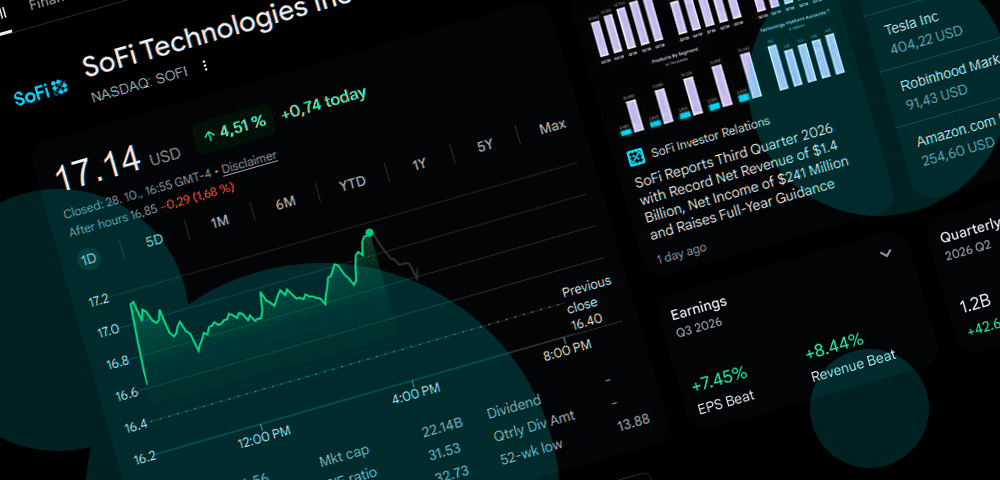
Shares rose 13.42% to $16.40 on October 27 and gained another 4.51% on October 28, closing at $17.14. The two-day advance lifted the stock approximately 18.5% from its October 26 closing price of $14.46.
- SoFi shares closed at $17.14 on October 28, 2026, gaining 4.51% after a 13.42% rally the previous day. The average 12-month analyst price target of $20.60 implies approximately 20% upside.
- Citi maintains a bullish $30 target, while Scotiabank raised its forecast to $26. Goldman Sachs and Wells Fargo target $18, BofA Securities forecasts $16.50, and Morgan Stanley remains bearish at $15.
- SoFi raised its 2026 adjusted revenue outlook to $5.04 bn and expects $6.4 bn in 2027, with adjusted EPS projected to increase to $0.90.
The rally followed a 44% increase in quarterly adjusted net revenue and a substantial upgrade to management’s earnings expectations. Investment banks have responded differently, however. Several raised their targets without changing their cautious ratings, while more optimistic analysts see considerable upside from continued earnings growth.
Among 26 analysts covering SoFi, the average 12-month price target stands at approximately $20.60, with a median forecast of $19.50. The broader forecast range extends from $12 to $30, and the overall consensus rating remains Hold.
The difference between the highest and lowest forecasts reflects disagreement over the valuation investors should assign to SoFi’s projected earnings growth, its exposure to consumer lending and the sustainability of its expanding financial services business.
Wall Street analysts’ latest SoFi stock price forecasts
Citi is among the most bullish major investment banks covering SoFi. Analyst Peter Christiansen maintained a Buy rating and a $30 price target on October 28, implying approximately 75% upside from the latest closing price.
Christiansen pointed to favorable credit trends despite elevated interest rates, particularly lower net charge-offs. Citi also sees evidence that SoFi’s growth is extending beyond traditional balance-sheet lending, supporting its positive assessment of the company’s earnings prospects.
Scotiabank analyst Lance Jessurun raised his target from $25 to $26 while maintaining a Sector Outperform rating. The revised forecast implies approximately 52% upside.
Scotiabank highlighted accelerating revenue growth, a 34% adjusted EBITDA margin and 2027 management guidance exceeding previous consensus expectations. The bank also noted that hedging largely offset the effects of interest-rate movements on loan valuations, while personal-loan risk-adjusted margins remained above 7.5%.
StoneX analyst Mark Palmer increased his price target from $25 to $27, retaining a Buy recommendation. The new forecast represents potential appreciation of approximately 58%.
Needham’s Kyle Peterson maintained a Buy rating with a $24 target, equivalent to approximately 40% upside. The firm pointed to strong lending performance, renewed momentum in loan platform volumes and signs of improvement in SoFi’s technology business.
Goldman Sachs took a more restrained position. Analyst Will Nance increased the bank’s price target from $15 to $18 but maintained a Neutral rating.
The 20% target increase followed better-than-expected originations and 2027 guidance roughly 10% above previous market expectations. Goldman also acknowledged the effectiveness of SoFi’s interest-rate hedging.
Nevertheless, Nance identified risks associated with capital-intensive lending growth and a quarterly decline of approximately 200 basis points in capital ratios. Slower originations or increased sales of lower-yielding loans could constrain revenue growth. The $18 target implies only 5% upside from the October 28 close.
Wells Fargo analyst Donald Fandetti similarly raised his target from $17 to $18, retaining an Equal Weight recommendation. Barclays analyst Terry Ma maintained an $18 target and a neutral stance.
TD Cowen’s Moshe Orenbuch lifted his forecast from $17.50 to $18, also maintaining a Hold rating. These three banks’ forecasts cluster around $18, suggesting limited additional appreciation following the earnings-driven rally.
Morgan Stanley remains more cautious. Analyst Jeffrey Adelson reiterated an Underweight rating and a $15 price target, approximately 12.5% below the current share price. The bank’s position reflects continuing valuation concerns despite stronger operating results.
BofA Securities analyst Mihir Bhatia raised his target from $16 to $16.50 but maintained an Underperform recommendation. The forecast implies approximately 3.7% downside.
BofA acknowledged that SoFi exceeded revenue expectations, particularly within lending. Adjusted revenue of $1.37 bn surpassed the bank’s $1.27 bn forecast by approximately 8%, with lending revenue of $807 mn exceeding consensus estimates of $717 mn.
Operating expenses, however, were approximately $100 mn higher than BofA expected. Adjusted EPS of $0.18 matched the bank’s forecast, despite the revenue outperformance. That combination helps explain why BofA raised its target only modestly.
Keefe, Bruyette & Woods analyst Timothy Switzer also maintained an Underperform rating, although the firm increased its target from $15 to $16.
Among other established forecasts, Mizuho Securities analyst Dan Dolev has an Outperform rating and a $22 target, last revised in July. UBS has an older $21 target, while Deutsche Bank’s most recently reported forecast stands at $18. These estimates have not all been updated following the latest earnings release.
Why SoFi’s Q3 earnings changed Wall Street forecasts
SoFi reported third-quarter GAAP revenue of $1.385 bn, up 44% year over year, with adjusted net revenue reaching $1.371 bn. GAAP net income increased 73% to $241 mn, and diluted EPS advanced 64% to $0.18.
Adjusted EBITDA increased 70% to approximately $470 mn, producing a 34% margin. The revenue result exceeded the roughly $1.26 bn consensus estimate, providing evidence that business growth was running ahead of expectations.
The Lending segment contributed $807.4 mn in adjusted net revenue, an increase of 68%. Total loan originations reached $16.9 bn, up 71%, including approximately $3.8 bn originated through the Loan Platform Business on behalf of third parties.
Those third-party originations are relevant to valuation because they can generate revenue without requiring SoFi to retain every loan on its balance sheet.
The company also added 1.2 mn members during the quarter, taking total membership to 17.1 mn, up 35% year over year. Total products rose 44% to 26.7 mn, with existing members accounting for 51% of newly opened products.
Financial Services revenue increased 25% to $525.1 mn. Fee-based revenue reached $570.6 mn, representing approximately 42% of quarterly adjusted revenue.
Deposits increased by $5.8 bn to $51.3 bn. SoFi estimates its deposit-funded structure delivers approximately $745 mn in annualized interest-expense savings compared with warehouse financing. Net interest margin improved sequentially by 16 basis points to 6.14%.
These developments support analysts’ expectations of higher earnings, but they also explain some of the differences between bullish and bearish forecasts. SoFi continues to depend heavily on lending income, and growing loan volumes can increase its exposure to credit losses and capital requirements.
The Technology Platform presents a separate concern. Quarterly revenue declined 24% to $87.4 mn, partly because of a major client departure. Excluding that impact, revenue increased 18%, although a sustained recovery has yet to be established.
SoFi and Prudential Financial have partnered to offer Prudential’s term life insurance directly through the SoFi app, giving more than 15 mn members access to coverage without leaving the platform.
The digital service, developed and operated by SoFi, allows members to review Prudential’s SimplyTerm insurance, receive an instant quote and complete their application and purchase online.
Eligible customers often obtain coverage within minutes, without medical examinations or laboratory tests. The process also reduces repeated data entry.
SoFi’s 2027 earnings forecast and stock valuation
Management increased its 2026 adjusted net revenue outlook to $5.04 bn from the previous range of $4.75 bn to $4.85 bn. It also raised expected adjusted EPS to $0.61 from $0.60 and projected adjusted EBITDA of $1.66 bn.
The preliminary 2027 guidance was more consequential for analysts’ valuations.
SoFi expects adjusted net revenue of approximately $6.4 bn, adjusted EBITDA of $2.24 bn and adjusted net income of $1.28 bn. Adjusted EPS is projected at $0.90.
These forecasts imply approximately 27% revenue growth and 48% adjusted EPS growth from management’s 2026 expectations. The company is therefore forecasting faster earnings growth than revenue growth.
At the October 28 closing price of $17.14, SoFi trades at approximately 19 times management’s projected 2027 adjusted EPS. That valuation assumes the company achieves its stated earnings objective.
The investment banks’ forecasts imply substantially different valuations against the same management earnings target.
Citi’s $30 target equates to approximately 33.3 times projected 2027 adjusted EPS, while Scotiabank’s $26 forecast corresponds to 28.9 times. Goldman’s $18 target represents 20 times earnings, compared with 18.3 times at BofA’s $16.50 forecast and 16.7 times at Morgan Stanley’s $15 target.
The differences demonstrate why the earnings outlook alone does not determine a future stock price. Investors must also decide how much they are prepared to pay for expected growth.
At a 20-times multiple of management’s projected $0.90 adjusted EPS, the implied share price would be $18. A 25-times multiple would produce $22.50, while a 30-times multiple would imply $27.
Each outcome assumes that SoFi delivers its forecast earnings and that the market assigns the stated valuation multiple. Neither assumption is assured.
What could limit SoFi’s stock price growth?
The principal risk to bullish price targets is that earnings growth fails to match management’s projections. Personal lending remains an important contributor to SoFi’s profitability. Economic weakness, higher unemployment or deteriorating consumer credit quality could increase defaults and reduce risk-adjusted lending returns.
SoFi reported an annualized personal-loan charge-off rate of 2.26%, compared with 2.60% a year earlier. That improvement supports the credit-quality argument, although the measure is affected by the company’s loan sales and origination mix.
Operating expenses also warrant attention. The approximately $100 mn difference between BofA’s expense forecast and actual quarterly spending suggests that revenue outperformance does not necessarily translate proportionately into higher earnings.
Potential share dilution presents another consideration. Management’s 2027 outlook implies approximately 52% adjusted net income growth but 48% adjusted EPS growth, consistent with an increase in the diluted share count.
If the number of shares grows faster than currently implied, earnings per share could fall short of the $0.90 objective even if aggregate profits continue rising.
Capital requirements, interest-rate movements and the pace of loan sales could also influence future profitability. Goldman Sachs specifically identified capital consumption as a concern following the third-quarter results.
SoFi’s expanding fee-based businesses may help reduce its reliance on interest income, but some fees remain connected to lending volumes. Its Technology Platform must also recover from the effects of its major client transition.
SoFi stock price prediction for 2027
The latest analyst forecasts suggest three distinct valuation outcomes.
The bearish range of $15 to $16.50, represented by Morgan Stanley, KBW and BofA Securities, implies approximately 4% to 12% downside from the October 28 close. These targets are consistent with concerns about valuation, capital intensity and the risks of sustaining rapid loan growth.
The more cautious middle of the forecast distribution lies near $18 to $21. Goldman Sachs, Wells Fargo, Barclays and TD Cowen cluster at $18, while the wider analyst median stands at $19.50. This range implies that improving earnings may already be partly reflected in the stock’s price.
The bullish forecasts extend from Needham’s $24 to Scotiabank’s $26, StoneX’s $27 and Citi’s $30. Achieving those valuations would likely require SoFi to deliver its 2027 earnings targets and retain a relatively high earnings multiple.
The average analyst target of $20.60 implies approximately 20% appreciation from $17.14, compared with nearly 14% at the $19.50 median. Neither is a guaranteed return, and both are 12-month targets rather than forecasts specifically for December 2027.
SoFi’s strong third-quarter results have improved the earnings outlook, but they have not produced a uniform change in analyst recommendations. Goldman Sachs, Wells Fargo and BofA raised their targets while retaining cautious ratings, whereas Citi and Scotiabank continue to anticipate substantially higher share prices.
The key financial test is now management’s $6.4 bn adjusted revenue and $0.90 adjusted EPS outlook for 2027. Meeting those targets would support the earnings assumptions underpinning higher valuations. Whether the stock reaches $20, $26 or $30 will also depend on credit performance, capital requirements and the earnings multiple investors are willing to sustain.