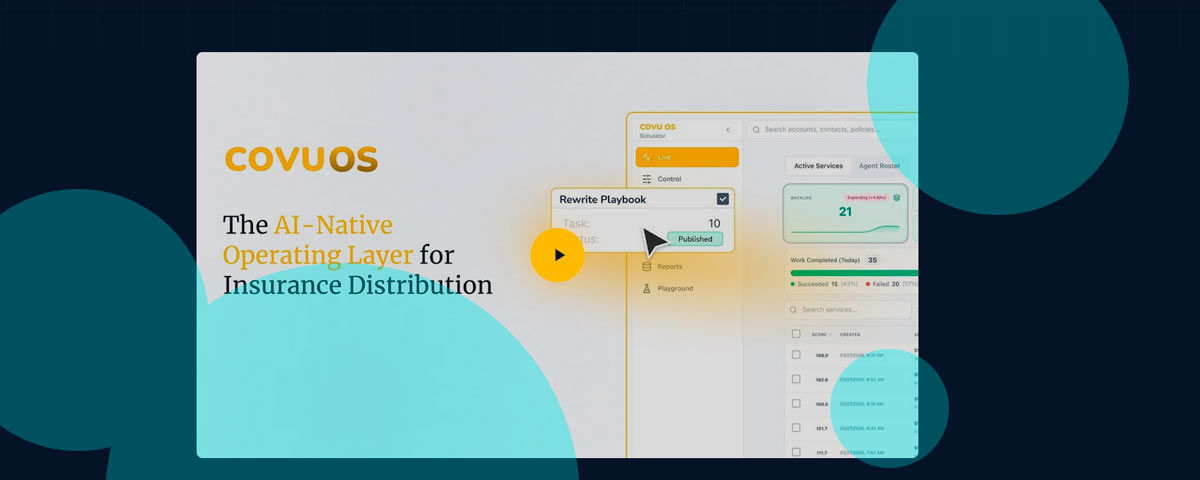
COVU has launched COVU OS, the operating layer at the center of its AI-native stack for insurance distribution. The company says COVU OS does not bolt AI onto old workflows. It rebuilds the workflow itself.
The platform functions as a task-native orchestration layer, turning each inbound service request into a structured task and routing it to the right execution layer, whether AI, licensed agents, or offshore support, based on cost, compliance, and complexity.
Ali Safavi, founder and chief executive of COVU, said insurance agencies have spent more than 20 years trying to modernize. He said the missing piece was never smarter software or better AI, but an operating layer able to run the work itself. He described COVU OS as that layer.
COVU argues the insurance industry still has not fixed a basic operational problem. The average independent agency spends 50-70% of its resources on service work while operating at EBITDA margins of 20-25%.
A mid-sized agency with 10,000 policies can process as many as 100,000 service transactions a year. Most of that work still moves through email, manual triage, and fragmented handoffs. It is not built to be routed, measured, or improved in a systematic way.
According to the company, the main constraint is not intelligence. It is operating design. AI agents layered onto ambiguous and unstructured workflows tend to fail in regulated environments packed with exceptions.
Without breaking work into structured tasks, AI remains an assistant sitting on top of the same broken infrastructure.
COVU OS is built around a different unit of work: the task. The company says every service request entering a COVU agency is automatically interpreted, enriched with policy and carrier context, broken into structured tasks with defined inputs and outputs, and then routed to the correct execution layer.
That can include AI, automation, offshore support, or licensed agents, depending on what the workflow requires.
COVU OS sits inside a broader stack that includes VERO, Connect, Service Engine, Markets, and Capital. The company positions OS not as a separate feature, but as the layer that makes the wider stack operational.
Once the task becomes the unit of work, COVU says insurance operations become visible, controllable, and easier to optimize. Operations teams get access to live data on cost per task, resolution time, escalation frequency, rework rate, workload balance, and routing efficiency.
The company frames it less as a reporting dashboard and more as an active operating system for service work.
COVU says the platform is already live across dozens of agencies serving tens of thousands of customers.
The company reports that AI is now embedded across more than 230 task types spanning over 50 lines of insurance, with automation coverage still expanding. In its first 30 days in production, COVU OS processed more than 150,000 tasks.
COVU says task-level cost tracking allows continuous optimization as more workflows move onto the platform.
A certificate of insurance, which the company says costs the industry $10-15 and takes 44 minutes, costs COVU less than $2 and is completed in minutes.
A renewal that once required a licensed agent from start to finish is now handled as 15 structured tasks orchestrated through COVU OS, with licensed staff involved only where a license is required.
Safavi said the company is not selling a tool. He said COVU rebuilt the workflow itself. In his view, that changes the economics of agency operations and produces a different operating model rather than a marginal efficiency gain.
COVU says it is building a full AI-native operating stack for insurance distribution, aimed at changing how agencies operate, grow, and transition.
The platform combines software that restructures work into AI-native workflows and connects the fragmented systems agencies already run on, services that ensure compliant execution, markets that expand carrier access and distribution leverage, and capital that supports ownership, growth, and succession.