Follow Beinsure
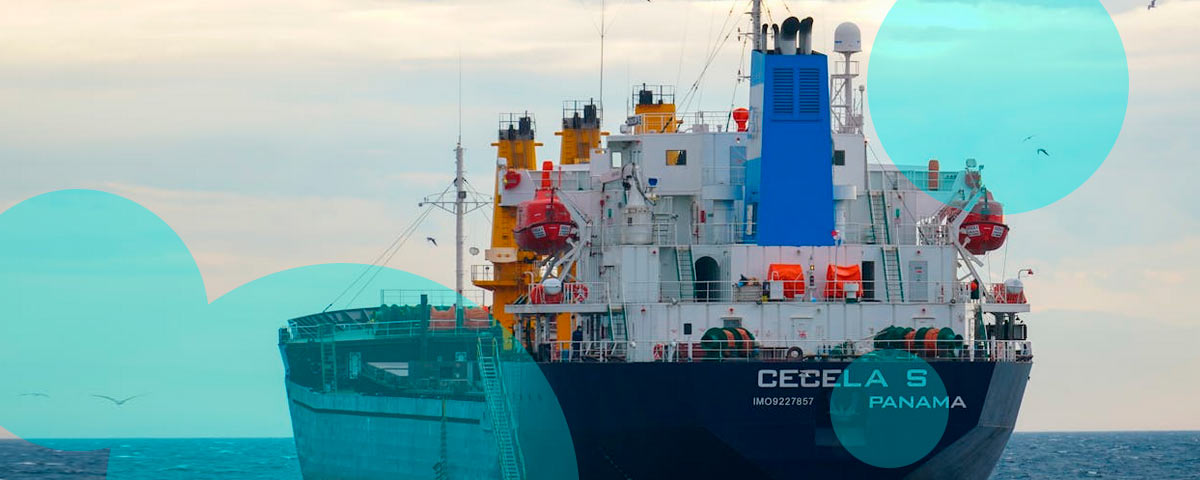
The U.S. International Development Finance Corporation named Chubb lead partner for a $20 bn maritime reinsurance program designed to restore commercial shipping through the Persian Gulf.
The initiative targets cargoes such as oil, gasoline, LNG, jet fuel, and fertilizer moving through the Strait of Hormuz.
Officials announced the program on March 11. The structure seeks to restart shipping activity after insurers pulled capacity from the region following rising military tensions.
According to Jefferies analysts, the design attempts to contain reinsurance exposure within DFC’s statutory limits while still providing meaningful coverage support.
The initiative also introduces a security layer. Coordination will involve United States Central Command, with the U.S. Navy expected to escort tankers before the end of the month.
The framework therefore ties insurance coverage to operational protection on the water.
The DFC operates as Washington’s closest analogue to China’s Belt and Road Initiative. Its statutory maximum contingent liability now stands at $205 bn, a sharp increase from the earlier $60 bn ceiling.
Congress expanded the agency’s operational scope under fiscal year 2026 appropriations, allowing projects in higher-income countries when linked to U.S. national security priorities.
DFC Financing Vehicles
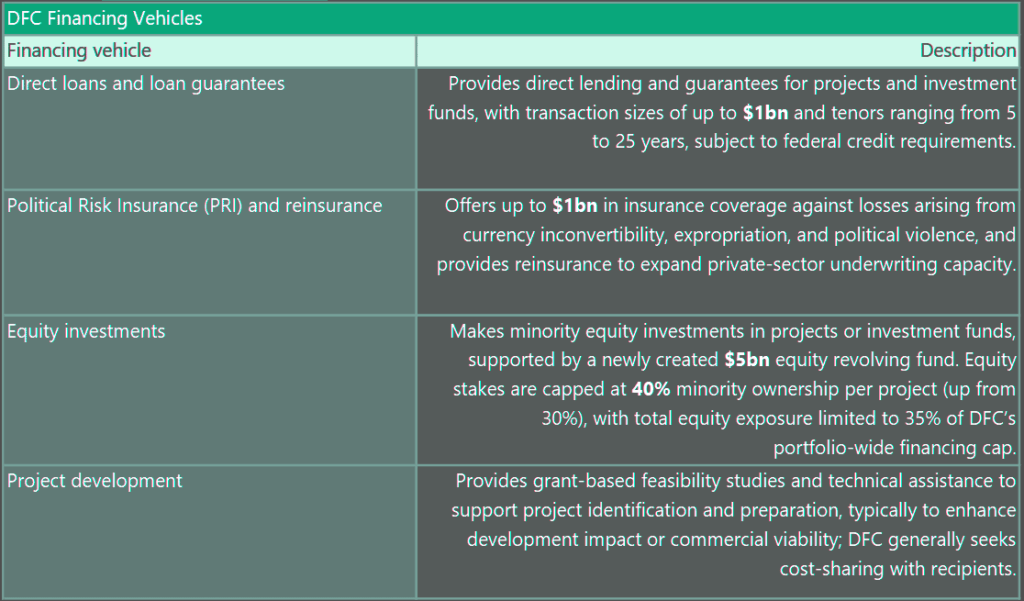
Political Risk Insurance represents one of the agency’s primary financial tools. PRI policies provide coverage of up to $1bn against risks such as currency inconvertibility, expropriation, and political violence. The product also supports reinsurance structures designed to expand private underwriting capacity.
Other financing mechanisms remain available through the agency. Direct loans and loan guarantees support projects and investment funds, typically reaching transaction sizes near $1 bn with maturities between five and twenty-five years.
Equity investments allow minority stakes of up to 40% per project through a $5 bn revolving equity fund, with total equity exposure capped at 35% of the agency’s portfolio financing ceiling.
The DFC also provides grant-based feasibility studies and technical assistance for project preparation, often with cost-sharing requirements.
Government-backed political risk insurance has appeared in conflict settings before. Between 1971 and 2024, the DFC and predecessor agencies settled 311 PRI claims totaling more than $1 bn.
More recently, during the Russia–Ukraine war, the agency deployed PRI to support war-risk insurance after commercial coverage evaporated. A $50 mn reinsurance facility brokered by Aon operated through local insurer ARX, part of Fairfax Financial Holdings. The mechanism helped develop a portfolio of war-risk policies and reopen private market coverage.
The Hormuz initiative applies a similar approach to maritime shipping. It adds a military coordination element and focuses on restoring flows of oil, LNG, jet fuel, gasoline, and fertilizer through the Gulf.
Several structural features attempt to manage exposure.
The $20 bn commitment with Chubb operates as a rolling facility. Coverage links to individual ship transits and expires once vessels clear the Strait, preventing accumulation of long-term exposure.
Security coordination provides another layer. U.S. officials indicated the Navy could begin escorting tankers by the end of March, allowing insurance protection to move in parallel with naval operations.
Statutory concentration rules also shape the framework. No single entity can represent more than 5% of the DFC’s total exposure, equal to roughly $10.25bn.
The rule applies vessel by vessel, treating each ship transit as a separate project rather than aggregating traffic across the entire Strait.
Coverage will initially focus on a narrower group of ships, primarily those with U.S. links. Insurance terms concentrate on Hull and Machinery as well as cargo coverage, with vessel operators required to satisfy eligibility conditions before receiving support.
The program’s effectiveness will depend on several factors. Naval deployment timing matters. Escalation patterns in the region matter too. Shipowner willingness to resume Gulf routes will shape demand for coverage.
Still, the structure suggests a pathway for restoring maritime trade flows and limiting the risk of prolonged disruption to energy shipments through the Strait of Hormuz.