Follow Beinsure
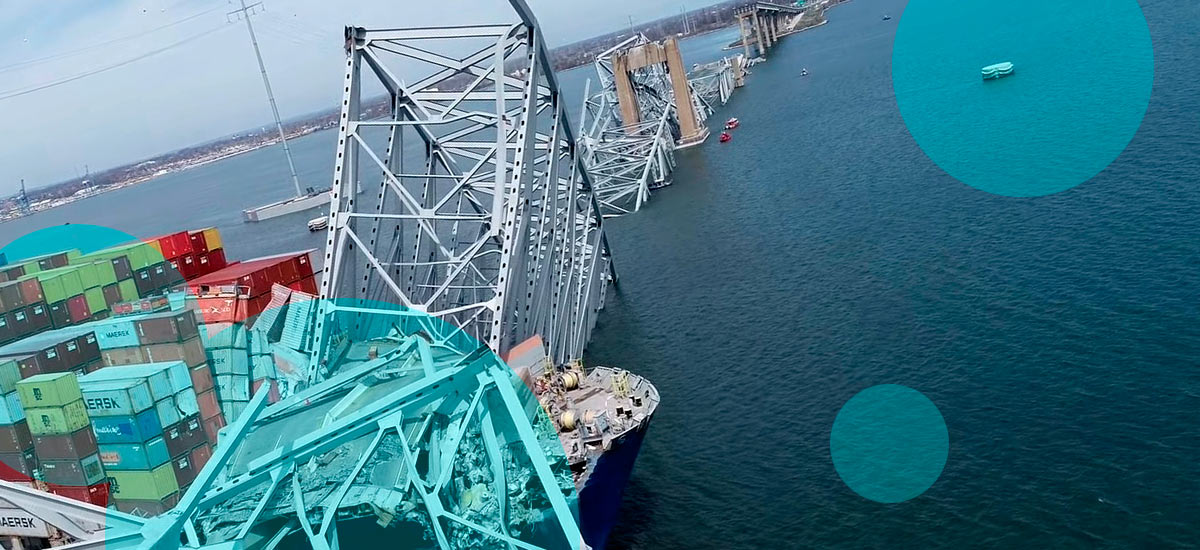
When the container vessel Dali struck the Francis Scott Key Bridge in Baltimore in March 2024, early market reserves sat at $1.5 bn. That figure became the working assumption across much of the marine and reinsurance market through 2024 and into 2025, shaping expectations before the January 1, 2026 renewals.
The loss picture has since changed sharply. Legal, salvage, liability, and reconstruction costs kept developing, and recent market disclosures now point to a total insured loss above $2.8 bn.
At that level, the Baltimore Bridge event becomes the largest single marine insurance loss ever recorded, surpassing the roughly $1.6 bn Costa Concordia insured loss from 2012.
That older loss had long served as the sector’s benchmark. Baltimore now resets it. The move from $1.5 bn to more than $2.8 bn surprised much of the market.
Hugo Chelton, managing director at Howden Re, said the late-Friday announcement gained traction quickly by Monday morning. He said a $1.3 bn deterioration would qualify as a major loss event on its own, even before adding it to what was already one of the largest marine losses in market history.
The main driver is the cost of replacing the Francis Scott Key Bridge. The settlement framework between the State of Maryland and Chubb, which insured the bridge, accounts for about $2.5 bn of the total loss.
Pollution liabilities, wreck removal, and lost toll revenues make up much of the remainder.
The International Group of P&I Clubs sits at the centre of the settlement. The group represents 13 mutual clubs that insure major marine liability risks.
Those clubs mutualise large claims through a pooling mechanism and a large excess-of-loss reinsurance programme, giving them the financial structure to respond to catastrophic losses of this size.
Because the International Group buys large reinsurance placements, Baltimore’s outcome moves well beyond the primary market. Reinsurers and retrocessionaires take the heavier load.
Most of the $2.8 bn loss will fall on reinsurance and retrocession markets. Some market participants initially expected the International Group’s full $3 bn reinsurance tower to be called.
Statutory limits on shipowner liability did not ultimately restrict the settlement in that way, but the deterioration still moves into higher layers.
Chelton said the loss becomes more concentrated as it grows. The deepest exposure sits with large reinsurers and the retro market. For some participants, measured against their own capital base, Baltimore will represent a significant single-event hit.
That concentration fits market expectations since 2024. Analysts had already flagged the Baltimore incident as a potential record P&I and marine reinsurance loss, even as legal and liability questions remained open.
According to Beinsure, the settlement will test marine liability pricing discipline, but it does not land in isolation. The same carriers writing marine liability also carry exposure to aviation leasing disputes, Middle East conflict losses, energy risk, terrorism, and peak natural catastrophe events.
Chelton said many of the same carriers exposed to marine liability also write hurricane risk. A $2.8 bn marine loss is material for the class, but reinsurers still compare it with potential $100 bn natural catastrophe events when they allocate capital.
Marine liability insurance and reinsurance rates are still expected to rise. Aviation leasing settlements across overlapping carrier panels add pressure, as do losses linked to the Middle East conflict.
Chelton said marine liability rates will increase, though whether that becomes a broader market correction remains less clear.
Capital remains the main counterweight. Across marine, energy, and terrorism, available capacity still exceeds demand. Several market estimates place available limit at several times the amount technically required for many large energy and infrastructure risks.
At the April 2026 renewals, pricing softened by as much as 15% to 20% in parts of the market despite ongoing losses. New entrants absorbed known exposures with limited adjustment, while fresh capital kept pressure on pricing.
Loss-affected carriers have reviewed appetite, but new capacity has continued to enter the market. That keeps negotiating power with buyers, at least for now.
Chelton said the market is reading mixed signals. Losses of this scale change thinking over time, and early signs of that shift are appearing. For clients, the issue is how to position before the turn, rather than scramble after it.