South Korean AI semiconductor startup FuriosaAI has raised $620 mn in Series D financing, reaching a post-money valuation of $2.9 bn as it expands production of its RNGD inference accelerators and seeks to compete with Nvidia in the AI infrastructure market.
The Seoul-based company secured KRW370 bn ($280 mn) from South Korea’s state-backed National Growth Fund, making it the largest investor in the round. International investors contributed another $110 mn, according to the company.
- FuriosaAI raised $620 mn in Series D financing at a $2.9 bn valuation, nearly quadrupling its valuation from July 2025.
- South Korea’s National Growth Fund committed KRW370 bn ($280 mn), supporting FuriosaAI’s expansion in the AI inference chip market.
- The company plans to produce 20,000 RNGD accelerators in 2026 and more than double production in 2027, while developing a third-generation 2nm chip with Broadcom.
The financing attracted demand from domestic and overseas investors, exceeding FuriosaAI’s initial fundraising target of KRW450 bn to KRW750 bn, Seoul Economic Daily reported.
The new valuation is nearly four times the $735 mn reported following FuriosaAI’s $125 mn Series C bridge financing in July 2025. Earlier that year, Bloomberg reported that the company had rejected an $800 mn acquisition offer from Meta Platforms, choosing to remain independent.
Founded in 2017, FuriosaAI develops processors designed specifically for artificial intelligence workloads. Its technology focuses on inference, the process of generating outputs from trained AI models, where electricity consumption and operating costs have become major considerations for data center operators.
The company is positioning its energy-efficient chip architecture as an alternative to Nvidia’s accelerators, which dominate the AI data center market.
“We see strong demand and opportunities as we are scaling our business globally,” chief executive June Paik told Bloomberg Television, citing customer engagement across the Asia-Pacific region and the Middle East.
South Korea backs FuriosaAI through its National Growth Fund
South Korea’s Financial Services Commission said the National Growth Fund’s management committee approved KRW370 bn in direct investment from its Advanced Strategic Industry Fund on May 28.
The commission cited FuriosaAI’s independent technological competitiveness and said the financing was intended to help the company overcome funding constraints and compete internationally without interruptions caused by insufficient capital.
FuriosaAI is the second company selected under South Korea’s “K-Nvidia” initiative, following domestic AI semiconductor developer Rebellions, according to TheElec.
Rebellions received KRW300 bn in policy financing in March, including KRW250 bn from the National Growth Fund. The company also announced a $400 mn financing round that month, valuing it at approximately $2.34 bn, Reuters reported.
The National Growth Fund forms part of a five-year, KRW150 tn government initiative designed to direct public financing and private investment, including household savings, into strategic industries such as artificial intelligence and semiconductors.
By late May, the fund had approved 16 projects totaling KRW12.5 tn. Around KRW2 tn of its direct investment allocation had been designated for AI developers and semiconductor companies, including FuriosaAI, Rebellions and Upstage.
Several other government-linked financial institutions participated in FuriosaAI’s Series D.
The Export-Import Bank of Korea selected FuriosaAI for its first direct investment in a startup since its establishment, Seoul Economic Daily reported. Existing shareholder Korea Development Bank contributed an additional KRW30 bn.
Other returning investors included Naver, DSC Investment, Nextrans and Kakao Investment.
FuriosaAI expands RNGD chip production to compete with Nvidia
FuriosaAI began mass production of its second-generation RNGD accelerator, pronounced “renegade”, in January 2026.
Taiwan Semiconductor Manufacturing Co (TSMC) is manufacturing 20,000 RNGD accelerators this year, with FuriosaAI targeting production of more than 40,000 units in 2027.
The company said it had already secured the necessary memory supplies and semiconductor fabrication capacity to support the planned increase.
RNGD is designed to reduce energy-intensive data movement during AI inference, an approach FuriosaAI expects will improve efficiency compared with conventional accelerator architectures.
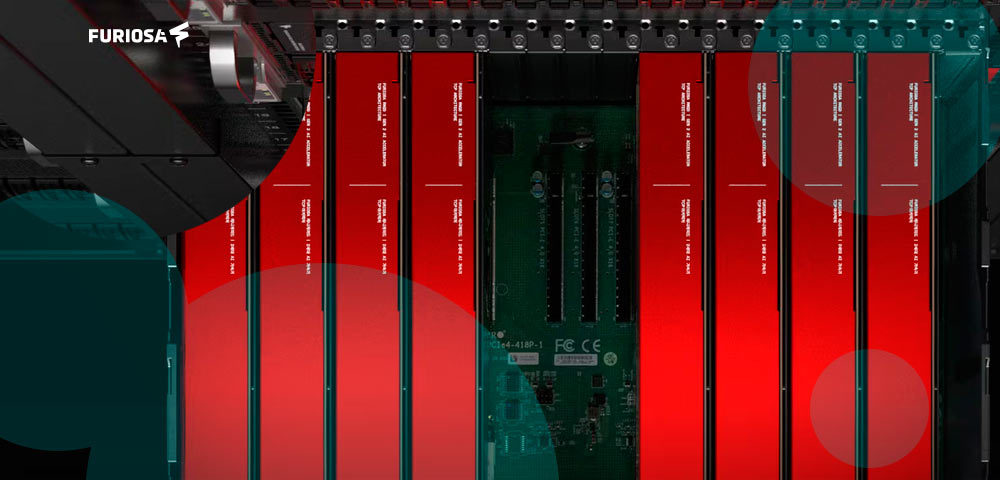
The processor is supplied as a 180-watt, air-cooled PCIe card. Eight accelerators can be combined in FuriosaAI’s NXT RNGD Server, which operates within a 3kW power envelope.
According to the company, the server can operate within existing enterprise racks and power budgets without requiring additional cooling infrastructure.
FuriosaAI claims RNGD can serve twice as many users per kilowatt as Nvidia’s RTX PRO 6000, although the comparison is based on the company’s own reported performance figures.
Energy efficiency has become an important purchasing consideration as demand for AI inference increases. Data center operators are seeking alternatives capable of processing growing workloads without proportionate increases in electricity consumption.
FuriosaAI has already secured several commercial deployments in South Korea.
- Samsung SDS has introduced an NPU-as-a-Service offering powered by RNGD, allowing customers to access AI accelerator capacity through its infrastructure.
- LG Group companies are deploying RNGD chips within their on-premises hybrid cloud environments. LG AI Research, Upstage and internet company Daum are also among the company’s reported deployment partners.
Paik said the latest financing demonstrated investor confidence in FuriosaAI’s technology and ability to execute its commercial plans. The additional capital will support international sales of RNGD and development of future products.
FuriosaAI develops third-generation 2nm AI accelerator with Broadcom
FuriosaAI is working with Broadcom and other technology partners on its third-generation accelerator, targeting large-scale AI infrastructure and advanced agentic AI workloads. The processor will use a 2nm multi-die architecture incorporating HBM4/4E high-bandwidth memory.
The design is intended for frontier AI models operating across large computing clusters, extending FuriosaAI’s product development beyond its current RNGD inference platform.
The company’s architecture seeks to minimise the movement of data between processing and memory components, which can account for a substantial portion of the energy consumed during AI computation.
FuriosaAI expects the new accelerator to support its expansion into larger deployments as enterprise customers and infrastructure providers seek more efficient hardware for advanced AI models.
International investors support FuriosaAI’s global expansion
The Series D attracted international investors including Infinitum Partners, Cisco Investments, Jericho Capital, Worldline Capital, Singapore-based QUDA Capital and Abu Dhabi-based NeoFort Holding.
Seoul Economic Daily reported that US investor Infinitum acquired the largest stake among the overseas participants. Infinitum also co-led AI chip developer Groq’s $650 mn financing round in June, according to the publication.
The participation of overseas investors gives FuriosaAI additional financial backing as it seeks customers beyond South Korea, particularly in North America, the Asia-Pacific region and the Middle East.
NAVER Ventures, an original seed investor in the company, identified North American expansion as a priority.
As a Silicon Valley-based investor, helping the company grow in North America is where we can add the most value.
Yong Jung Park, general partner at NAVER Ventures
The financing provides FuriosaAI with capital to increase RNGD production, expand international commercial operations and continue developing its third-generation accelerator. Its immediate manufacturing target is to more than double annual output in 2027, following the planned production of 20,000 chips in 2026.