Nasdaq-100 futures surged approximately 1.7% on November 11, 2026, recovering from Tuesday’s losses as stronger-than-expected CoreWeave earnings revived demand for artificial intelligence stocks.
Nasdaq futures gained around 470 points in early trading, while S&P 500 futures advanced 0.7%. Dow Jones futures were little changed.
The rebound followed a difficult session for US equities. On November 10, the Nasdaq Composite fell 0.74% to 25,065.87, the S&P 500 declined 0.38% to 7,520.93, and the Dow Jones Industrial Average lost 0.30% to 52,231.89.
- Nasdaq-100 futures surged 1.7% on November 11 as CoreWeave reported record Q3 revenue of $3.66 bn, up 168% year over year, and raised its 2026 revenue forecast to $13 bn–$13.3 bn.
- US inflation exceeded expectations, with headline CPI rising 0.4% and core CPI increasing 0.3% in October. Markets expect a December Fed rate hike, with growing concerns about a possible 50-basis-point increase.
- Goldman Sachs sees semiconductor stocks as oversold, while JPMorgan and Morgan Stanley remain constructive on the broader market. The Nasdaq-100 base-case forecast is 27,500–28,500, with potential upside toward 29,000.
The market remains divided between strong AI infrastructure demand and expectations of further Federal Reserve interest rate increases following October’s hotter-than-expected inflation report (see Stock Market Return Forecast: Fidelity and Vanguard Predict Slower Growth).
Nasdaq Futures Rise as CoreWeave Reports Record Revenue
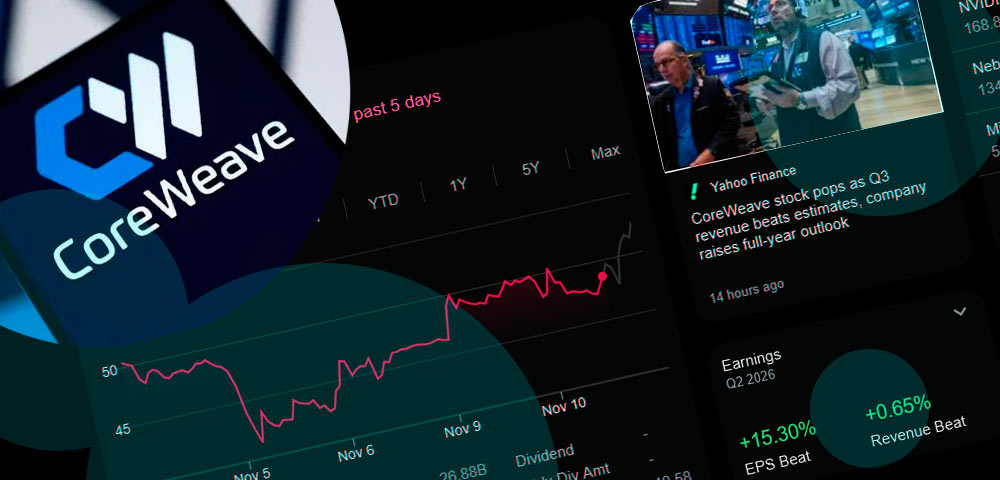
CoreWeave (NASDAQ: CRWV) emerged as the main catalyst for Wednesday’s technology rebound after reporting third-quarter revenue of $3.66 bn, up 168% year over year.
The company raised its full-year 2026 revenue guidance to $13 bn–$13.3 bn and projected annualized revenue of $20 bn–$21 bn by year-end.
CoreWeave also increased its adjusted operating income forecast to $1.275 bn–$1.375 bn and expects capital expenditure of $37 bn–$39 bn.
Shares advanced more than 10% in premarket trading after management outlined its financing strategy and indicated that adjusted profitability could be achieved in the first half of 2028.
However, financing costs remain substantial. CoreWeave recorded a $709 mn quarterly net loss and $846 mn in net interest expenses.
The results demonstrate that AI computing demand remains strong, although the infrastructure required to support that growth continues to demand significant capital.
CoreWeave’s performance also lifted semiconductor stocks. Micron and Marvell Technology gained nearly 7% in early trading, while NVIDIA rebounded approximately 4% following two consecutive sessions of heavy losses.
Goldman Sachs Sees Semiconductor Stocks as Oversold
Goldman Sachs considers semiconductor shares oversold following the recent correction, which saw the Philadelphia Semiconductor Index lose more than 20% over the past month. Dow, S&P 500 and Nasdaq mixed ahead of CPI as investment banks assess Fed Rate hikes.
The bank remains constructive on the longer-term earnings outlook for AI infrastructure suppliers despite concerns about valuations and capital expenditure.
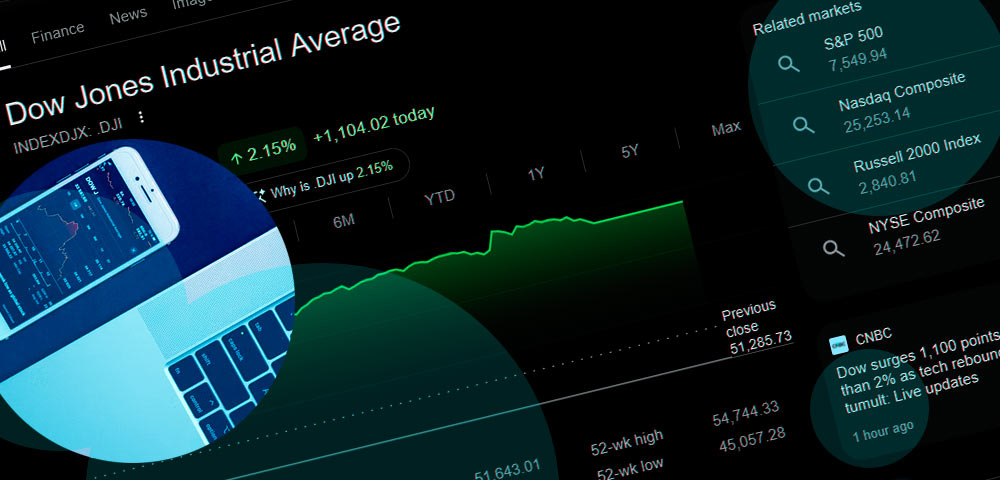
Goldman Sachs maintains an S&P 500 forecast of 8,000 for year-end 2026 and 8,700 over a 12-month horizon. The Dow Jones Industrial Average surged 1,104 points, supported by falling oil prices and gains in industrial and technology stocks.
JPMorgan also expects the broader US market to reach 8,000 by the end of 2026. Its positive outlook for semiconductors reflects continued earnings growth, strong demand for advanced chips and supply constraints extending into 2027.
Morgan Stanley believes the wider equity correction is approaching its final stages, although another test of recent lows remains possible. The bank sees opportunities in semiconductor companies whose valuations have declined significantly without a comparable deterioration in earnings expectations.
Bank of America expects improving policy clarity and corporate earnings to support a potential semiconductor recovery in early 2027. It continues to identify NVIDIA, AMD and Broadcom among the major beneficiaries of AI infrastructure investment.
Citigroup is more cautious, having moved its assessment of US and global technology stocks to neutral because of positioning risks and the possibility of additional selling.
These investment bank forecasts are primarily sector assessments and broader equity-market targets, not direct Nasdaq-100 futures price targets.
US Inflation Raises Risks for Nasdaq Futures
October’s Consumer Price Index increased 0.4% month over month, exceeding expectations of 0.3%. Core inflation also surprised to the upside, rising 0.3% against forecasts of 0.2%. The report strengthened expectations that the Federal Reserve will raise interest rates at its December meeting.
Markets now price an approximately 90% probability of a 25-basis-point increase, alongside a smaller probability of a 50-basis-point move.
The two-year Treasury yield surged nearly 19 basis points to 4.736% on Tuesday, reflecting expectations of tighter monetary policy.
Higher yields create particular pressure on Nasdaq valuations because technology companies derive a significant portion of their market value from expected future earnings.
The latest inflation data also complicates the outlook for debt-financed AI infrastructure projects, where higher borrowing costs can weaken investment returns.
Anthropic IPO Adds Another Test for AI Stock Valuations
Investor attention is also shifting toward Anthropic’s planned initial public offering.
The AI developer is reportedly targeting a capital raise of up to $64.4 bn, with discussions around a valuation of $1.4 tn or higher.
A successful listing could demonstrate continued institutional demand for AI businesses despite recent market volatility. However, the IPO would also introduce another major investment opportunity competing for capital allocated to existing technology stocks.
Its valuation could influence how investors assess future revenue growth, infrastructure spending and profitability across the AI industry.
Nasdaq-100 Futures Forecast for November 2026
The Nasdaq-100’s near-term direction depends on whether recovering AI earnings expectations can offset tighter financial conditions.
Three scenarios remain relevant:
| Scenario | Nasdaq-100 outlook | Main drivers |
|---|---|---|
| Bullish | Recovery toward 28,500–29,000 | Strong AI earnings, renewed semiconductor buying and stable yields |
| Base case | Consolidation around 27,500–28,500 | Resilient technology demand offset by restrictive monetary policy |
| Bearish | Decline toward 27,000 | Higher Treasury yields, AI earnings downgrades and renewed selling |
These are independent short-term analytical scenarios, not price targets issued by investment banks.
The immediate technical test is whether Nasdaq-100 futures can sustain trading above 28,000 following Wednesday’s rebound.
A sustained advance through 28,500 would improve the short-term outlook and suggest that investors are rebuilding technology exposure after last week’s correction.
Conversely, a decline below 27,500 would indicate that the recovery remains vulnerable to renewed selling.
Nasdaq Futures Outlook for 2027
The medium-term outlook remains supported by demand for AI computing, cloud infrastructure and advanced semiconductors.
CoreWeave’s latest earnings reinforce the view that customers continue investing heavily in computing capacity despite rising financing costs.
Nevertheless, strong revenue growth does not automatically justify higher stock valuations. Investors are increasingly examining debt, cash flow, capital expenditure and the timing of profitability.
Goldman Sachs, JPMorgan and Morgan Stanley remain broadly constructive on the earnings outlook, while Citigroup’s cautious positioning highlights the risk of further valuation adjustments.
The next decisive developments will be NVIDIA’s upcoming earnings, additional AI infrastructure spending forecasts and the Federal Reserve’s December policy decision.
For now, Nasdaq futures are recovering on stronger corporate fundamentals, but sustained gains will depend on whether earnings growth can outweigh the impact of higher interest rates.