Follow Beinsure

- AI spending and disappointing earnings trigger October’s technology selloff
- Goldman Sachs warns AI investment could reach $1.2 tn in 2027
- Morgan Stanley forecasts further S&P 500 downside before recovery
- JPMorgan sees strong earnings growth but rising financial risks
- Citigroup and RBC Capital Markets reduce technology exposure
- Strong corporate profits provide an important counterweight
- Federal Reserve policy adds pressure to technology valuations
- Apple earnings, US midterms and jobs data will test the market
US stocks ended October with their sharpest technology-led selloff in months, as disappointing corporate guidance, rising artificial intelligence investment costs and tighter financial conditions forced Wall Street to reassess the outlook for 2027.
- The Nasdaq Composite fell 2.86% on October 30, closing at 25,437.00, while the S&P 500 lost 1.82% to 7,580.07.
- The Dow Jones Industrial Average declined 1.09% to 51,770.31.
- For October, the Nasdaq dropped 5.3%, its worst monthly performance since March 2025, compared with a 0.9% decline for the S&P 500 and a 1.7% gain for the Dow.
Investment banks remain divided over what comes next. Morgan Stanley sees the possibility of another 5-6% decline in the S&P 500 before the correction ends. Goldman Sachs and JPMorgan maintain year-end targets of 8,000, while Citigroup and RBC Capital Markets have adopted more cautious positioning as investors rotate away from expensive technology stocks.
The central concern is no longer whether demand for AI infrastructure exists. It is whether the companies financing that infrastructure can generate sufficient returns to justify their spending.
AI spending and disappointing earnings trigger October’s technology selloff
The latest decline followed quarterly results from Alphabet, Amazon and Intel, which exposed different weaknesses across the technology sector.
Alphabet suffered its worst weekly performance since 2011 after third-quarter revenue missed expectations and free cash flow turned negative by approximately $9 bn. The company also indicated that investment in AI infrastructure would continue rising in 2027.
Amazon reported adjusted earnings below expectations and negative trailing 12-month free cash flow of $42.4 bn. Its capital expenditure forecast remains approximately $220 bn for 2026, with management expecting significantly higher spending next year.
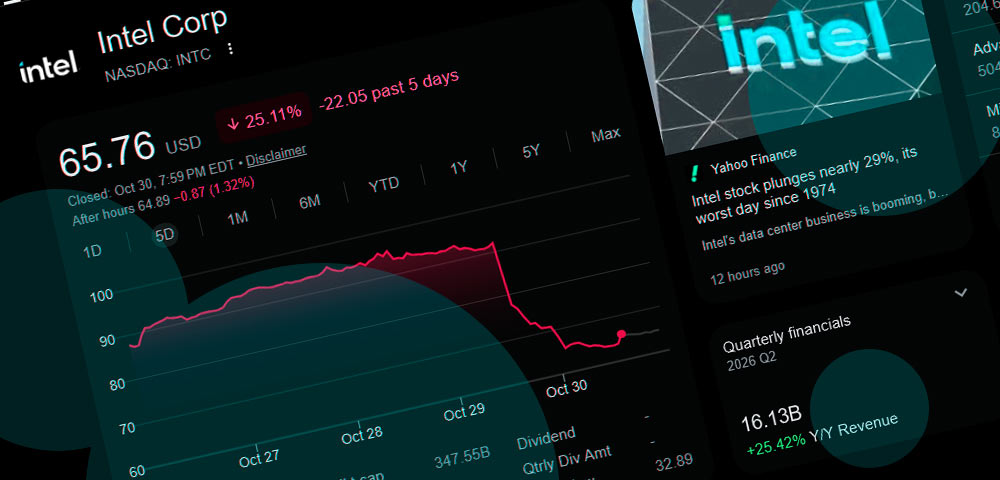
Intel delivered one of the most dramatic reactions. Shares plunged 28.6% on October 30, their second-largest daily decline in trading data extending back to 1973. The company forecast fourth-quarter revenue of $15 bn–$16 bn, substantially below Wall Street’s estimate of approximately $17.1 bn.
Intel’s data center and AI revenue rose 78% to $7.3 bn in the third quarter. However, the company faces weakening PC demand, production constraints and continued challenges in its foundry operations.
Bank of America analyst Vivek Arya downgraded Intel from Buy to Neutral and reduced his price target from $145 to $100. The bank argued that growing demand for server processors linked to agentic AI is insufficient to offset near-term weakness in PCs and supply constraints.
The selling spread across semiconductor manufacturers. AMD lost nearly 11% on Friday, while Nvidia fell about 4% and Broadcom declined approximately 5%.
These declines reflect a broader change in market expectations: investors are increasingly distinguishing between companies benefiting from AI infrastructure spending and those capable of converting that investment into sustainable profits.
Goldman Sachs warns AI investment could reach $1.2 tn in 2027
Goldman Sachs Research estimates that global AI investment will exceed $1 tn in 2026, including more than $580 bn in the United States. Its latest analysis projects that capital spending by major hyperscalers could reach $1.2 tn in 2027 and $1.4 trillion in 2028.
According to Goldman Sachs, AI-related investment accounts for almost half of the S&P 500’s expected earnings-per-share growth in 2026.
This creates a potential vulnerability. Technology companies are spending heavily on data centers, networking equipment, semiconductors and electricity infrastructure before the full financial returns from those investments become visible.
Higher borrowing costs and accelerating depreciation expenses could weaken future profitability even if demand for computing capacity remains strong.
Goldman’s analysis suggests that AI investment could shift from supporting S&P 500 earnings growth in 2026 to becoming a marginal drag by 2028.
The implications extend beyond large technology companies. Data center developers, cloud infrastructure providers and businesses financing projects through debt markets face increasing pressure to demonstrate predictable cash flow.
The latest market correction therefore represents a reassessment of capital efficiency across the AI ecosystem, rather than evidence that demand for artificial intelligence has disappeared.
Morgan Stanley forecasts further S&P 500 downside before recovery
Morgan Stanley’s chief US equity strategist Mike Wilson believes the market correction is approaching its final stages, but he does not expect a smooth recovery.
In his October 26 assessment, Wilson identified the 7,100–7,200 range as a potential support area for the S&P 500. That would represent a further decline of approximately 5%–6% from the October 30 closing level of 7,580.07.
Wilson also warned that semiconductor stocks could decline another 10%–15% by mid-November as investors reassess AI financing and demand.
Morgan Stanley notes that approximately 60% of Russell 3000 stocks have already fallen more than 20% from their June levels. That suggests much of the market has undergone a substantial correction even while major indexes remained relatively resilient.
Despite the near-term risks, Morgan Stanley retains its 8,000 year-end S&P 500 forecast. Wilson views additional weakness as a possible opportunity to increase exposure to higher-quality companies.
JPMorgan sees strong earnings growth but rising financial risks
J.P. Morgan Asset Management remains constructive on corporate earnings but is considerably more cautious about prospective market returns.
In its fourth-quarter 2026 Global Equity Views, the investment manager forecast approximately 27% growth in US operating profits this year, excluding valuation gains on private technology investments.
Its global outlook anticipates earnings growth approaching 30% in 2026 and approximately 20% in 2027.
However, JPMorgan’s equity team has shifted toward a more neutral assessment of market returns.
The reason is the growing difference between corporate earnings growth and the financial risks associated with generating those earnings.
According to JPMorgan, hyperscalers are increasingly accessing debt markets as investment spending exceeds internally generated cash flow.
The firm is particularly concerned about companies operating AI infrastructure with high leverage and limited financial flexibility.
JPMorgan therefore favors diversification and higher-quality businesses rather than indiscriminate exposure to AI-related shares. Its analysis indicates that strong profits can sustain the broader bull market even while individual companies experience substantial valuation declines.
Citigroup and RBC Capital Markets reduce technology exposure
Not every investment bank is waiting for earnings growth to restore confidence.
Citigroup reduced its tactical exposure to US equities on October 13, removing its overweight recommendation and closing a long position in the equal-weighted S&P 500.
The decision reflected concerns about stretched investor positioning, elevated optimism and deteriorating risk-reward conditions.
The move preceded the latest decline and does not necessarily represent a change to Citigroup’s previously published 8,100 year-end index target.
RBC Capital Markets also adjusted its sector allocations ahead of the selloff.
On October 14, chief US equity strategist Lori Calvasina downgraded technology from overweight to market weight and upgraded healthcare from market weight to overweight.
The subsequent market performance reinforced the importance of sector selection. Healthcare substantially outperformed the S&P 500 during October, while technology and communication services came under sustained selling pressure.
Energy also attracted investors seeking exposure to companies benefiting from higher oil prices. ExxonMobil and Chevron advanced on Friday following stronger earnings supported by refining margins.
The divergence suggests that investors are reallocating capital within the US equity market rather than withdrawing uniformly from stocks.
Strong corporate profits provide an important counterweight
The latest earnings data indicate that the broader market’s fundamentals remain relatively strong.
According to FactSet’s October 30 earnings analysis, 60% of S&P 500 companies have reported third-quarter results. Of those companies, 82% exceeded analysts’ earnings estimates, compared with a five-year average of 78%.
Blended earnings growth for the quarter stands at 30.2%, while revenue growth is estimated at 13.4%.
There is an important qualification: companies have exceeded earnings estimates by only 1.9% in aggregate, well below the five-year average surprise of 7.5%.
FactSet also places the S&P 500’s forward 12-month price-to-earnings ratio at 18.7, below its five-year average of 19.8.
This helps explain why investment banks have not abandoned their positive earnings forecasts. Nevertheless, forward valuations depend on analysts’ projections being achieved. If borrowing costs remain elevated or AI investment generates weaker returns, those expectations may require downward revisions.
Federal Reserve policy adds pressure to technology valuations
The Federal Reserve left its benchmark interest rate unchanged at 3.75%–4.00% on October 28 in a 10–2 decision.
Chair Kevin Warsh declined to provide a firm commitment regarding the December meeting.
The decision followed economic figures indicating that US GDP expanded at a 3.4% annualized rate in the third quarter, while annual PCE inflation reached 3.6% in September.
Stronger economic activity supports corporate revenue, but persistent inflation limits the Federal Reserve’s ability to ease financial conditions.
Interest-rate futures suggest approximately a 75% probability of another rate increase in December.
For technology stocks, tighter policy affects valuations through two channels: a higher discount rate reduces the present value of expected future profits, while more expensive financing weakens returns on debt-funded infrastructure projects.
That combination is particularly challenging for companies whose investment plans require several years before generating positive cash flow.
Apple earnings, US midterms and jobs data will test the market
The first week of November offers several immediate catalysts.
Apple’s results will be particularly important because the company’s shares have held up better than many large technology peers, making its outlook a test of whether investors continue to favor comparatively less capital-intensive technology businesses.
AMD and Super Micro Computer report on Tuesday, November 3, the same day as the US midterm elections.
Qualcomm and Arm Holdings follow on Wednesday, November 4, providing additional information about semiconductor demand and the smartphone market.
The week concludes with the US employment report on Friday, November 6. Economists expect approximately 60,000 new jobs in October, following an increase of 29,000 in September.
A weaker labor market could reduce expectations for another Federal Reserve rate increase. Conversely, unexpectedly strong employment or persistent wage inflation could reinforce concerns that interest rates will remain elevated.
For November, the most important market indicators will be AI capital expenditure guidance, credit spreads, corporate cash flow and the relationship between earnings growth and valuations.
Wall Street’s forecasts suggest that the October selloff has not eliminated the possibility of a year-end recovery. The disagreement is over how much further prices may fall before investors become comfortable financing the next stage of the AI expansion.