Follow Beinsure
- Meta Q3 2026 earnings beat revenue expectations
- Meta plans up to $95 bn in equity financing
- Meta’s planned stock split and Class C shares
- AI capital expenditure pressures Meta’s free cash flow
- Meta’s Muse AI agent offers another revenue opportunity
- Meta stock price forecast: analysts see potential recovery
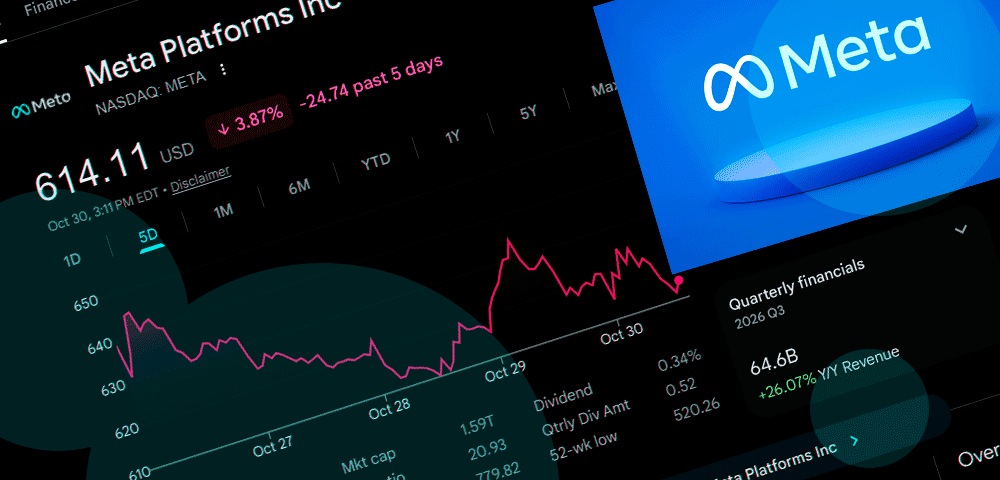
Meta Platforms (NASDAQ: META) shares remained under pressure on October 30, 2026, as investors weighed strong advertising growth against rising artificial intelligence spending, legal expenses and the company’s plans to issue new equity.
The stock traded around $612.41 during Friday’s session, extending its decline following Meta’s third-quarter earnings and October 26 financing announcement.
- Meta Platforms shares traded near $612 on October 30, while the 24/7 Wall St. model projects a 12-month price target of $804.16.
- Q3 revenue increased 26% to $64.6 bn, exceeding expectations, but a $9.89 bn legal charge and negative free cash flow weighed on earnings.
- Meta announced a major equity financing plan to support AI infrastructure, including a proposed $60 bn share-sale programme that could increase shareholder dilution.
The 24/7 Wall St. valuation model assigns Meta a 12-month price target of $804.16, implying approximately 31% upside from that trading price. The model maintains a Buy recommendation.
A separate TipRanks consensus of 44 analysts places the average price target at $852.31, although those forecasts may be revised following Meta’s latest earnings and financing announcements.
Meta Q3 2026 earnings beat revenue expectations
Meta reported third-quarter revenue of $64.60 bn, an increase of 26.1% year over year and above Wall Street expectations of $63.39 bn. Advertising remained the company’s primary growth driver.
The average price per advertisement increased 14%, while advertising impressions rose 10%. Total advertising revenue reached approximately $63.1 bn, up 26% from the previous year.
However, reported earnings were affected by a substantial legal expense.
| Financial metric | Q3 2026 |
|---|---|
| Revenue | $64.60 bn |
| Revenue growth | +26.1% |
| GAAP earnings per share | $3.83 |
| EPS excluding legal charge | $7.40 |
| Legal settlement charge | $9.89 bn |
| Capital expenditure | $34.91 bn |
| Free cash flow | -$2.12 bn |
The $9.89 bn charge related to a settlement with US state attorneys general over claims involving teenage mental health. Excluding that expense, earnings per share would have reached approximately $7.40.
Operating margin declined to around 20%, reflecting the legal charge and higher spending. Despite strong revenue growth, free cash flow turned negative as investment in AI infrastructure increased sharply.
Meta plans up to $95 bn in equity financing
Meta announced a major financing initiative on October 26 to support its expanding AI infrastructure programme.
The initial transaction included common and preferred equity offerings, with the company subsequently pricing approximately $25 bn in Class A shares and $12.5 bn in mandatory convertible preferred securities.
Meta also outlined plans for a separate at-the-market programme allowing it to sell up to $60 bn in new nonvoting Class C shares.
That programme has not yet been established, and the full $60 bn represents potential future issuance rather than capital already raised. The preferred securities carry a 6.5% annual dividend and are expected to convert into Meta shares in August 2029.
Meta’s common stock financing involves 40 mn Class A shares priced at $625 each. Together with the shares potentially issued through preferred stock conversion, the initial financing could increase the company’s share count by approximately 2.2%–2.3%.
Further issuance under the proposed $60 bn programme would create additional dilution.
Meta’s planned stock split and Class C shares
Meta also announced plans to distribute one nonvoting Class C share for each existing share held by investors.
The distribution is expected to have an effect similar to a 2-for-1 stock split, with trading in the new shares anticipated in early 2027. Unlike an ordinary stock split, the new Class C shares will not carry voting rights.
The structure would allow Meta to raise additional equity while preserving Mark Zuckerberg’s existing voting control.
The stock dividend itself does not reduce shareholders’ proportional economic ownership. Dilution would arise from subsequent sales of additional shares to investors.
Existing analyst price targets would also require adjustment to reflect the new share structure once implemented.
AI capital expenditure pressures Meta’s free cash flow
Meta expects capital expenditure of $135 bn to $145 bn in 2026. Third-quarter spending reached approximately $34.9 bn, an increase of more than 85% year over year.
The company generated approximately $97 bn in operating cash flow during the first nine months of 2026. However, the scale of infrastructure investment has placed considerable pressure on free cash flow.
At September 30, Meta held approximately $82.4 bn in cash and marketable securities against $83.7 bn in total debt.
Management expects infrastructure requirements to remain substantial as it expands AI computing capacity and develops new products.
The financing programme reduces the need to rely exclusively on additional borrowing, but investors must consider the potential effect of higher share counts on future earnings per share.
Meta’s Muse AI agent offers another revenue opportunity
Meta’s long-term growth strategy extends beyond its established advertising business.
The company’s Muse personal AI agent attracted more than 10 mn users in the United States and Canada within six weeks of launch.
Approximately 25% of those users engage with the service on a given day. Management plans to monetise Muse through commerce commissions, subscriptions and enterprise services. Meta could also distribute AI-powered tools through its existing business ecosystem, which serves hundreds of millions of companies.
However, these potential revenue streams remain at an early stage. Their contribution to future profitability will depend on user adoption, commercial demand and operating costs.
Meta stock price forecast: analysts see potential recovery
Despite the recent selloff, analyst sentiment toward Meta remains predominantly positive.
According to the supplied TipRanks consensus, 38 of 44 analysts rate the shares Buy, with no Sell recommendations.
| Forecast | Price target | Potential return from $612.41 |
|---|---|---|
| Lowest analyst target | $580 | -5.3% |
| 24/7 Wall St. model | $804.16 | +31.3% |
| Average analyst target | $852.31 | +39.2% |
The targets reflect assessments made before or around the latest financing developments and are not guarantees of future returns.
The bullish outlook assumes that Meta can sustain advertising growth while generating meaningful returns from AI infrastructure investment.
The bearish case centres on rising capital requirements, weaker free cash flow, future dilution and uncertainty over the profitability of newer AI products.
Meta’s core advertising business continues to deliver strong growth, supported by higher ad prices and expanding impressions. However, the company must demonstrate that its AI investments can eventually generate returns sufficient to offset the cost of additional infrastructure and financing.
The next major factors influencing META shares will be changes in capital expenditure expectations, free cash flow performance, the scale of future equity issuance and evidence that AI products such as Muse can generate profitable revenue.